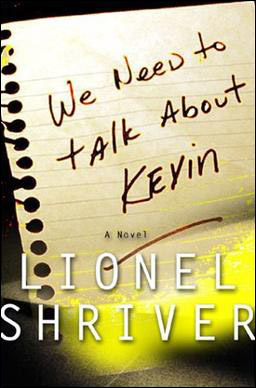
I am late to the party when it comes to this book — it was published over twenty years ago in 2003. I had not read it, nor seen its acclaimed movie adaptation in 2011 starring Tilda Swinton. It recently came to my radar when it was included in the list, “The 50 Best Thrillers of the 21st Century,” put out by the New York Times a couple of months ago. (See https://www.nytimes.com/interactive/2026/books/best-thriller-books-21st-century.html.) Thrillers is one of my favorite book genres, and I was not surprised to find that I had read most of the books on this list. One notable exception was We Need to Talk About Kevin, which is, in fact, as high up as #14 on the list! Now that I have finished reading it, I am wondering how I missed it — it is so good!
The protagonist of the book is a middle-aged woman who finds herself suddenly plunged into what must be one of the most hellish places imaginable, and one that she is condemned to live in for the rest of her life — she becomes the mother of a “school shooter.” The woman is Eva Khatchadourian, an American woman of Armenian descent, whose son, Kevin, goes on a shooting rampage at his school when he is just short of 16 years old, killing several students, a teacher, and a cafeteria worker who happened to be in the school gym where he executed his meticulously planned attack. Kevin displayed disturbing psychopathic tendencies right from when he was a child, but he was also very crafty and was able to hide them from everyone, including his own father. The only person who saw right through him was Eva, but she didn’t raise the alarm as she thought it was her failure to bond with Kevin when he was born and her lack of a maternal instinct that was mostly to blame for how he was. Also, while she suspected that he was responsible for the accidental injuries sustained by some of the kids around him — including his own younger sister, who actually lost one of her eyes in one of these so-called “accidents” — Eva never imagined that he would ever kill anyone, let alone carry out a massacre in which eleven people lost their lives.
Because Kevin was not yet 16, he was tried as a minor — he had timed the shooting precisely at that age, having educated himself on how the legal system works — and received a relatively light sentence of only seven years. One of the key arguments his lawyer made in his defense — again, after being “coached” on this by Kevin — was that he had recently started taking Prozac for depression and anxiety, which had caused his psychotic breakdown. (Kevin had arranged for a disturbing incident at his school a few months prior to the shooting — he accused a teacher of sexual assault — which had allowed him to get a prescription for Prozac.)
We Need to Talk about Kevin is narrated entirely in the form of letters that Eva is writing to her husband Franklin, Kevin’s dad, close to two years after the shooting. It is not clear at the start why she is writing to Franklin, except that she does not live with him anymore. She is no longer a high-flying, well-travelled, career woman running her own successful company as she was before; instead, she is now working in a run-of-the-mill job and living by herself in a rundown rental apartment. She was pretty much bankrupted — losing her company as well as the family home — not just by the legal fees for the criminal trial but also by a civil lawsuit that was brought against her by the mother of one of the students Kevin killed. The only thing that Eva now does religiously — the reason for which is unfathomable even to her except for perhaps giving her a reason to continue living — is visiting Kevin in prison every two weeks or so, whenever visitors are allowed.
Eva’s letters to Franklin provide a detailed account of the complete sequence of events that led up to the shooting, starting from when she and Franklin were a gloriously happy and very-much-in-love married couple leading a wonderfully carefree and child-free life in New York City, all the way to that fateful day when Kevin executed his massacre. We learn about Eva’s ambivalent attitude to the idea of parenthood, her reluctant acquiescence to have a child in order to give her husband something he desperately wanted, her journey throughout pregnancy and (a very difficult) labor, Kevin’s absolute refusal to breastfeed or bond with her in any way after he was born, and his continued tormenting of her throughout his childhood and teenage years. While Kevin cannot hide his sociopathic tendencies entirely from some of the other people he has to engage with — such as his nannies as an infant, his fellow students and teachers at school, and his neighbors where he lives — he is able to hide them completely from Franklin. In fact, he goes out of his way to always play the doting son who hero-worships his dad, as a result of which Franklin is completely clueless about Kevin’s real nature.
It might be surprising that Eva continues to stay married to Franklin despite their diametrically opposite views about Kevin and their interactions with him. She also had to scale back her career significantly to provide childcare for Kevin when he was little — he was able to drive all his nannies away even at that age! — in addition to giving up living in New York City and moving to the suburbs. But she stays in the marriage because she loves Franklin and does not want to be forced to leave him because of Kevin. She does, however, do something to balance out the family dynamic of her versus Franklin and Kevin — she gets pregnant again, despite Franklin’s opposition to the idea. Her daughter, Celia, is mercifully the exact opposite of Kevin — loving, trusting, obedient, very easy to parent. Mothering Celia allows Eva to dwell less on Kevin and her general uneasiness with him as he grows into a teen. That, as it turns out, would be fatal.
In Eva’s letters, there is no mention of Celia living with her, but a passing reference to her being with Franklin. It is not difficult to guess what happens to Franklin and Celia when Kevin carries out his massacre.
I should also add that Eva’s letters to Franklin — which constitute the entirety of the book — are written in a highly erudite voice rather than a more casual tone. They are filled with critical observations and reflections, not just about the intricate details of her life and all the ways in which she was tormented mercilessly by Kevin, but also about society and politics in general, making We Need to Talk About Kevin quite a dense book. In fact, each letter that Eva writes is a carefully crafted missive in his own right that takes time to read and appreciate. I must admit that I almost gave up on the book half-way and searched for the plot online — but much to my amazement, even after knowing how the book ends, I went back to it, right where I had left off, and continued reading. I found that I could now appreciate the writing so much more, since I knew the ending. In fact, I went back and re-read the whole book after I had finished it — it was so well-written. The author is absolutely brilliant.
She even manages to find a way to end the novel in a heart-warming way, which I never thought would be possible for such a dark story!
We Need to Talk About Kevin
Author: Lionel Shriver
Publisher: Counterpoint Press
Publication Date: April 2003
Contributor: Lachmi Khemlani is a fan of the written word.