“What Does It all Mean?” by Thomas Nagel

what-does-it-all-mean

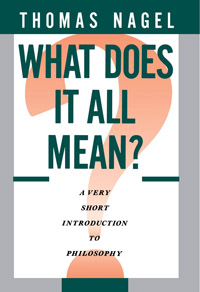
This brief book, which intends to provide a very short introduction to philosophy, ends with a chapter on The Meaning of Life and concludes with the sentence, “Life may be not only meaningless but absurd.” This will surely be off-putting to most people, who just cannot imagine the possibility that life as a whole, and their lives in particular, might not have a meaning. If so, why bother to live? What’s the point? A possible answer to this, according to Nagel, is, “There’s no point. It wouldn’t matter if I didn’t exist at all, or if I didn’t care about anything at all. But I do. That’s all there is to it.”

At the outset, I must say that this book is not for anyone who is religious and believes that all philosophical questions are answered by God, that God provides meaning to our lives, that we have souls that are immortal, that there is a heaven to which souls go to after they leave their physical bodies, that we are just instruments in God’s hands, that he is looking out for us, and that our lives have a higher purpose which comes from God. This kind of faith can provide an enormous amount of emotional support throughout life’s trials and tribulations, and people who have this faith are to be envied, but sadly, you cannot force yourself to believe in God any more than you can force yourself to like something you don’t.

Having recently lost someone very dear to me, I skipped to the chapter on Death. So much of what Nagel captures in this chapter resonated with me, especially the idea that there really is no reason to be afraid of death since we did not exist before we were born and will similarly cease to exist after we are dead. So why is non-existence scary? I had prided myself on having this brilliant insight long before I read this book, and while my “delusions of grandeur” have been deflated, I am gratified to see that this idea has also been recognized by others, as was evidenced in this book. Nagel, in particular, captures it very eloquently. Of course, he is talking about how people feel about their own death rather than how people feel about the death of their loved ones. Grief is a part of human make-up, and it would have been helpful to understand what philosophy has to say about it.

I did not find all the chapters as brilliant and compelling as Death and The Meaning of Life. For instance, there is a chapter on Free Will which sort of drags on, is very abstract, does not have any specific conclusion, and on the whole was not particularly insightful. Others in the same vein were the earlier chapters in the book on subjects such as knowledge and knowing, what words mean, and the connection between the body and the mind. On the other hand, the chapter on Free Will provides a good segway into discussing moral questions of Right and Wrong and Justice. If there’s so much in our lives that we cannot control (and some would argue that our sense of controlling anything whatsoever is a complete illusion), does it make sense to talk about morality and punish those who are “immoral”? It’s an ethical dilemma society as a whole has to deal with. There are no easy answers to any of these questions.

What Does It All Mean? is definitely a book that makes us think, and if we are open, to make us question the many assumptions we have about life in general, and our lives in particular.

What Does It All Mean? A Very Short Introduction to Philosophy
Author: Thomas Nagel
Publisher: Oxford University Press
Publication Date: 1987

Contributor: Lachmi Khemlani runs a technology publication in the San Francisco Bay Area.

“Empires of the Indus: The Story of a River” by Alice Albinia

empires-of-the-indus

This first book by a young author made me feel thoroughly ashamed of my ignorance of history. A splendid piece of meticulous research, it ought to be read by every Indian and Pakistani, not to mentions Afghans, Tibetans, and others. The author traces the path and history of the mighty Indus River in an altogether novel narrative, and portrays the lives and aspirations of the peoples who inhabited the lands surrounding it. The book is at once a delightful travelogue, and a superb historical narrative spanning thousands of years. It is serious, yet entertaining, cerebral but not incomprehensible.

Consider these snippets of information:

  1. Islam had a complex relationship with slavery. As in the Bible, slaves were an important part of the Quran’s social system. Mohammed himself sold the Jewish women of Medina into slavery – and the Quran, which has a rule for everything, scripted a strict code regarding their treatment. Slaves were not objects but human beings and they were to be considered a part of the family.
  2. The 10th century Baghdad Caliph had 7000 black eunuchs (and 4000 white ones).
  3. As Islam’s reach into Africa deepened, and the number of black slaves being exported to Arabia increased, so did Arab racism about Africans. Some historians trace this to the revolt by black slaves working in the mines and plantations of Mesopotamia in 883CE.
  4. Arabs imported/exported 2 million sub-Saharan slaves between 900 and 1100.
  5. When the first Muslim-Arab army arrived on the shores of Sind in 711CE, it arrived with plenty of African slaves.
  6. In 1240 Razia Sultan was deposed for having an affair with her Abyssinian (Ethiopian) slave minister Jamaluddin Yaqut, though Razia herself belonged to the ‘Slave Dynasty’ which was of Turkish origin.

All this has to do with slavery but that’s not what the book is about. There’s lots of information about many things, people and events. There are profound sentiments and an overall sense of pathos. The unstated is as powerful as the stated. Babur hunted rhinoceros in the jungles of northern Punjab. (Now the region has no more rhinos.) Ashoka’s edict at Kandahar was scripted in Aramaic and Greek. The land where the Golden Temple of Amritsar stands was donated by Emperor Akbar to the fourth Sikh Guru. (This is fiercely contested.)

Overall Assessment: If you have any intellectual pretensions, do read the book. If you have an interest in history, sociology and the environment, it’s a must-read. Flippant readers, keep away – this book is not for you!

Empires of the Indus: The Story of a River
Author: Alice Albinia
Publisher: John Murray (An Hatchette UK Company)
Date of Publication: 2008

Contributor: Pushpa Kurup lives in Trivandrum, India and works in the IT sector.

“Sahibs’ India: Vignettes from the Raj” by Pran Nevile

sahibs-india

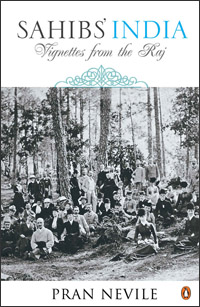
This is a meticulously researched work, yet the author eschews boring details and tells us only what informs and entertains. “In the royal household of the Viceroy, Lord Lytton, there were 300 indoor servants, of whom a third were cooks.” My heart stops, my head spins, my hair stands on end! While we do know that the British in India lived in opulent splendor, the actual details and descriptions are revealing if not shocking. We are left wondering whether the kings and queens of England enjoyed such luxuries as the sahibs did.

The chapters have interesting titles, indicating the shape of things to come: Sex and the Sahib, Memsahibs and the Indian Marriage Bazar, When Sahib was Hooked to Hookah, Nautch Parties, Fun and Frolic in Simla, Shikar and Pig-Sticking, Sadhus, Sufis and Sanyasis, Banning of an Indian Erotic Epic, and so on. “David Ochterlony, the British resident in Delhi (1803) popularly known as ‘Loony Ahktar’, lived like a royal prince and used to take the air in the evening accompanied by his thirteen Indian bibis riding elephants.” Similarly, William Frazer who was the British commissioner in the 1830s maintained seven Indian wives and had several children, who were either Hindu or Muslim depending on the faith of their mothers.

We learn that “The cost of landing a European wife in Calcutta worked out to Rs.5000 – far beyond the means of ordinary company officials. On the other hand, according to Captain Williamson’s Guide book published in 1810, the expenses that had to be incurred on an Indian mistress worked out to Rs.40 per month.” We also learn than white-skinned girls from Eastern Europe and Japan were procured to staff the brothels of Bombay and Calcutta. Robert Clive in the 18th century described Calcutta as “one of the most wicked places in the Universe.” In 1828 there was a general strike by palanquin bearers in Calcutta. Interestingly, all of them were natives of Orissa. The rickshaw was introduced from Japan in the 1880s. The Kumbh Mela at Haridwar attracted pilgrims from China, Persia and Bokhara.

“All accounts emphasize the fact that Muslims celebrated their festivals just like the Hindus, with the same earnestness and ostentation and amused themselves with dance and song and other entertainments, including feast and sports,” the book informs us. Persian songs were as popular in India as Hindi songs until the end of the 19th century. “Tazah ba tazah, nu ba nu”, a ghazal by Hafiz (Shirazi) dominated the nautch scene for over a century. By the early 20th century, thanks to the fervor of the missionaries and the campaigns of the vigilantes, the nautch had fallen out of favour and the nautch girls had faded into oblivion.

The book has several amusing anecdotes. Here’s a sample: As the story goes, Nobel laureate C.V. Raman was once performing religious rituals with offerings of food to his ancestors in Gaya when someone said to him, ‘Sir, you are such a great scientist – how can you believe this food would reach your ancestors? Sir Raman smiled and replied, ‘I cannot prove that it will not reach them.’

The author, Pran Nevile, was born and educated in Lahore and served in the Indian Foreign Service and the United Nations. He has written several books on the British Raj, including Beyond the Veil: Indian Women in the Raj, Rare Glimpses of the Raj, and Nautch Girls of the Raj.

Overall Assessment: Worth reading

Sahibs’ India: Vignettes from the Raj
Author: Pran Nevile
Publisher: Penguin
Publication Date: November 2010

Contributor: Pushpa Kurup lives in Trivandrum, India and works in the IT sector.

“The Travels of Ibn Battuta” by Ibn Batuta (Abridged and Edited by Tim Mackintosh-Smith)

Travels of Ibn Battutah

“They told me that one of the Hindu infidels had died, that a fire had been kindled to burn him, and his wife would burn herself along with him.” Describing the practice of sati in 14th century Hindustan, Ibn Battuta observes that, “The burning of the wife after her husband’s death is regarded by them as a commendable act, but is not compulsory; but when a widow burns herself her family acquire a certain prestige by it…”

Abu Abdallah Ibn Battuta is undoubtedly the greatest traveller in world history. Born in Tangier, Morocco in 1304, he set out for Mecca and Medina at the age of 22 and returned home a quarter of a century later, having visited much of the old world from Hangzhou in China to Timbuktu in Mali, and traversed an estimated 75,000 miles between 1325 and 1354. On his return he wrote his epic travelogue wherein he mentioned more than 1500 persons by name. Ibn Battuta (that’s his family name) was a Sunni Muslim and a scholar of Islamic jurisprudence.

He described Al Iskandariya (Alexandria) in Egypt as one of the most beautiful places he has ever seen. “Among all the ports in the world I have seen none to equal it except the ports of Kawlam (Quilon) and Qalicut (Calicut) in India……..and the port of Zaitun (Quanzhou) in China.” [Alexandria is still beautiful, but Kollam and Calicut are ports no longer.] Ibn Battuta observed the famed lighthouse of Alexandria (Pharos), one of the wonders of the ancient world, on his outward journey and also on his return. When he saw it for the first time, only one face had been ruined but when he returned in 1349, it had virtually become inaccessible.

At Delhi, Sultan Muhammad bin Tugluq appointed him as Maliki Qadi and he spent six years there, referring to his benefactor as king of Al-Sind and Al-Hind. His description of the Qutub Minar and the metal pillar are revealing. There are some descriptions that would make painful reading for devout Hindus. “At the eastern gate of the mosque there are two enormous idols of brass, prostrate on the ground and held by stones, and everyone entering or leaving the mosque treads on them. The site was formerly occupied by a budkhanah, that is an idol temple, and was converted to a mosque on the conquest of the city.” (Delhi was sacked by Muhammad Ghori in 1192, Prithviraj Chauhan was defeated, and a few years later Qutbuddin Aibak established the Slave Dynasty.)

Of the holy man Shaikh Ala al-Din he wrote, “He preaches to the people every Friday and multitudes of them repent before him and shave their heads and fall into ecstasies of lamentation, and some of them faint.” Sounds familiar? These practices persist even today, but not necessarily in the Islamic world.

“No person eats with another out of the same dish,” Ibn Battuta noted. He also spoke of the Indian habit of eating betel leaves with areca nuts, sprinkling rose water and eating samosas. He recounted the common scenes in the capital, telling us a great deal about life in Delhi in the 14th century. “Every day there are brought to the audience hall hundreds of people chained, pinioned and fettered, and those who are for execution are executed, those for torture tortured, and those for beating beaten.” The shifting of the capital from Delhi to Daulatabd in the Deccan is recounted, probably with a little exaggeration.

Of the Syrian city of Aleppo he said, “The spirit feels in the environs of the city of Halab (Aleppo) an exhilaration, gladness and sprightliness which are not experienced elsewhere, and it is one of the cities which is worthy to be the seat of the Caliphate.” Well, if Ibn Battuta were to see the state of Aleppo today he would just sit down amidst the rubble and weep.

These teeny-weeny tales are just the tip of the iceberg. There’s lots more! Overall Assessment: Very, very interesting.

The Travels of Ibn Battuta
Author : Ibn Battuta (Abridged and Edited by Tim Mackintosh-Smith from the translation by Sir Hamilton Gibb and C F Beckingham)
Publisher: Picador
Date of Publication: December 2002

Contributor: Pushpa Kurup lives in Trivandrum, India and works in the IT sector.