“Canada” by Richard Ford

Canada

Richard Ford’s “Canada” is the first of his books that I have read, but it will not be the last. An author in the grand tradition of Franzen in his description of family dysfunction, he writes a slow moving and subtle book, emphasizing the inner workings of his character’s mind and his difficult coming of age story rather than the intricacies of plotting.

Dell Parsons is the teenage son of Neeva and Bev Parsons and twin brother of Berner Parsons whose life story is grandly dramatic and worthy of a fast-moving pulp fiction thriller. Dell’s life falls apart one summer in Montana as his parents make a giant foolish leap into criminality and fail spectacularly. He is cast from the proverbial frying pan into the fire in his “escape” to Canada. Within the broad and grand sweep of this story, the author details his protagonist in small steady brush strokes. The first couple of hundred pages are very slow as Dell prepares for high school in his little town and talks about his family, his surroundings and small day to day events and descriptions. Taken at the pace the author sets, it’s like watching a train wreck in super-slow motion. Richard Ford sets this up cleverly, telling us the most important dramatic details right up front in the first few sentences.

This book falls short on a few counts and succeeds in others. It needed some self-discipline to plod through the first couple of hundred pages which are slow and meandering. For the more impatient modern reader, 200+ pages of slow moving storyline could be a deal-breaker. However, the second half of the book had me completely hooked, so the discipline of working my way through the slow first half paid off amply in the end.

The book’s great success is in describing a “regular” adolescent faced with “irregular” life experiences and painting a clear, believable picture of the protagonist that resonated with me as the reader. The poignant contrast of the melodramatic events in the plot and the protagonist’s calm and matter of fact narration are masterful.

Canada
Author: Richard Ford
Publisher: Ecco Press
Publication Date: June 2012

Contributor: Seema Varma is an avid reader – mystery, fantasy, literary fiction.

“The Lake of Dreams” by Kim Edwards

The Lake of Dreams

This book is from the author of a brilliant book that I read several years ago — The Memory Keeper’s Daughter by Kim Edwards. It wasn’t just me who loved it — that book became a runaway hit and spent 122 weeks on the New York Times bestseller list. Kim Edwards hasn’t written a whole lot of other books, so when I did find another one by her, The Lake of Dreams, I picked it up immediately to read.

If I was hoping for an encore performance, for something as brilliant as The Memory Keeper’s Daughter, I was disappointed. The Lake of Dreams is definitely not as good, or even as successful, as her earlier book, which I remember being everywhere when it was published (in 2006). However, the writing quality is just as good, not at all pedestrian, and as it so often happens, perhaps my expectations from this book were way too high for it to live up to them.

The Lake of Dreams is the story of a young woman, Lucy, struggling to find her place in the world and never able to really come to terms with the death of her father in a freak boating accident when she was a teenager. If only she had accompanied him for a ride on the boat that night when he had asked her to join him, perhaps the accident wouldn’t have happened. She leaves the town they lived in – called “The Lake of Dreams” – soon after to go to college and thereafter becomes a  nomad of sorts – traveling to different countries for projects as part of her job as a hydrologist. When the book opens, she is living in Japan with her boyfriend of Japanese descent and is temporarily out of a job, and she takes a trip home to The Lake of Dreams to visit her family – her mother and her brother. Once there, she is caught up in the familiar emotions brought on after the death of her father – restlessness, guilt, the feeling of being unmoored – until the chance discovery of a letter and a piece of fabric in her home – which dates back to several generations – leads her to a search for an ancestor who seems to have been expunged from the family history. Who is this Rose and what happened to her? And what about her daughter Iris? Why was she forced to leave her? And was Rose the woman modeled in the stained glass windows in the local church that were created by a famous artist? If so, what was the connection between them?

While Lucy is researching the mystery of Rose, Iris, and the stained glass windows, she is, at the same time, dealing with the attraction she still feels for her high school boyfriend, who is settled in The Lake of Dreams, and runs a successful artisanal glass factory. At the same time, she is still in love with her boyfriend in Japan. In addition to this inner conflict, family issues with her brother and her uncle come up, compounding her feelings of guilt about her father’s death.

Eventually, everything is resolved, and there is a surprise twist regarding the circumstances of her father’s death, reinforcing the fact that his accident was not her fault in any way and she did not need to blame herself for it. This was the only somewhat dramatic part of the book, which was otherwise not melodramatic in the least. While I appreciated this aspect of the book – the story was so believable – it did make it a little slow, plodding almost. A little drama could have spiced it up a bit, I think.

But I guess that is not the author’s style, which is subtle, almost understated. It worked beautifully for The Memory Keeper’s Daughter, and while I’m glad I read The Lake of Dreams, it reinforced the fact that great art owes a lot to serendipity, to a flash of inspiration. It cannot be manufactured at will, it cannot be commanded, which is why there is no guarantee of loving someone’s second book or movie or painting just because you have loved the first.

The Lake of Dreams
Author: Kim Edwards
Publisher: Viking
Publication Date: January 2011

Contributor: Lachmi Khemlani runs a technology publication in the San Francisco Bay Area.

“Zealot: The Life and Times of Jesus of Nazareth” by Reza Aslan

Zealot.jpg

“If you do not have a sword,” Jesus instructed his disciples, “go sell your cloak and buy one.” Was this the same man who said, “Turn the other cheek” and “Love thy neighbour as thyself”?

Iranian born American author Reza Aslan makes a valiant attempt to unveil the real Jesus – and in the process unearths some curious facts. The gospels were recorded by Greek speaking diaspora Jews. The gospel of Luke was written in Antioch and that of John in Ephesus. Almost every story written about Jesus was composed after the Jewish rebellion against Rome in 66 C.E. (In 70 C.E., the Romans razed Jerusalem to the ground.) The Kingdom of God never came. But Jesus, the messiah, was gradually transformed from a revolutionary nationalist into a spiritual leader espousing a message of peace and brotherhood.

Belief in the resurrection of Jesus seems to have pre-dated the gospels and other written sources. But only two facts about Jesus are absolutely certain: Firstly, that he was a charismatic preacher who led a Jewish movement in Palestine at the beginning of the first century. Secondly, that Rome crucified him for this crime. The plaque they placed above his head on the cross read, “Jesus of Nazareth, King of the Jews”. (However, Mathew and Luke claim that Jesus was born in Bethlehem.) There’s no evidence for the ‘born in the manger’ story or the ‘immaculate conception’ theory.

Jesus performed faith cure and exorcism – and never exacted a fee. There’s more historical material confirming his miracles than either his birth or his death.

Jerusalem had a history of conflict long before the birth of the saviour. The story of Moses and the great exodus is well known. But the Jews did not live happily ever after in the Promised Land. The Babylonians obliterated King Solomon’s temple in 586 B.C.E. Later they were defeated by the Persians who allowed the enslaved Jews to return to Jerusalem and rebuild the Temple. Then Jerusalem fell to Alexander the Great and was subsequently ruled by the Ptolemaic dynasty. In 164 B.C.E. the Jews regained power and held it for the next 100 years. Roman dominion began in 63 B.C.E., and when Herod died in 4 B.C.E. a period of violent uprisings followed. Jesus was born sometime between 4 B.C.E. and the takeover of Jerusalem by Roman troops in 6 C.E.

In 28 C.E. an ascetic preacher, John the Baptist, began baptizing people in the River Jordan. Jesus was baptised by him – and probably began his ministry as John’s disciple. Sometime between 28 and 30 C.E. John the Baptist was put to death by Herod Antipas, one of Pontius Pilate’s lieutenants.

After his baptism Jesus went out into the wilderness of Judea – and returned home only after the arrest of his mentor. By then he had metamorphosed into a preacher. He called himself ‘Son of Man’. He had both male and female disciples who followed him from place to place. Women disciples named in the New Testament include Joanna, Mary, Salome, Susanna and Mary of Magdala.

The matter of Jesus’ bachelorhood also remains unresolved. Celibacy was extremely rare in Jewish society, being restricted to monastic orders such as the Essenes (custodians of the Dead Sea Scrolls).

The prophet Isaiah had foretold that Israel would be redeemed, that God’s Kingdom would be established on earth. Jesus merely said the Kingdom of God is at hand. But it amounted to saying the end of the Roman Empire was imminent. His “blessed are the poor….” statement implied a reversal of the prevailing social order. It was a call to rebellion. Consider this quote from Matthew and Luke, “Do not think that I have come to bring peace on earth. I have not come to bring peace, but the sword.”

After Jesus’ death his brother James became leader of the early Christians. The Lord did have brothers and sisters – which goes to disprove his mother’s perpetual virginity. Joseph, the father, disappears after the infancy narratives. He is mentioned only by Matthew and Luke, as is the story of the virgin birth. According to the gospel of Mark, when Jesus first begins preaching in Nazareth, the villagers ask, “Is this not Mary’s son?” Males in Palestine were never called by their mothers’ names. Burial after crucifixion was not normal practice either. It was customary to leave the corpses on the cross to be devoured by dogs and birds of prey. So why and how did Jesus get a burial?

Saul of Tarsus (who became Paul after his conversion) rejected Jewish law and began teaching believers not to circumcise their children. He had serious conflicts with James and the apostles. In the early sixties Paul was arrested and extradited to Rome, where Peter, the first of the 12 apostles was already living. In 66 C.E. as Jerusalem erupted in revolt, the emperor Nero had Peter and Paul executed. Their martyrdom made them the most important figures of Christiandom. There had been messiahs and martyrs before and after Jesus, but today he alone is God.

Though James headed the first Christian community and eventually died a martyr, he was overlooked in later chronicles, and almost wholly excised from the New Testament.

The book throws light on some ancient Jewish traditions. I was struck by the uncanny resemblance of the daily rites of the Temple of Jerusalem to that of our Hindu temples. The burning of incense, the lighting of lamps, the sounding of trumpets, and the animal sacrifices (which are now unlawful), the purification rituals and the shaving of heads would be all too familiar to any practising Hindu. Menstruating women were not allowed to enter the Temple.

Overall Assessment: Great read, though it does appear that the author has a bee in his bonnet.

Zealot: The Life and Times of Jesus of Nazareth
AUTHOR: Reza Aslan
PUBLISHER: The Westbourne Press
YEAR OF PUBLICATION: 2013

Contributor: Pushpa Kurup lives in Trivandrum, India and works in the IT sector.

“The Boss of Bosses: The Life of the Infamous Toto Riina, Dreaded Head of the Sicilian Mafia” by Attilio Bolzoni and Giuseppe D’Avanzo

The Boss of Bosses

‘The best forgiveness is revenge.’

This book about the Sicilian Mafia boss, Salvatore Riina (nicknamed Toto Riiia or U Curtu) was published 15 years after his arrest and imprisonment in 1993. He is now 86 years old, ill with terminal cancer and about to be released from prison on compassionate grounds. His son Guiseppe Salvatore recently came out of prison and published his autobiography.

I picked up The Boss of Bosses at the Muscat airport while waiting for a flight to Milan. The book was meant to relieve boredom in transit but it actually made me lose my sleep, literally and figuratively. After having read The Godfather by Mario Puzo in my schooldays, this was the first time in decades that I was reading about the Mafia. (I must confess at this juncture that I really enjoy the party game ‘Mafia’ which can be adapted to management training in skilful ways.)

“Cosa Nostra was ruled by terror. You could die over nothing. Over a word, a look. All you needed to do was dither over an order to kill a crony, give one question too many or one answer too few to be squashed like a fly on a window pane.” The authors give a brilliant portrayal of the life and times of the man who rises from a humble peasant background to become the supreme head of the Sicilian mafia in the early eighties.

“One day the Corleonese confided in a cellmate: ‘When I get out of here I want to walk on a carpet of 100,000 lira notes.’ This was a simple peasant from Corleone speaking in 1963. His father and brother had died in a blast when he was thirteen. Toto Riina knew only one kind of life – he had only one option, only one goal, the Cosa Nostra.”
Prison life is described thus: “It was commonly said that ‘you were almost better off inside than out’, and the Ucciardone (prison) was compared to the Grand Hotel. Lobster and champagne came in everyday via the register office, and ended up in the cells of the big guns.”

Riina’s constant companions in the early days were Calogero Bagarella and Bernardo Provenzano. In 1969 he went underground after being arrested and later acquitted in a case of triple homicide. Toto married Antonina Bagarella, the sister of Calo, on 16th April 1974 after a 19 year engagement. They were blessed by a team of three priests at a secret hideout. Their four children were delivered in secret. They lived incognito and were constantly on the move. Toto Riina drove a white Mercedes with his wife seated in front and children at the back all the time remaining undetected. His unexpected arrest in 1993 stunned the nation and the world.

When Toto Riina wrested control of the mafia after a bitterly fought ‘mafia war’ the changes were dramatic. “Cosa Nostra, which was, in its own way of course, a democratic state, became a dictatorship in only two years. The Corleonesi weren’t just a family, they had become a current, an alignment, a party. The affairs of Cosa Nostra effectively changed from one day to the next. The Sicilian mafia had altered its structure, its DNA.”

The book tell us a lot about the mafia – how they lived, what they did, their bizarre norms and values, their code of silence, the businesses they ran, and the bloodshed, vendetta and violence that marked their lives. Here are some interesting descriptions:

• You earned more and risked less with cigarettes. Chesterfield, Camel, Pall Mall. In 1959 a case cost 28,000 lire in Tangier and was sold in Rome for 210,000. Cigarettes were a goldmine. Cigarettes had kept Cosa Nostra alive for a quarter of a century.

• During the early 1980s Palermo was a refinery operating at full steam. DEA experts maintained that the Sicilians covered a third of the North Atlantic market, something like four tons of heroin a year. According to FBI figures it was more than that: six tons a year.

• Piccioli, piccioli, piccioli -money, money, money…No one in Palermo was talking about anything else. Some had mother-of-pearl floors, some had gold taps. They would buy a Jaguar one day and a Ferrari the day after, or build villas with silver swimming pools.

• Giovanni (son of Toto Riina) supplies the proof that his uncle was looking for. At his first murder he doesn’t look away when his victim is dying. He shows character and determination. He doesn’t give in. He doesn’t feel pity. A ‘brave’ son, a man of honour, worthy of his father, his uncle, the whole Corleone ‘family’.

Tommaso Buscetta became the first Mafia boss to spill the beans and his testimony sealed the fate of Toto Riina and several others. In 1987, Riina and several other received life sentences from the court. But he was nabbed only after six years.

In May 1992 anti-Mafia judge Giovanni Falcone was killed in a bomb blast. Soon thereafter another judge Paolo Borsellino was killed. No one had any doubts about who was behind the killings. Buscetta had given valuable information to these judges to enable the conviction of the mafia bosses. After their assassination Buscetta came out with the names of the politicians who were aiding the mafia.

Overall assessment: Brilliant book.

The Boss of Bosses: The Life of the Infamous Toto Riina, Dreaded Head of the Sicilian Mafia
AUTHORS: Attilio Bolzoni and GuiseppeD’Avanzano
TRANSLATOR: Shaun Whiteside
PUBLISHER: Orion Books Ltd.
Year of Publication: 2015

Contributor: Pushpa Kurup lives in Trivandrum, India and works in the IT sector.

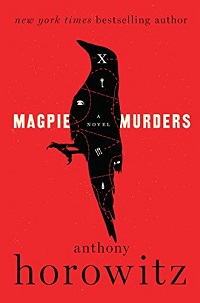
“Magpie Murders” by Anthony Horowitz

Magpie Murders

For those who love mysteries—and I very much belong in this category— Magpie Murders is a double treat. It is a mystery within a mystery, a classic whodunit (short for “Who [has] done it?”) within a whodunit. Agatha Christie was the undisputed queen of this genre, and I find her books absolutely riveting and impossible to put down until the end, when the detective finally reveals the murderer. I have always wished she was still alive and writing, so I wouldn’t have to make do by re-reading her books over and over again.

This is why I was delighted to come across Magpie Murders. Not only did it provide twice the thrill by being a book within a book, it had also one of the most innovative plot lines I have come across so far. A book editor of a publishing company, Susan Ryeland, is given the manuscript of the latest book by their most successful author, Alan Conway. The name of the book is Magpie Murders, and it is the ninth book in his widely popular crime series that is modeled almost entirely on Agatha Christie books—they also feature a Poirot-like detective and are set in small English villages in the 1950s. While Susan dislikes Alan Conway as a person, she loves his books and starts reading the manuscript. It is reproduced in full, and we are reading it with her. This is the “inside” book, and it is every bit as riveting as any Agatha Christie mystery, just as well-written, just as suspenseful, just as impossible to put down.

Therefore imagine her agony, as well as ours, when she comes to the end of the manuscript and finds that it is not complete! This is just before the big reveal when the detective gathers all the suspects and presents the solution to the mystery with a flourish. Needless to say, she can’t wait to get hold of Alan Conway to find out what happens. But then it turns out that he has died, ostensibly from suicide, going by the letter he sent to her boss, the head of the publishing company. In a quest to find the missing chapters of the manuscript, not just for her company but also to get the solution to the mystery in the book, Susan dig deeper and becomes increasingly convinced that Alan may have been died of murder rather than suicide.

This is the “outer” mystery, and while it is set in contemporary times and therefore easier to relate to, I have to admit that I didn’t find as gripping as the inner Agatha Christie-like mystery in the fictional book that Alan Conway wrote. Thankfully, Susan finds the missing end chapters of the inside book, so we find the answer to that mystery. And of course, by the end of the book, we get to know the mystery behind Alan Conway’s death as well.

The fictional Alan Convoy’s fictional book was so good, and such a terrific stand-in for Agatha Christie fans, that I wish Anthony Horowitz would keep writing these books in addition to the other books he writes.

Magpie Murders
Author: Anthony Horowitz
Publisher: Harper
Publication Date: June 2017

 Contributor: Lachmi Khemlani runs a technology publication in the San Francisco Bay Area.