“Salvage the Bones” by Jesmyn Ward

Salvage the Bones

Salvage the Bones is Jesmyn Ward’s 2011 National Book Award winner (she is much in the news lately for her 2017 National Book Award winner Sing, Unburied, Sing which I loved). It is the story of a family living in poverty in semi-rural Mississippi in the fictional town of Bois Sauvage. The protagonist is a young teenage girl who has two older brothers and a younger brother. Their father is largely absent in any supervisory sort of parenting role and focused on preparing the house for the onslaught of Katrina. The mother has died some years ago in childbirth.

As the story unfolds, we get to meet the family and their friends and see the world from our protagonist’s viewpoint, with all the pain and panic of realizing she is pregnant, the care and concern for her brothers and the anguish of unrequited love. We see her brothers struggle with their own demons – one brother has basketball aspirations and hopes for opportunity, another is totally absorbed with his dog and her litter and the puppies’ well being. The father is focused on preparing their decrepit house to withstand the coming storm, oblivious of the storms raging in his children’s lives. Ward is not verbose and descriptions do not drag on, but the early chapters are awash with all manner of big and small details of life that make this family real to the reader. When the storm finally hits, we are heavily vested in their struggle to survive, and the description of the power and majesty of the storm is gripping. However, it is in the aftermath with the family picking themselves up, that this book shines brightest.

The writing is lyrical and reminds me of Maya Angelou – Jesmyn Ward writes like a painter or poet. The scenes she sets, the characters she puts in those scenes and the description is so absorbing that you barely notice the story unfolding. Ward takes a poor dysfunctional family with problems aplenty (petty crime, dog fighting, drugs and teenage pregnancy) and makes them beautiful and noble and heroic.

This is a book that will shine for some years to come. I am so glad to have read it.

Salvage the Bones
Author: Jesmyn Ward
Publisher: Bloomsbury
Publication Date: September 2011

Contributor: Seema Varma is an avid reader, sometime engineer.

“Dastan-e-Ghadar -The Tale of the Mutiny” by Zahir Dehlvi

Dastan-e-Ghadar

This is an English translation by Rana Safvi of the Urdu original by Zahir Dehlvi. It gives a fascinating first person account of life in Delhi during India’s First War of Independence, an earth-shaking event that the British simply called the ‘Sepoy Mutiny.’ Zahir Dehlvi was a privileged official in the court of Bahadur Shah Zafar, the last Mughal emperor, and he saw and reported everything that went on in those tumultuous days.

The Enfield rifles supplied to the Indian soldiers by the British rulers had greased cartridges said to be coated with cow and pig fat, which was obnoxious to Hindus and Muslims alike. They refused to bite the bullet. Instead they revolted. Soldiers from the Meerut cantonment killed their British officers, marched to Delhi on 11th May 1857 and declared the octogenarian Mughal as Emperor of Hindustan. The aged poet, a pensioner of the British, was simply not up to the task. Zahir Dehlvi was then 22 years old. His wrote his memoirs on his deathbed. While he is no historian and his narrative is prone to hyperbole and unmistakably pro-British it gives us rare insights into the events of the day, and for this reason alone deserves to be read. The translator has done a commendable job and the publisher has ensured that the book itself is a collector’s delight.

Dehlvi’s father and grandfather served the Emperor and he too was presented in court at the age of 12. He led a leisurely and lavish existence, riding horses, smoking the hookah, writing poetry and mingling with the likes of Mirza Ghalib. “Our days were festive like perpetual Eid….” Until the advent of the rebels.

After the mutiny was suppressed the Emperor was exiled to Rangoon and all his employees were fired. Dehlvi was destitute, having lost all his wealth and his ghazals as well. He fled with his family and later took up employment in the states of Alwar, Jaipur and Tonk which he described in great detail. He also presented interesting portraits of Bhopal, Baroda and Hyderabad where he had brief sojourns.

Here are some quotes and anecdotes from the book:

“There is a mosque here, which was built by Qutbuddin, though it is in a dilapidated condition. This mosque was built from the remains of temples. It had only been half done when the Badshah-e-Islam dies, and was thus left incomplete…….In the courtyard of this mosque is the broken temple, which is absolutely different and unique…….The iron pillar which people call killi or nail, has been installed in this courtyard. It has inscriptions in khat-e-shastri.” (The author meant Sanskrit but he was wrong. The translator tells us it was Brahmi script.)

“Once some Hindus, along with officers of the British government, hatched a plot to throw all the butchers slaughtering cows out of the city. The British government gave orders stating that these butchers should take their shops out of the city. They had all the shops within the city closed.” When the butchers and their families moved out and camped outside the city, the emperor insisted on pitching his tent alongside them. He stayed put until the British Resident rescinded the order.

The rebel soldiers after capturing Delhi appealed to the Emperor, “We are employees of the British. We have helped establish British rule from Calcutta to Kabul by sacrificing our lives, since they did not bring an army with them from England. All their conquests are due to the Indian army……And now…they want to destroy our faith and religion and convert the whole of Hindustan to Christianity. ….Now the time for revolt has come and the entire army has risen and refused to obey orders.” The Emperor’s response was, “Who calls me badshah? I am but a mendicant who is somehow living a Sufi’s life in the fort with my progeny…….The monarchy left my house 100 years ago.” His hapless grandfather had entrusted Hindustan to the British. He himself had no powers to take any decision. Therefore he has summoned the British Resident, Fraser. The Resident arrived soon thereafter.

The first victim of the riot was a Christian priest – a Hindu covert. Dehlvi says, “….as the sound of the shot rang out, the priest’s soul left for its heavenly abode.” The next to follow was Chamanlal, the emperor’s physician, who too had converted to Christianity. Then came the turn of the Resident.

Months passed. The rebels continued to hold Delhi. “The poor Badshah was always in a state of worry and anxiety and had stopped coming out of his Mahal. He was always sad and teary-eyed.” The Emperor said of the mutineers: ‘These rogues came to ruin my dynasty…..After they leave, the British are going to cut my head off, along with that of my children, and hang it on the Qila merlons.”

After several battles the British finally gained the upper hand and the rebels had to flee. They requested Bahadur Shah Zafar to go with them but he declined. The Emperor left the fort and took refuge in the environs of Humayun’s tomb. The British commander “arrested thirty Timurid princes, including the Badshah’s sons, grandsons and sons-in-law, and murdered them outside the walls of Delhi. He sent their heads to the Emperor.”

I read the book with a heavy heart.

Overall Assessment: Read it if you have an interest in Indian history.

Dastan-e-Ghadar -The Tale of the Mutiny
AUTHOR: ZAHIR DEHLVI
TRANSLATOR: RANA SAFVI
PUBLISHER: PENGUIN
YEAR OF PUBLICATION: 2017 (Urdu original in 1914 at Lahore)


Contributor: Pushpa Kurup lives in Trivandrum, India and works in the IT sector.

“The Association of Small Bombs” by Karan Mahajan

The Association of Small Bombs

This debut novel won a lot of awards when it was published last year and was one of the finalists for the National Book Award. Not only did it come to me with a strong recommendation, I was also intrigued at the prospect of discovering a new talented Indian author whose books I could identify with. Having grown up in India, it’s always nice to read fiction set in familiar surroundings that I can immediately relate to.

As should be obvious from its title, The Association of Small Bombs is about terrorism, not the large-scale terrorist attacks that make deadlines but the many smaller ones that are set off in local markets and neighborhoods, which happen so frequently in India that not a big deal is made of them. Unless, of course, you happen to be one of the families that are affected, in which case your whole world is turned upside down. The Association of Small Bombs starts off with one such bomb blast in a Delhi neighborhood in which two young boys — brothers who had gone to pick up their family’s television set at a repair shop, accompanied by their friend — are immediately killed. Their parents, the Khuranas, are shocked and devastated, and their marriage never recovers, despite having another baby five years after the blast. They spend much of their time in the courts where the terrorism suspects that the police have rounded up are on trial, and as to be expected, these are long-winded court cases where there is no real evidence of the crime. Eventually, the Khuranas take the lead in bringing together other families who have been affected by similar blasts into an “association,” which is where the title of the book comes from. Sadly, even this common cause is not enough to prevent the Khuranas’ marriage from eventually unraveling.

Meanwhile, the friend that the Khurana boys were with at the time of the blast, Mansoor, managed to survive but with severe injuries from the shrapnel of the bomb. He seemed to eventually recover and even goes to the US to study and get a degree in computer engineering. But after just a few semesters, the pain comes back with a vengeance, making it impossible for him to type on a computer and forcing him to return to India. He never goes back to the US to resume his studies and instead gets caught up in an NGO — a group of idealistic young Muslims — working on behalf of suspected terrorists — all Muslim — that have been jailed without any real proof of wrong-doing. While Mansoor is also Muslim, he was brought up in a non-religious family and never gave religion much thought until he joined this group, after which he becomes almost an Islamic fundamentalist. Eventually, one of his close friends, Ayub, from the NGO becomes inducted into the same terrorist group which had planted the first bomb and goes on to detonate another bomb, also in Delhi, on a scale similar to the first one. Ayub himself is injured in the blast and eventually dies. Mansoor is arrested as the bombing suspect because he was close to Ayub and spends several years in prison. The book ends with his release from prison; he goes home and never leaves the house again.

I can’t really say that I enjoyed reading this book or even learned something from it. It started off on a very strong footing by powerfully capturing the first bomb blast and the toll it took on a couple whose lost both their young sons to it, their utter devastation along with terrible feelings of guilt — why had they sent the boys to a TV repair shop to fix an old TV instead of just buying a new one? This “if only I had done this or hadn’t done that” persistent feeling of guilt will be familiar to anyone who has experienced the irreversible loss of a loved one. However, the rest of the book lacked a similar strong focus and seemed quite disjointed, going inside the minds of multiple characters including the Khuranas, Mansoor, Mansoor’s parents, Ayub, and the perpetrator of the original blast, Shockie, but without really delving too deeply into any of them. While it could have been very interesting to understand the mindset and psyche of a terrorist, The Association of Small Bombs didn’t really succeed in achieving that. Instead, there were bits and pieces of different lives, experiences, and thoughts, none of which added up to any kind of comprehensive understanding of even one person in the story.

It was all the more disappointing because the book had such a promising start. It definitely points to a talented author, and I hope he can bring it together in his next book.

The Association of Small Bombs
Author: Karan Mahajan
Publisher: Penguin Books
Publication Date: October 2016

 Contributor: Lachmi Khemlani runs a technology publication in the San Francisco Bay Area.

“A Revolutionary History of Interwar India” by Kama Maclean

A Revolutionary History of Interwar India.jpg

“On 12th April 1931, a conference of India’s martyrs was held in Paradise. We know because the proceedings were published in the Lahori Urdu newspaper Vir Bharat the following week.” This brilliant piece of anonymous journalism envisions a full-fledged conference with all the formalities and protocol, and presents an intricate blend of humour and pathos. Khudiram Bose, Ramparshad Bismil, Ishfaqullah, Haribhai Balmukand and Khushi Ram occupy prominent seats. The martyrs of Jallianwala Bagh appear in bloodied outfits. The martyrs of Sholapur are there too. Jatindranath Das as head the reception committee ushers in the much awaited trio of Bhagat Singh, Rajguru and Sukhdev. Conches are blown, the gods shower flowers and shouts of ‘Shahidon ki jai’ rend the air. As Jatin Das delivers the welcome address, Jesus Christ arrives. Sardar Bhagat Singh says, “India’s martyrs greet the martyr of Jerusalem.” The Jallianwala martyrs chip in, “Accept our salutation O peaceful shepherd of bloodthirsty sheep.” Jesus announces that “Dyer is today being burnt in hell fire.”

Kama Maclean painstakingly traces the role of revolutionaries in ushering in India’s freedom, unearthing many enigmatic characters who fail to surface in mainstream narratives. In a 1937 book titled The Vanishing Empire, Chamanlal predicted that the British Empire would collapse in ten years. Later he became a Buddhist monk, ‘Bhikshu’ Chamanlal. Ganesh Shankar Vidyarthi was fatally stabbed in Kanpur when he intervened to make peace amidst communal riots. Uddham Singh waited 21 years to avenge Jallianwala Bagh finally murdering Michael O Dwyer in London in 1940.

The Hindustan Republican Army sprang up in the 1920s in the United Provinces, later metamorphosed into the HSRA (Hindustan Socialistic Republican Association/Army) and shifted its focus to Lahore. There were invisible linkages between the HSRA and Nau Jawan Bharat Sabha (NJBS) and the Jugantar and Anushilan groups of Bengal.

The revolutionaries were determined to free India from British rule. Their main strategy was to make targeted attacks on powerful people. They attacked a train near Lucknow on 9th August 1925, looted government funds and killed a passenger. For this ‘Kakori Conspiracy’, four men were hanged and five transported for life. On 17th December 1928 Bhagat Singh and Shivram Rajguru shot dead a British policeman J P Saunders at Lahore, and Chandrashekhar Azad killed an Indian constable who gave chase. This was their revenge for the lathi-charge in November that had resulted in the death of Lala Lajpat Rai. They went underground, regrouped in Agra and on 8th April 1929 Bhagat Singh and Batukeswar Dutt threw low intensity bombs and leaflets on the floor of the Legislative Assembly before courting arrest. Soon other co-conspirators were arrested. The trial dragged on for 23 months, and the bravery and brilliance of the revolutionaries captured the imagination of the nation. Interestingly, they had had themselves photographed in studios in anticipation of capital punishment. These pictures made their way to every nook and corner of India in a brilliantly orchestrated campaign, and soon Bhagat Singh was just as popular as Mahatma Gandhi.

In June 1929 in Lahore Jail the revolutionaries commenced a hunger strike in protest against the differential treatment meted out to Indian and European prisoners. On 13th September Jatindranath Das passed away after 63 days of fasting. Subhas Chandra Bose (on behalf of the Bengal Congress) arranged to repatriate his body to Calcutta, and all along the way it was hailed by wailing crowds.

Jock Scott, Lahore’s Senior Superintendent of Police (who had been the original target of the Saunders assassination) soon packed his bags and sailed for England. The California-based based Ghadar Party threatened that if Bhagat Singh was executed, they would assassinate the incoming Viceroy even before he landed in India.

The HSRA bombed the Viceroy’s train on 23 December 1929 as it approached Delhi but Lord Irwin escaped unhurt. In April 1930 the daring Chittagong Armoury Raid by the Bengal revolutionaries masterminded by Surya Sen rattled the British. However, the young militants were out-numbered and died fighting.

Azad managed to remain incognito until he was killed in a shootout with the police at Allahabad on 27th February 1931. British intelligence noted that the Allahabad Provincial Congress Committee “took an active interest in the cremation of Azad’s body.” Motilal Nehru had died only two weeks earlier and revolutionary memoirs recounted that Azad had taken part in the funeral procession in disguise. It came to light later that Motilal had communicated with and funded Azad. In fact the revolutionaries usually relied on Congress members for financial backing and legal defence.

Bhagat Singh, Rajguru and Sukhdev were hanged on 23rd March 1931. It is one of the classic ironies of Indian history that Bhagat Singh, although shunned by Gandhi and neglected by historians, was omnipresent in visual culture. Though originally a turbaned Sikh, his ‘hat portrait’ was firmly imprinted on the Indian psyche, never to be erased.

In Bengal on 14th December 1931, teenagers Shanti Ghosh and Suniti Choudhury shot dead a British magistrate, and expressed disappointment when they received only jail sentences.

HSRA members had multiple aliases. David Petrie (who later headed the MI5) was convinced that Balraj, Chief of the HSRA, was Bhagat Singh but decades later Shiv Verma, a surviving member of the inner circle, disclosed that Balraj was Azad.

The book has a chapter on the secret life of Durga Devi, widow of HSRA leader Bhagwati Charan Vohra. The latter had died in a bomb-making accident on 28th May 1930. Durga had masqueraded as Bhagat Singh’s wife to facilitate his escape from Lahore in December 1928. On 8th October 1930 she took part in a daring shooting attempt on Lamington Road, Mumbai, leaving her infant son with Babarao Savarkar, brother of V D Savarkar.

Overall Assessment: The best part of the book is the exhaustive array of photographs and pictures.

A Revolutionary History of Interwar India
AUTHOR: Kama Maclean
PUBLISHER: PENGUIN BOOKS
YEAR OF PUBLICATION: 2016

Contributor: Pushpa Kurup lives in Trivandrum, India and works in the IT sector.

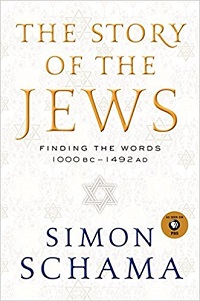
“The Story of the Jews: Finding the Words 1000 BC – 1492 AD” by Simon Schama

The Story of the Jews

Well, I thought I knew their story – until I read this masterpiece and found out how little I knew. The Exodus story is something you can’t help knowing, how Moses led the Israelites out of Egypt, how they wandered in the desert and finally reached the Promised Land. You needed faith to believe the story but I had believed it anyway, at least most of it, excepting of course the more fanciful parts, like the parting of the Red Sea and the encounter with God on Mount Sinai. Nebuchadnezzar destroyed the Temple of Solomon in 587 BCE. Cyrus of Persia liberated the Jews and enabled the rebuilding of the temple. Jesus was a Jew. The Romans destroyed Jerusalem in 70CE and scattered the Jews in all directions. All this I knew. I also knew that my home state, Kerala, had a Jewish community from times immemorial – and after the birth of Israel many of them migrated. Like everyone else, I knew about the Holocaust. And well, the Qumran scrolls or Dead Sea Scrolls as they are called. (I’m somewhat ashamed to admit that I’d learnt about the Spanish Inquisition in my schooldays but had forgotten what it was all about.)

This book was an eye-opener. It brought to mind just as many questions as answers. If the Israelites found Egypt so abhorrent, why did they keep going back there? “The very first time that ‘Israel’ appears on any historical artefact is on the famous late thirteenth century BCE triumphal inscription of Pharaoh Merneptah, son of Rameses II.” The inscription claimed that Israel had been routed. This lends credence to the belief that Rameses II is the Pharaoh of the Exodus. And the Exodus probably did happen, though no evidence has been found till date.

Egyptian sources claim that when Sennacherib’s Assyrian army surrounded Jerusalem in 715 BCE it was an army under the Nubian pharaoh that broke the siege. Very plausible, says Simon Schama. So Egypt wasn’t a permanent enemy after all.

In the 6th century BCE Jews were settled in many parts of Egypt. In Elephantine, the capital of the Pathros region, they even had a temple. They kept the Sabbath, made animal sacrifices and circumcised their sons. Surviving documents related to marriage and divorce reveal interesting facts. While Israelite men had unilateral rights to divorce their wives, in Egypt Jewish women were also entitled to initiate the separation. Tragedy truck in 410 BCE when the temple was destroyed, rebuilt, and destroyed again. By the middle of the fourth century BCE, before the coming of Alexander, the Elephantine colony had ceased to exist. However, a century later Jewish settlements had popped up all over Egypt, especially at Alexandria and Thebes.

The Hebrew Bible was written over three centuries – eighth to fifth BCE. While it proclaims monotheism and an exclusive bond with Yehowah, it chronicles a saga of betrayals, transgressions, atrocities, disasters and defeats. “David’s best-loved son, Absalom, is killed in a particularly horrifying way while in rebellion against his father. Solomon’s imperially aggrandizing kingdom lasts not even one generation after his death. King Manasseh institutes the horror of child sacrifice by fire. The Egyptians are always at one gate and the Mesopotamian empires at the other.”

The Song of the Sea has much in common with the Phoenician epic of the storm god Baal’s conquest of the sea. Ecclesiastes is a ‘Wisdom Book’ that owes something to Persian-Babylonian proverbial literature. It was the Hellenistic Jewish world that invented the synagogue. ‘Holocaust’ was the Greek word for ritual cremation of whole animals. Only Greeks and Jews made fire sacrifices of whole animals.

Judaism was imposed at the point of the sword (and the circumciser’s knife) on neighbouring peoples like Itureans and Idumeans. In the first century BCE the Roman general Pompey marched through the Temple, tearing aside the curtain veil and entering the Holy of Holies, where only the high priest was admitted. But he spared the temple, as Alexander had done centuries ago. Eventually Vespasian would destroy it.

The mass social upheaval in the towns and villages of Palestine, the coming of Jesus and his crucifixion, the exaltation of Christianity as the state religion of Rome, the birth of Islam, the Muslim conquest of Jerusalem, the Crusades, the persecution of Jews by Christians in various parts of Europe, and the horrors of the Inquisition are set out in explicit detail. One is left feeling sorry for the Jews, although the author recounts the atrocities committed by the Jews as well.

There is much that would evoke shock and/or surprise. Here are some examples:

  • Judaism and Zoroastrianism had shared purity obsessions,including a belief in the uncleanness of menstruation.
  • Peter the apostle refused to share a table with the uncircumcised.
  • The Prophet Muhammad first commanded the Believers to pray in the direction of Jerusalem. It was only when the Jews of Yathrib rejected his beliefs that he switched the orientation to Makkah.
  • Christians were forbidden by Canon Law to lend money at interest. So it wasn’t just the Jews and Muslims who had this prohibition!
  • Much of the heart of Westminster Abbey comes from the estate of Licoricia the Jewess and her husband, David of Oxford. The Crown had appropriated the estate in the thirteenth century. Soon thereafter the Jews of England were all sent packing. This happened in France, Germany, Spain and Portugal. By the time Columbus had set out to discover America in 1492, Spain had been wiped clean of its Jewish population and five years later Portugal followed suit.!
  • When Vasco da Gama returned in triumph after his India expedition he brought to Portugal back not only spices and animals but also a Polish Jew. I wonder what became of the poor man in a country that had evicted all its Jews!

The book has a sequel. I intend to read it soon.

Overall Assessment: A labour of love.

The Story of the Jews: Finding the Words 1000 BC – 1492 AD
AUTHOR: SIMON SCHAMA
PUBLISHER: VINTAGE
YEAR OF PUBLICATION: 2014


Contributor: Pushpa Kurup lives in Trivandrum, India and works in the IT sector.