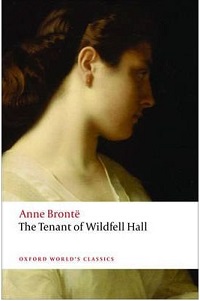
“The Tenant of Wildfell Hall” by Anne Brontë

The Tenant of Wildfell Hall.jpg

Having recently rediscovered my love for Victorian classics (courtesy Elizabeth Gaskell’s North and South), I turned to one I hadn’t yet read – The Tenant of Wildfell Hall by Anne Brontë. She is, I think, the least known of the Bronte sisters – Charlotte Brontë has become immortalized in our literary canon with Jane Eyre and so has Emily Brontë’s Wuthering Heights. After finishing the book, I can see why. While the writing is as good – all the Brontë sisters were undeniably talented writers – I did not find the The Tenant of Wildfell Hall the kind of book I would necessarily want to again read, unlike Jane Eyre, for example, which I have re-read multiple times and find it as enthralling each time as the first time I read it.

The Tenant of Wildfell Hall is primarily the story of a young woman, Helen Huntington, and her journey – from being wooed as a young girl by a dashing, charming man whom she falls madly in love with and marries, to the gradual descent of the marriage into a loveless nightmare because of her husband’s predilection for alcohol and dissoluteness. Her only consolation is her son, born shortly after her marriage, but whom she eventually becomes desperate to remove from the corrupting influence of his father. So she does what was almost unimaginable in those days – she runs away. With the help of her brother, she becomes a tenant in a house he owns in a distant location, Wildfell Hall, and assumes a false name and the guise of being a widow. Being young and beautiful, she naturally arouses the interest and gossip of the families in the neighborhood, as well as the ardent love of a local landowner, Gilbert Markham. While the story does come to a happy conclusion at the end of the book, most of it describes the trials and tribulations faced by Helen and the degenerate behavior of her husband — to the point at which you just wanted to say, “Enough, already! Just leave him!”

Even though I did not find The Tenant of Wildfell Hall the kind of book I would love to read multiple times, it is definitely a good book and I am glad to have read it. For those who enjoy Victorian classics, it is one more on the rather limited list we have of these books. In addition to their literary merits, they allow us to know what it was like to live in those times, and therefore also serve as important historical records. The Tenant of Wildfell Hall is especially a important reminder that while many of us have very romantic notions of what it was like to live in Victorian times, it was far from being hunky-dory, especially for women, the vast majority of whom were not so lucky to have devoted husbands with whom they could “live happily ever after.” Apparently, Charlotte Brontë tried to block the publication of this book because it was so scandalous at that time, with its account of a marriage gone sour, the dissipation of a man to alcohol, and a woman escaping from an untenable situation. We are fortunate to live in an age when it’s even hard to comprehend how a woman could be forced to stay in a marriage that was as abusive as Helen Huntington’s in The Tenant of Wildfell Hall.

Not only this, the book was initially published under a male pseudonym, Acton Bell. It is bound to make any feminist’s hackles rise!

The Tenant of Wildfell Hall
Author: Anne Brontë
Original Publisher and Date: Thomas Cautley Newby (June 1848)
Reprint Publisher and Date: Oxford University Press (May 2008)

Contributor: Lachmi Khemlani runs a technology publication in the San Francisco Bay Area.
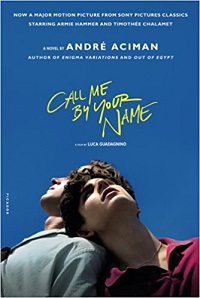
“Call Me by Your Name” by André Aciman

Call Me By Your Name

It was only after I had seen the movie “Call Me by Your Name”—which was nominated for four Oscars at this year’s Academy Awards and won the Oscar for Best Adapted Screenplay—did I realize that it was based on a book. The movie was excellent, but the book was not very well known prior to the movie. It would be fair to say that it had not really made a “splash” in literary circles, which was somewhat unusual as most movie adaptations are made of books that are highly acclaimed. I typically do not like to watch the movie adaptation of a book before reading it first, but in this case, I wanted to find out more about the book that had inspired such a beautiful movie.

Call Me by Your Name is what is commonly referred to as a “coming-of-age” story of an adolescent going from youth to adulthood. The adolescent here is a 17-year-old American-Italian boy named Elio, the setting is Italy, and the time period is in the 1980s. While the story is being narrated by Elio twenty years later, it is almost entirely an account of the one summer when a visitor, Oliver, comes to stay in Elio’s house. Elio’s father is a professor, and every summer, he takes in a doctoral student as a house guest for six weeks as an apprentice of sorts, who helps him with some academic work while simultaneously engaged in some academic activity of his own. In the case of Oliver, he is working on a manuscript for a book, and a summer in the beautiful Italian countryside seems like the perfect place to do it in.

Not every “coming-of-age” story is about love and sex, but this one is. And what makes it especially distinctive is that both Elio and Oliver are male. Elio feels an overpowering attraction towards Oliver from the minute he sees him, and Oliver eventually reciprocates after holding out for a few weeks. The book chronicles their intense and passionate relationship over that summer, and while this is not one of those “happily ever after” love stories, it represents the most meaningful relationship of their lives for both Elio and Oliver, as they realize when they get a chance to meet years later.

While the movie adaptation of Call Me by Your Name was referred to as a “gay” love story, I found it interesting that neither the word “gay” nor the word “homosexual” are ever mentioned in the book. Of course, social norms were a lot less liberal in the mid-80s, and while Elio often feels “shame,” especially after sex, he never ever feels that it is wrong to experience the overwhelming love he feels for Oliver. The story is told entirely in the form of an internal monologue in Elio’s head, making us experience the depth of his emotions in all of their complexity. The fact that these are no different from the teenage angst experienced by a “heterosexual” adolescent points to the universality of human emotions. Not everyone may be able to identify with the attraction Elio feels for another man, but we can all identify with the intense, overpowering, and often tortured emotions that typically accompany the throes of first love.

Call Me by Your Name
Author: André Aciman
Original Publisher and Date: Farrar, Straus, and Giroux (January 2007)
Reprint Publisher and Date: Picador Media Tie-in edition (October 2017)

Contributor: Lachmi Khemlani runs a technology publication in the San Francisco Bay Area.
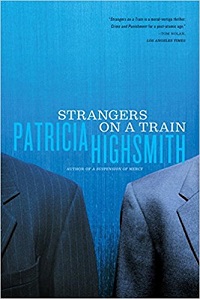
“Strangers on a Train” by Patricia Highsmith

Strangers on a Train

I was alerted to this book by the recent write-up of The Kind Worth Killing, which was seemingly inspired by Strangers on a Train. While I had not read any books by Patricia Highsmith before, I have seen other movies based on her novels including The Talented Mr. Ripley and Carol, both of which were very good. Strangers on a Train was her first novel and it was made into a movie by none other than Alfred Hitchcock shortly after it was published in 1950. The book, therefore, came with an impressive back story and I was prepared to be wowed, especially given that I enjoy thrillers in general.

The plot line of Strangers on a Train is very intriguing. Two men, Guy and Bruno, meet on a train, they both have someone in their lives they’re unhappy with, but instead of “sucking it up” as most people do, one of the men, Bruno, floats the idea of getting rid of their respective nemeses by doing exchange murders — he would kill Guy’s ex-wife and Guy, in turn, would kill his father. Like most people, Guy shies away from Bruno when he proposes this plan and is very happy to see the last of him when the train journey ends. Or so he thinks. Bruno actually goes ahead with killing Guy’s ex-wife, and subsequently keeps up the pressure on Guy to carry out the exchange murder — kill his father. Ultimately, Guy caves in and does it, but his life subsequently becomes a living hell, plagued by guilt and Bruno’s continued presence in his life. Because it turns out that Bruno is a psychopath and cannot leave Guy alone, despite the fact that Guy ultimately succumbed to his pressure and killed his father.

Strangers on a Train is really a psychological thriller, and it does a great job in capturing Guy’s perspective, starting from his chance meeting with Bruno on a train, his desire to get away after Bruno proposes his bizarre “exchange murder” idea, his consternation at the murder of his ex-wife and his horror at the growing realization that Bruno might be responsible, his dread once Bruno starts stalking him, the constant pressure from Bruno that makes him eventually kill Bruno’s father, and living in constantly torment and dread after the murder. In contrast, we don’t get inside Bruno’s mind that much and cannot really understand why he does what he does.

I found Strangers on a Train an enjoyable read in parts, but not particularly gripping. The premise of the story was more interesting than its execution — it was not very well developed, and the end was especially disappointing. The writing style was also quite pedestrian, which didn’t help to redeem the book. Overall, it seems like the kind of book which could be made into a good movie by a talented director, rather than a book that can be enjoyed in and of itself.

Strangers on a Train
Author: Patricia Highsmith
Original Publisher and Date: Harper & Brothers, 1950
Reprint Publisher and Date: W. W. Norton & Company Norilana Books Norilana Books, August 2001

Contributor: Lachmi Khemlani runs a technology publication in the San Francisco Bay Area.