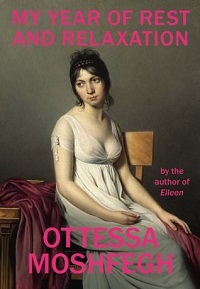
“My Year of Rest and Relaxation” by Ottessa Moshfegh

My Year of Rest and Relaxation

The premise of this book is very intriguing – a young woman decides to go into hibernation for a year to get through a depressing and listless period of her life. She has plenty of money to bankroll this, thanks to her inheritance from her wealthy parents who died within six months of each other a few years ago. Rather than committing suicide, which would be a permanent end to life, she thinks of “checking out” for a year, hoping it will help with the general malaise she is feeling and rejuvenate her. This hibernation – a whole year of rest and relaxation — is accomplished with the help of a large number of drugs prescribed by a not-very-professional therapist the woman manages to find, who seems to have no issues prescribing increasingly stronger drugs for depression and insomnia that the woman tells her she is experiencing.

Not only is the plot of book so fascinating, it also draws you in right away. Narrated in first person, it is almost like reading a diary – it is brutally honest and describes the narrator’s thoughts and feelings in such vivid detail, we can almost feel like we are her. The first person account is so well maintained throughout the book that we never learn the narrator’s name. We do, however, learn a lot of other details about her – in addition to having a lot of money, she is smart with a degree in art history from Columbia, and she is outstandingly pretty without even trying, attracting a lot of attention from guys and envy from women. She lives in a fancy apartment in Manhattan, buys very expensive clothes, and occasionally dates. She has an on-again off-again relationship with a handsome and successful man working in Wall Street, and has one loyal friend who is always dropping in to check on her. After graduation, she lands a job in a prestigious art gallery reputed for discovering “eclectic” artists and hosting their cutting-edge, post-modernist work.

While all of these may seem to be more than enough for a very rewarding and satisfying life for most people, for our narrator, they are not. While there is no one particular event that triggers her wanting to “check out” and go into hibernation, it seems to be the culmination of years of not having many happy or joyful moments, and a childhood growing up with parents who really didn’t feel anything for each other. Sometimes, it is not just the presence of bad things that can lead to antipathy and depression; it can also very well be the absence of good things. And this seems to be what is afflicting our narrator.

While the first few chapters of the book continue to hold your interest as you learn more about the narrator, her background, her reasons for wanting to hibernate, and the process she follows – heavy doses of drugs which make her sleep most of the time, long periods of blackouts in which she does not know what she is doing or where she is going, a lot of TV watching, trips to the local coffee shop to pick up coffee and snacks, a lot of take-out for meals, monthly visits to the therapist and the pharmacy to refill prescriptions – it begins to get very repetitive after some time, and I found myself skipping a lot of the content towards the second half of the book. By this time, you also lose sympathy for the narrator as she shows herself to be quite a selfish, uncaring person, and is particularly mean to her one friend who continues to visit her. You simply stop caring about what happens to her.

The time period that the book is set in is an important part of the plot, although you don’t realize that in the beginning. The woman goes into hibernation in the summer of 2000, which means that when her “one year” ends, it is close to 9/11. Her friend was working in the World Trade Center when the planes hit, and she keep watching the recording of the event over and over as it seems like one of the women jumping off from one of the towers may have been her friend.

The book ends with this, and you can’t help but read it with a catch in your throat.

My Year of Rest and Relaxation
Author: Ottessa Moshfegh
Publisher: Penguin Press
Publication Date: July 2018

Contributor: Lachmi Khemlani runs a technology publication in the San Francisco Bay Area.

“Clock Dance” by Anne Tyler

Clock Dance

Willa Drake—the protagonist of Anne Tyler’s latest novel, Clock Dance—is a self-defeating, self-effacing wimp.

Tyler divided Willa’s story into two parts. The first part consists of three situations in which Willa made self-defeating, shoot-yourself-in-the-foot, type choices.

When she is eleven years old, Willa rejects both her parents in a prolonged pre-teen pout. It’s easy to see why she rejects her mother: she’s a moody person who sometimes leaves her family to fend for themselves, and then returns pretending that nothing has happened. Willa’s anger at her mild-mannered, even-tempered father, is harder to fathom. She seems to deliberately take offense at something he says in an effort to comfort her while her mother is gone. The reader is left to wonder the real reason she gets angry and refuses his love. Is it because he is too passive to confront her mother? Because he goes along with the pretense that everything is fine? Or is it because he doesn’t take seriously Willa’s effort to fill the gap?

By the time she is 21, Willa is so far gone that when the passenger on one side of her in a jet airplane threatens her life with a gun, she doesn’t react in any way. She doesn’t scream; she doesn’t question the guy about what he wants; she doesn’t alert her boyfriend on the other side of her; she doesn’t alert the stewardess who comes by. Her will is paralyzed. When she later tells her boyfriend, he is incredulous and discounts her story.

She and her boyfriend, Derek Macintyre, are flying to visit her parents because Derek wants to marry her. Where Willa is weak, Derek is willful and assertive. Willa wants to wait until she has finished college, but he wants to marry in the summer coming up and move to California to start his career. His plans are more important to him than her plans, which he discounts. Toward the end of their week-end visit, he announces their engagement to her parents. Her mother says all the right things: she points out that he isn’t looking at Willa’s side of things and what Willa would have to give up for him. And she particularly notes that Derek had brushed off Willa’s story of being threatened on the airplane, because it shows how he disrespects her. Derek confronts her mother in a way that her father never could, and calmly tells her off. Instead of being strengthened by her mother’s support, Willa reacts against it, and against her own best interests, by giving into Derek.

After 20 years of predictable life with Derek—giving up college to raise two sons, being the sort of dependable mom she wishes her mother had been—Willa is suddenly left to her own devices when Derek is killed in an accident caused by his own road rage. She feels helpless and incompetent, which is the way he had always treated her. She begins to wonder about the purpose of life, or simply ‘why bother?’ She had always wanted to be so reliable that her sons could take her for granted, but now she finds that being taken for granted is not very satisfying. She still longs for someone to take care of her, and to boss her around.

The real story, Part II, starts when Willa is 61 years old, and it opens with a call to another life, an offer she can’t refuse. It takes the form of a phone call from someone who mistakenly assumes that Willa is the grandmother of an 8-year-old girl whose mother had been shot in the leg, in her neighborhood in Baltimore. She wants Willa to take care of the girl, Cheryl, while her mother, Denise, is in the hospital. Willa is now married to Peter, who is the same type as Derek, and is living the same arid retirement life in Arizona that she would have had with him. Uprooted from her world in California, Willa feels her life is meaningless and boring. When she hears of a child in need of a grandma, she can’t resist the temptation to play the role. Perhaps for the first time in her life, she spontaneously makes a major decision, without consulting Peter, and books her flight to Baltimore. Her bid for independence is somewhat muted by his decision to accompany her, condescendingly assuming she can’t handle the flight by herself.

Peter is fairly helpful, or at least non-interfering, but his attention is still on his own world, his business associates and golf buddies. Willa adapts to her role as grandmother, which includes adapting to a colorful cast of characters in the poor but respectable neighborhood where Cheryl and Denise live. She becomes so engrossed in her new life that she barely notices when Peter goes back to his world in Arizona. Meanwhile she is developing self-reliance—learning to drive a strange car around a strange town, learning to make decisions and choices on her own, learning to appreciate ‘everyday people,’ learning, for the first time, to enjoy the absence of a man to dominate her life. And the reader keeps thinking she ought to go back to her husband. Or should she?

My usual preference is for novels that are intellectually challenging, with a difficult vocabulary and complicated sentences, with big ideas and heavy drama. But sometimes I need a vacation from all that, and then I turn to Anne Tyler. Clock Dance is her 21st novel, and I have read about half of them. Her themes are positive and life-affirming, but her stories don’t reek of sentimentality and preachiness because her style is so spare and understated. It’s like Quaker wood furniture—functional but not fancy, well-crafted but plain. Tyler is generous with homely detail and engaging minor characters, but she is spare in her depiction of Willa’s inner life. By leaving a lot unsaid, she forces the reader to use their imagination.

For me, Anne Tyler is consistently good, but never great. But that’s okay. It’s like simple home cooking compared to gourmet meals—sometimes that’s just what I need.

Clock Dance
Author: Anne Tyler
Publisher: Knopf
Publication Date: July 2018

Contributor: Jan Looper Smith writes about her culture experiences for a blog called “In the Loop.”

“My Ex-Life” by Stephen McCauley

My Ex-Life

This was a fun, breezy book, a welcome change from the intense, heavy, and serious plotlines of most of the current crop of critically acclaimed novels that I have been reading lately. However, it was not escapist fiction by any means, which can be fun to read at times, but is neither memorable not uplifting. My Ex-Life was both.

The book tells the story of a gay man, David, who travels from San Francisco to the East Coast to help out his ex-wife, Julie, who he was briefly married to in his early twenties, and her seventeen year old daughter from a subsequent marriage, Mandy, whose father, Henry, is pushing her to “get her act together” and get into a good college. David is a college counselor, and when Mandy finds out that he was Julie’s first husband, she reaches out to him. She is going through the turmoil and angst typical of kids of that age, and it is compounded by the fact that her parents are going through a divorce. While this is not an emotional blow for Julie — she fell out of love with Henry a long time ago — it is problematic in a different way — she will lose the house that she jointly owns with Henry unless she buys out his share. She is running it as an Airbnb, and while she is not making a whole lot of money from it, she loves it.

David, too, is in somewhat of a crisis — his younger boyfriend has left him for another man, and the house that he was renting is going to be sold, so he will have to find another place to live. Therefore, when Mandy reaches out to him, ostensibly for help with her college applications, he actually travels to the small town near Boston called Beauport where Julie lives, to visit them and help Mandy in person. He ends up staying at the Airbnb and helping Julie with it, doing a lot of repairs and de-cluttering. Despite the breakup of their marriage all those years ago, David and Julie remain very fond of each other, and their deep mutual affection is rekindled by David’s extended visit. Not only is he working with Julie on trying to get the money to buy out Henry’s share so she can retain the house, the trip to Beauport has also allowed him to get away from his own problems in San Francisco. And, of course, there’s the challenge of helping Mandy, who has some other issues in addition to typical teenage rebellion and aimlessness.

With such an unconventional plotline, My Ex-Life was hard to put down, and it was made even more enjoyable by the quality of the writing, especially the humor. There were so many parts that were funny, especially earlier on in the book — David’s chance meeting with his ex-boyfriend at a party, Julie’s struggles with her pot addiction, Mandy’s summer job at a knick-knacks store in Beauport from which she is fired for not having an enthusiastic “cheery” attitude that could encourages sales, and the increasingly scathing feedback from the Airbnb consultant that Julie has hired to figure out how to improve business as she (the consultant) is taken on a tour of the house. All of the humor is extremely witty, and I appreciated that it was intelligent rather than slapstick.

It was also both funny and insightful to learn about David’s work as a college counselor and read some of the college essays that the students he was counseling were writing for their applications. Apparently, about 90% of essays begin with the mention of a grandparent or cancer and these rarely get read by admission directors, since they have so many to plow throw. In contrast, there is this one with an opening that is impossible to not continue reading:

Growing up, my father encouraged my brother and me to piss in the kitchen sink when my mother wasn’t home.”

Just that one line made reading this book so worth it!

My Ex-Life
Author: Stephen McCauley
Publisher: Flatiron Books
Publication Date: May 2018

Contributor: Lachmi Khemlani runs a technology publication in the San Francisco Bay Area.

“A Place for Us” by Fatima Farheen Mirza

A Place for Us

This book had almost too much hype surrounding it, as it was the first book to be published by Sarah Jessica Parker’s new imprint at Hogarth Publishing, called SJP. (She is best known as the lead actress from TV’s Sex and the City.) Apparently, it was hand-picked by her and she described herself as being “taken hostage by Fatima Mirza’s heartrending and timely story.” I was naturally excited when I was able to get a copy of the book to read — I expected it to be mind-blowing.

At the outset, I must say that it was not. It tells the story of a traditional Muslim family living in the San Francisco Bay area — although it would be more accurate to say that it is more of a narration of their lives rather than a “story” as such. The parents are extremely religious and follow all the Islamic rules and rituals. They have three children, all of whom were born in the US. You would expect some kind of conflict between the parents and the kids, some kind of culture clash, which is so much a part of the immigrant experience. However, for the family in A Place for Us, the two older children — who are girls — grow up following the religion and being obedient daughters, not out of fear of their parents but because they simply do not question their faith. While they do go on to achieve professional success — one becomes a doctor and the other a teacher – their lives are firmly rooted in Islam. They both wear the hijab and end up marry Muslims. About the only rebellious thing the elder daughter does is marry a Muslim boy from a different sect!

There is some drama, however, that comes from the youngest child, Amar, who does rebel – he smokes, drinks alcohol, and eventually gets into drugs, all of which are forbidden by Islam. Naturally, he clashes with his traditional parents and ends up leaving home. And oh, he also falls for a girl, but she is also a Muslim. That is the extent of his non-conformity. Amar never returns home, apart from a brief visit for his sister’s wedding. The book ends with the father looking back on his parenting with some regret and wishing that he had been less angry and more loving with his children, so that his son was not driven away.

This, really, was the extent of the plot of the book. Apart from Amar rebelling and leaving the house, nothing really happens. There is no other issue, no calamity as such. It made me wonder why I was even reading about this family, with its relative lack of problems. If all they had to worry about was one child not being sold on the religious beliefs of the family, they seemed to be very lucky. Even the fact that they were Muslims in an increasingly Islamaphobic world did not emerge as an issue. There was only a brief reference to 9/11 and its aftermath — Amar got into a fight at school and the two older girls stopped wearing the hijab for some time following their parents’ advice — but that was about it. A passing reference is made to the 2016 election towards the end of the book, but I imagine that most of the book must have been written before the current hostile political climate.

Given the lack of a real plot, what may have given the book credibility and led to its selection by Sarah Jessica Parker as the first book for her new imprint was that it was very well written and provided a lot of details about the lives of the individual members of the family. I could see how this could be a novelty to Western audiences, allowing them a glimpse into a totally different way of life and culture — how a Muslim family lives in the US, how the kids are brought up, what are the customs and rituals they follow, and so on. However, as someone from India who now lives in the US, none of these details were new to me or even especially interesting. It was as if anyone could just capture the mundane details of their life — how they were brought up, the little things they did, their relationships with their parents and their siblings, etc. — and it would be worthy of publication in a novel. I imagine that many of the details in A Place for Us come directly from the author’s own life and experiences, given that it is her first novel and most first novels tend to be very autobiographical.

I would put this book in the same category as Exit West, another book that was highly acclaimed by critics, but which I did not much care for. While I appreciate the fact that these young authors are getting a chance and feel happy for them, I wish critics and publishers were a little more discerning and found books with some real merit to them.

A Place for Us
Author: Fatima Farheen Mirza
Publisher: SJP for Hogarth
Publication Date: June 2018

Contributor: Lachmi Khemlani runs a technology publication in the San Francisco Bay Area.