“The Secret History” by Donna Tartt

The author of The Secret History, Donna Tartt, is best known for her book, The Goldfinch, for which she won the Pulitzer Prize in 2014 and which was recently made into a movie. Even though the movie was almost universally panned by critics, I loved it, which made me want to read more of Donna Tartt’s work. The Secret History is her first book, published in 1992, and like The Goldfinch, it is extremely long (592 pages) and amazingly detailed. In fact, given the length of her books (The Goldfinch was 784 pages), I was not surprised to find that she publishes a book only every 10 years or so — The Goldfinch, published in 2013, was her third book, following her second one, The Little Friend, which was published in 2002. 

The Secret History came to me so highly recommended that I didn’t bother with knowing what it was about — my copy of the book from the library was missing the blurb — and I plunged right into it, prepared to stop reading as soon as it got uninteresting. And for such a long book, this seemed more likely than not. But much to my surprise, I found it fascinating and while it did lose a bit of momentum towards the end, I was so invested in the story by this time that I had no trouble finishing it — I had to know what happens in the end.

The book is set in a small liberal arts college in Vermont and the protagonist is a new student, Richard, who has transferred to it from a local college in California that he attended after high school. He is not close to his parents and they do not care much about him either, and with no siblings as well, there is no real family that he is close to. This makes it believable that he would be strongly attracted to a small group of students who keep to themselves and choose to be isolated from the other students. In fact, not only do they distance themselves socially, they are academically separated as well, as they study Greek exclusively under the tutelage of a brilliant, charismatic, and eccentric professor, who seems to have the kind of leverage with the college that is needed to create such a closed classroom.

Richard manages to break through and get inducted in the group, and at first all goes well — he loves the closeness and the camaraderie as well as getting deeper into Greek and the classics. But then, there is an accidental murder during one of the Greek rituals being performed by the group (it is called “Bacchanalia” — there is actually such a thing, as I found when I looked it up), and this murder is then followed by a deliberate murder of a student in the group who was blackmailing the others to keep quiet about it. As a reader, you know this is coming, since the book starts with a prologue about the murder — so it is not a “murder mystery” as such — but you don’t know the “how” and the “why,” which keeps you hooked. Then there is the whole aftermath of the second murder, how it plays out with the family of the dead student, and what effect it has on the group.

While the basic premise of The Secret History — that a professor can form an exclusive club of students within a college and dictate their academic requirements, that some students would actually want to be part of such a club that won’t really give them a usable degree, and that anyone would want to get so knee-deep into Greek that they don’t care about learning anything else — is downright unbelievable, it is to the author’s credit that she can take something so implausible and craft a story around it that seems so believable, so authentic. And the book was so vivid, so full of details about the lives of these students and about life in a college town, not to mention the extensive discourse on Greek mythology and Greek philosophy, that I was completely hooked.

And rather than being intimidated by the length of the book, it was so nice to have a good long book to sink my teeth into!

The Secret History
Author: Donna Tartt   
Publisher: Alfred A. Knopf
Publication Date: September 1992 

Contributor: Lachmi Khemlani runs a technology publication in the San Francisco Bay Area.

“Island of a Thousand Mirrors” by Nayomi Munaweera

I was entranced by this book. Not only was it such a gripping story, the quality of the writing was so lyrical that I actually read the book slowly to savor it, which is not something I normally do. Also, the story is set against the backdrop of the civil war in Sri Lanka, which, being from neighboring India, was something I knew a little about — but not a whole lot. Any reference to war in India usually brings to mind its long-standing conflict with Pakistan, and to a smaller extent, its conflict with China in the 1960s. Most Indians don’t pay much attention to this relatively small island nation, just south of India’s border, except when the conflict comes to our doors, as with the assassination of Rajiv Gandhi in 1991 by a suicide bomber from the LTTE (Liberation Tigers of Tamil Eelam). Also known as the “Tamil Tigers,” this is the same militant organization that is on one side of the conflict in Sri Lanka, with the other being the Sinhalese, who make up the largest ethnic group in the country.

Island of a Thousand Mirrors follows the lives of two women, one Sinhalese and the other Tamil, growing up in different parts of the country. They never meet, but their lives intersect towards the end in an unexpectedly brutal way. The Sinhalese woman, Yasodhara, grows up in the capital city, Colombo, in the years before the conflict, and has what can best be described as an idyllic childhood, with a loving extended family. When the civil war escalates and the brutality of it comes too close to home, Yasodhara’s parents immigrate to the US and she lives there, shielded from the conflict, until she returns to Sri Lanka for a visit — urged by her sister who has returned before her — to heal from a broken marriage.

In parallel, we also follow the life of Saraswathi, who grows up in the north of the island in a Tamil enclave, and despite the best efforts of her parents to keep her away from the conflict, she ends up being recruited by the Tamil Tigers to join the war for “Eelam,” the independent Tamil state they want. Saraswathi had dreamt of being a teacher growing up, but then she was captured by Sinhalese soldiers and suffered such horrific sexual violence that the only two options she could see before her were suicide — like some of her other friends who had been subjected to the same violence — or joining the Tamil Tigers. She ends up choosing the latter, and the memory of the abuse she suffered makes her a particularly brutal soldier, one who has no problem with wielding a machete and slashing even women and children to death. Her ferocity, cold-bloodedness, and fearlessness make her rise quickly through the ranks of the Tamil Tigers and lead her to become what is perceived as the highest honor for a soldier in the movement — a suicide bomber.

Island of a Thousand Mirrors is beautifully written, capturing the magical quality of the island, its tranquility, and its lushness in the years before the conflict, as well as the horrors of the civil war once it starts, the brutality, the riots, the senseless slaughter of people, the atrocities committed on both sides. Seeing the war through the personal lives of the two protagonists who are from the opposite sides of the ethnic conflict, and who get embroiled in it without wanting to, shows that there no winners in a war — everyone loses.

Despite the war being the central thread running through the book — and it is to the credit of the writing that I approached these parts with a sense of dread and foreboding — a good part of first half is devoted to describing Yasodhara’s extended family, starting with both sets of grandparents and going as far back as when the British departed the island in 1948.  This made Island of a Thousand Mirrors a truly multi-generational saga, with details about the lives of the different family members, their houses, their food, their day-to-day activities, family dynamics, family traditions, childhood friendships, first loves, and marriages. Not only was it fascinating to see how life and customs evolved in Sri Lanka — and in my case, to see the parallels with life in India — but also to see it captured in such beautiful, evocative prose. Here is an example, describing an interior courtyard in the childhood home of Visaka, Yasodhara’s mother:

The queen of this domain, an enormous trailing jasmine, impervious to pruning, spreads a fragrant carpet of white. When the sea breeze whispers, a  snowing flurry of flowers sweeps into the house so that Visaka’s earliest and most tender memory is the combined scent of jasmine and sea salt.

Another example, this one describing a dip in the ocean by Yasodhara’s father, Nishan, when he, as “the last British ships slip over the horizon,” is cavorting on beaches he does not yet know are pristine:

Farther out beyond the reef, where the coral gives way to the true deep, at a certain time of day, a tribe of flat silver fish gather in their thousands. To be there is to be surrounded by living shards of light. At a secret signal, all is chaos, a thousand mirrors shattering about him. Then the school speeds to sea and the boy is left in sedate water, a tug and pull of the body as comfortable as sitting in his father’s outspread sarong being sung to sleep.

With prose that is so poetic through the book, reading it was sheer delight. I was sorry when it came to an end.

Island of a Thousand Mirrors
Author: Nayomi Munaweera              
Publisher and Date, US Edition: St. Martin’s Press, September 2014        
First published in Sri Lanka in 2012 by Perara Hussein Publishing House

Contributor: Lachmi Khemlani runs a technology publication in the San Francisco Bay Area.
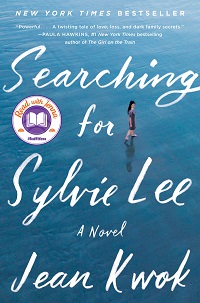
“Searching for Sylvie Lee” by Jean Kwok

What made me pick up this book from the many displayed in the ‘New’ section of my local library was the quote by Paula Hawkins on the cover, calling it a “twisting tale of love, loss, and dark family secrets.” I loved Paula Hawkins’ debut novel, The Girl on the Train, which was also a huge bestseller, and an endorsement from her seemed very promising. If it was even one-tenth as good as The Girl on the Train, that would be good enough for me.

Having finished it, I can say that it was — just about. I was at least able to finish it without forcing myself to — it did manage to sustain my interest right up to the end, which is no mean feat, given the number of books I started recently that I was forced to abandon after a few chapters because they just didn’t grip me. As the title of the book suggests — Searching for Sylvie Lee — there is a mystery at the heart of it, which makes you want to go on reading until it is solved. Over and above that, however, I also found the book well written, with a cast of characters in a setting that was unusual, to say the least. The majority of the book is set in the Netherlands, and most of the main characters are Chinese, either immigrants or, in the case of the younger generation, either Chinese Americans or Chinese Dutch. Here in the US, we are surrounded by Chinese Americans, so there is not much novelty, but in the Netherlands, people of Chinese origin are still a rarity, and it was very interesting to read about their experiences.

The basic plot of the book is that a young Chinese American woman, Sylvie — Ivy-league educated, smart, and successful — goes to the Netherlands to visit her dying grandmother — and then just disappears. She was supposed to have travelled back to the US, but never shows up. Her family is panic-stricken, and her younger sister, Amy, travels to the Netherlands to try and find her. The reason their grandmother was there to begin with was that she had been living permanently with her well-to-do niece, Helena, helping her with raising her son, Lukas. In fact, Sylvie was sent to stay with them for most of her childhood, as her immigrant parents were struggling to make ends meet in the US. Thus, Sylvie and Lukas grew up together, and she had a strong maternal bond with her grandmother, which she was never able to cultivate with her own mother even after she was brought back to the US.

The story is alternately told from the points of view of Amy, her mother (who, in turns out, has a critical role to play in how the plot unfolds), and Sylvie herself. Also, it is told in staggered timelines, with Sylvie’s chapters set about a month before Amy’s, so we are seeing their experiences in parallel, but without really knowing what happens to Sylvie until closer to the end of the book. It was an interesting plot device, one that I haven’t come across very often, and it was effective in sustaining the momentum of the story while progressively inching towards the mystery of what happened to Sylvie.

While I did find the end a little anticlimactic — it started out seeming like a murder mystery but wasn’t really — I enjoyed the overall storyline, the writing, and especially the details about life in the Netherlands as well as the Chinese Dutch experience of it. Those were very authentic and seemed to come from the author’s own experience of being of Chinese descent and currently living in the Netherlands. Searching for Sylvie Lee is by no means a work of literature, but it was overall, a good read.

Searching for Sylvie Lee
Author: Jean Kwok                               
Publisher: William Morrow               
Publication Date: June 2019       

Contributor: Lachmi Khemlani runs a technology publication in the San Francisco Bay Area.