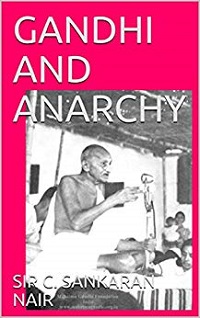
This book was given to me by a relative of the author. Published in 1922, just seven years after Gandhi’s arrival in India, it paints an unflattering portrait of the Mahatma. The author, Chettur Sankaran Nair, had been elected President of the Indian National Congress in 1897. In October 1915 (10 months after Gandhi’s arrival in India), Nair was appointed as a Member of the Viceroy’s Executive Council. He resigned in July 1919, soon after the Jallianwalabagh massacre. At that time he was the only Indian on the Council. Annie Besant and C F Andrews tried to persuade him to remain. Nair refused.
“Mr. Gandhi is not leading his followers in the direction of the promised land,” wrote Nair. “He is not only going in the opposite direction but instead of toughening our fibre by a life of toil and struggle is endeavouring to entirely emasculate us and render us altogether unfit for the glorious destiny that, but for him and others like him, is awaiting us.”
Nair was appalled by Gandhi’s views on mechanization. “His tirade against machinery and mill industries on account of the evils he has witnessed in the West is due to his ignorance; a little knowledge in his case has proved a dangerous thing. It is this feeling which has led him to advocate the use of spinning wheel in India. This might be useful as a cottage or home industry. It might find work for someone who would otherwise be idle. But he’s living in a fool’s paradise if he considers it a substitute for or will supplant machinery.”
Nair opined that Gandhi was justifying the caste system “to secure the support of the higher castes, without whose financial support his agitation must collapse.”
Citing a New India report of 27th October 1921, Nair stated tongue-in-cheek, “Mr. Gandhi said that if there was violence he would go to the Himalayas. There was a riot, but he did not go, but excused himself by saying that if it occurred a second time, he would go. A second riot occurred; he said nothing but did not go.” He further referred to a Times of India report published in October 1921. “Writing in the latest issue of Navajivan, his Gujarati newspaper, Mr. Gandhi makes the interesting announcement that if Swaraj is not obtained by December, he will either die of a broken heart or retire from public life.” That the Mahatma neither went to the Himalayas nor retired from public life, nor died of a broken heart is common knowledge.
Nair quotes extensively from Gandhi’s own writings, letters and speeches to highlight the sheer absurdity of the Mahatma’s stand:
• That which you consider to be the Mother of Parliaments is like a sterile woman and a prostitute. Both of these are harsh terms, but exactly fit the case. That Parliament has not yet of its own accord done a single good thing; hence I have compared it to a sterile woman……It is like a prostitute because it is under the control of ministers who change from time to time. Today it is under Mr. Asquith; tomorrow it may be under Mr. Balfour.
• Hospitals are the instruments that the devil has been using for his own purpose, in order to keep his hold on his kingdom. They perpetuate vice, misery and degradation and real slavery. (Written in 1909 in a letter to a friend in India.)
• I am not aiming at destroying railways or hospitals, though I would certainly welcome their natural destruction. Neither railways nor hospitals are a test of a high and pure civilization. At best they are a necessary evil. (Written in 1921.)
• When the charka comes into force in India, I would introduce the spinning wheel among the Afghan tribes and also thus prevent them from attacking the Indian territories. (In an interview to the Daily Express)
• If thirty crores of people say that they are not with me yet I shall do my work and win Swaraj…If you wish to accomplish work of thirty crores of men then come out with your money. Try to have money and ask me to give an account of the same. I appoint someone treasurer….If you know that you yourself cannot attain Swaraj then help one with money. If you do not help with money Swaraj will be difficult but not impossible to attain. (In a public address to the merchants of Calcutta on 30th January 1921.)
Well this is certainly not the Father of the Nation out history books told us about. Was Nair harbouring a grouse against Gandhi and out to malign him? Was he exaggerating, playing games with the truth, spreading canards? Well, he was too big a man to stoop to that level, and he wasn’t exactly competing with Gandhi.
Interestingly, Vinayak Damodar Savarkar had similar views about Gandhi’s stand on various issues. Recently two South African professors of Indian origin published a well-researched book titled, “The South African Gandhi – Stretcher Bearer of Empire”, wherein we come to see a hitherto unknown side of the Mahatma. (Read review here: https://bookswehaveread.com/2016/07/05/the-south-african-gandhi/)
The book is now available online free of cost. https://archive.org/details/gandhianarchy00sankuoft/page/n6
Overall Assessment: Certainly worth reading.
Gandhi and Anarchy
Author: Sir C Sankaran Nair
Publisher: Tagore & Co., Madras
Publication Date: 1922
Contributor: Pushpa Kurup lives in Trivandrum, India and works in the IT sector.

 Books We've Read