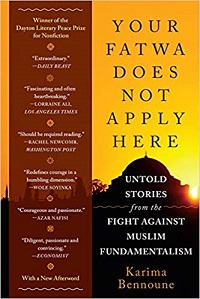
“The struggle waged in Muslim majority societies against extremism is one of the most important – and overlooked – human rights struggles in the world.” This book explores the nuances of Islamic extremism, and amplifies hitherto unheard voices from remote corners of the globe – men and women living under fundamentalist threats, victims of violence, martyrs and survivors. Bennoune managed to interview 286 Muslims across 26 countries.
“Muslims did not get hit on the head one day, then wake up and don niqabs, grow beards and become fundamentalists. A conscious political process fostered these developments…” Iran exported its brand of religious revolution ever since the mullahs came to power in 1979. Britain supported the Muslim Brotherhood in Egypt. Saudi Arabia spends colossal amounts to propagate its ultra-conservative ideology – and its US ally shamelessly shields it. The US funded Pakistan’s dictatorship and the Afghan mujahideen in order to counter Russian communist influence. Iraq under Saddam Hussein was a secular dictatorship, but US intervention turned it into a hotbed of Islamic terrorism.
In the author’s birthplace, Algeria, 200,000 innocents disappeared during the ‘dark decade’ of the 1990s. Tahar Djaout had uttered a dark prophesy before his assassination in 1993: “If you speak out, they will kill you. If you keep silent, they will kill you. So speak out, and die.”
The Quran states that the killing of an innocent person is killing the whole of humanity. Chechnya-born Moscow journalist, Said Bitsoev, avers, “Suicide is a very grave sin in Islam, but these radicals brought in the idea that you can blow yourself up to celebrate Islam.”
Speaking of the economic causes of the rise of fundamentalism in Niger, Aminatou Daouda Hainikoye says, “In the beginning they offer you money to adhere to their version of religion, to wear the burqa, the hijab, the niqab. They give out money, food, bags of rice, cooking oil. Even if you are not convinced in your heart, you accept so as not to die of hunger.” She adds, “They want to take Niger back to the days of the Prophet, PBUH.” Bennoune points out that even Fiji in the Pacific has seen a marked rise in number of veiled women.
Babur, the founder of the Mughal empire, during his Afghanistan sojourn, declared, “You only have to stretch your leg in Herat to kick a poet.” Five centuries later, in 2001, Taliban supremo Mullah Omar ordered all pre-Islamic art destroyed. The Talibs raided the National Museum and vandalized over 2750 statues.
In Pakistan in 2007, Zil-e Huma Usman, Punjab minister for Social Welfare, was shot dead, and the assassin said she was not properly covered in her salwar-kameez. In 2012 it was Malala Yousafzai for daring to advocate girls’ education. Asia Bibi was sentenced to death for ‘insulting the Prophet’. Punjab governor Salman Taseer was gunned down for tweeting his opposition to the blasphemy law. During Zia ul Haq’s regime, the poet Faiz Ahmed Faiz was forced into exile. (Today in India his 1979 composition ‘hum dekhenge’ has become a rallying cry for people opposing the far right and the Citizenship Amendment Act.)
When the Prophet captured Mecca, there was much rejoicing, with men and women singing, dancing, clapping and playing the duff. Today the fundamentalists say music is haraam. In 2010, Al Shabaab forbade music broadcasts in Somalia. In March 2012 the northern part of Mali, roughly 60% of the territory, fell to an affiliate of Al Qaeda. The Ansar Dine banned music, sports, smoking and drinking. They desecrated the tombs of Sufi saints in Timbuktu, and torched the library, destroying at least 2000 ancient manuscripts.
Shirwa Ahmed became the first US citizen suicide bomber when he blew himself up in Somalia on 29th October, 2009, killing thirty innocents. Ahmed apparently had been radicalized in his hometown in Minnesota, where Al Shabaab had begun recruitment in 2006. By 2008, twenty Somali boys had disappeared.
In Kabul in 2011, fifty women took out a procession carrying banners with the words, “I have the right to walk freely in my city,” and “Street harassment is against Islam.” The Prophet Muhammad said nobody but those who are inferior in character will disrespect women. But the fundamentalists say women ought to be chaste, then they abduct and gang rape them.
Though Iran is a Shi’a country, it has contributed to the radicalization of Sunni religious authorities as well. In a 1963 fatwa Ayatollah Khomeini had declared that women’s political participation was tantamount to prostitution.
In the holy city of Mecca in 2002, when girl students tied to escape a burning school building the religious police blocked their exit saying they were not properly covered. Fifteen girls died in the blaze.
Asma Al Ghoul, a journalist from the Gaza border town of Rafah, stopped wearing the headscarf in 2006. In 2010 she cycled along the Gaza coastline to defy the Hamas ban on women riding bikes. In post-Saddam Iraq, Yanar Mohammed was photographed burning a hijab, for a magazine cover seen around the world. (Later, Yanar had to flee the country.)
“Subordinating women – in the family, in the street, in the bedroom – is central to most fundamentalist visions for society around the world.” Worldwide some 140 million women have undergone female genital mutilation (FGM). Fundamentalists use the false alibi of religion to perpetuate such horrific pre-Islamic practices. The Quran does not say that women must be excised.
“The Left has often downplayed the threat of extremism,” Bennoune laments. She asks how the influential left-wing radio show Democracy Now could glorify Tariq Ramadan, grandson of the Muslim Brotherhood founder, who openly disapproves of homosexuality, feminism, and secular Muslims. The book argues that instead of fighting terrorism we need to fight fundamentalism, because as long as there are universities and communities where children are indoctrinated, terrorist groups will never lack fresh recruits.
Bennoune reminds us of the Quranic saying, “Unto you your religion and unto me mine.” She also quotes Algerian writer Yasmina Khadra’s statement, “What we have to prove to the world, we must prove with work, talent and ambition.”
I read the book with my heart in my mouth. Very often I googled the names of the people mentioned – just to make sure they are still alive.
Overall assessment: Must read.
Your Fatwa Does Not Apply Here
Author: Karima Bennoune
Publisher: WW Norton & Company Inc.
Publication Date: December 2014
Contributor: Pushpa Kurup lives in Trivandrum, India and works in the IT sector.

 Books We've Read