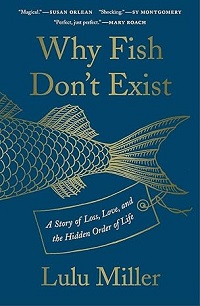
“Why Fish Don’t Exist” by Lulu Miller

I wanted to share a new read I enjoyed — Why Fish Don’t Exist. It is a memoir by Lulu Miller, an NPR science reporter. I stumbled upon this book after a few lukewarm reads recently. During one of her field assignments, Miller learns about a late 19th century taxonomist, David Starr Jordan, whose diaries reveal his lifetime focus and zeal to identify, name, and classify fish. Much of Miller’s book is focused on Jordan’s life and work and how it has inspired her own.

After 20 years of grueling work, Jordan’s lab, with all his named specimens, catches fire in the 1906 San Francisco earthquake, and his work is instantly ruined. Right after the incident, he was seen sowing a needle with the name tag into the first fish he recognized, and he rebuilt his entire body of work from the ground up.

Jordan is known to have named one-fifth of all the fishes in the world. He spends his entire life meticulously creating boundaries and clean edges on a species where none exists (as per Darwin’s definition of the word), and as an extension of his work, becomes one of first proponents of eugenics attempting to build a perfect human society. (As fate would have it, scientists later discover that the category Jordan was studying all his life was nonexistent — all fish do not have a common ancestor.)

Jordan was also the first president of Stanford university and was, in fact, suspected to have played a role in killing one of its founders! His life reads like a Shakespearean play with passion, drama, love and intrigue. 

In the book, Lulu Miller, through Jordan’s life, explores our need to classify and bucketize the world and how, in the process, we lose the subtleties and richness of existence. Limited by language, and the inherent need to rank and file and make sense of the world, leaves us stunted of its inconceivable breadth.  Part existential, part hopeful, Miller explores Jordan’s life in all its complexity, with grace and poignance, as well as her own.

Here are some quotes from the book that capture its essence.

In response to the question of “What are we here for?” that Miller asks her father when she was eight and going with him on a nature walk, her father, who was a man of science and similar to David Starr Jordan in spirit and in “seeing the grandeur,” responds with these:  

We are specks, flickering in and out of existence, with no significance to the cosmos.

And …

He informed me that there is no meaning of life. There is no point. There is no God. No one watching you or caring in any way. There is no afterlife. No destiny. No plan. And don’t believe anyone who tells you there is. These are all things people dream up to comfort themselves against the scary feeling that none of this matters and you don’t matter. But the truth is, none of this matters and you don’t matter.

But still, her father advises:

While other people don’t matter, either, treat them like they do.

Here is an excerpt from Jordan’s diary. His scribbles shed light on his obsession, his desperation, the near-muscular effort to restart when his lab burns down destroying all his work:

“Happiness comes from doing, helping, working, loving, fighting, conquering,” he writes in a syllabus from around the same time, “from the exercise of functions; from self-activity.” Don’t overthink it, I think, is his point. Enjoy the journey. Savor the small things. The “luscious” taste of a peach, the “lavish” colors of tropical fish, the rush from exercise that allows one to experience “the stern joy which warriors feel.” Toward the end of the book, he quotes Thoreau — “There is no hope for you unless this bit of sod under your feet is the sweetest to you in this world — in any world” — and then he sends his readers off with a rousing dose of carpe diem. “Nowhere is the sky so blue, the grass so green, the sunshine so bright, the shade so welcome, as right here, now, today.”

And finally, here is an astute summation of Jordan by the author, which I found very insightful:

Whatever the case, it works for him. He loses a wife, and wins another quickly. He loses a fish collection, and rebuilds a bigger one. He is promoted to higher and higher offices. The awards and medals start clattering in, for teaching, for ichthyology, for contributions to higher ed. An odd alchemy of delusion right before your eyes. Little lies transmuting into bronze, silver, gold. Forget millennia of warnings to stay humble; maybe this is just how it works in a godless system. Maybe David Starr Jordan is proof that a steady dose of hubris is the best way of overcoming doomed odds.

Why Fish Don’t Exist
Author: Lulu Miller
Publisher: Simon & Schuster
Publication Date: April 2020

Contributor: Sanjana Nair

“Strange Sally Diamond” by Liz Nugent

This book hooked me in right from the very first paragraph. A dying father tells his daughter to “put him in the trash” after he dies as he “won’t know any better” since he will be dead. He was joking, of course, but she took him at his word and did exactly that. The daughter is Sally Diamond, and after her father dies, she puts his body in a large garbage bag and feeds it to the incinerator on their property, just like they have been doing with all their garbage in the remote location in which she has been living with her father. It soon becomes obvious that she is autistic, which is why no criminal charges are brought against her when it is discovered that he is dead and that she had tried to cremate his remains. (The incineration did not work very well, and his body was eventually recovered.)

It turns out that there is a reason for Sally being “weird” or “strange,” which is what the folks around her — in the small town in Ireland where she lives — call her. She was born and raised under such extreme trauma that her brain has essentially “shut down,” leaving her with no memories of her childhood and severely limited social skills. Her mother was abducted by a pedophile when she was eleven and held captive for over 14 years, during which she was repeatedly abused and raped. Sally was born during this time and spent the first five years of her life locked up in a room with her mother. It was only through sheer luck — a botched burglary attempt — that she and her mother were discovered and rescued, and while her mother died soon after by suicide, Sally ended up being adopted by the psychiatrist couple who were in charge of treating her and her mother. They were very loving and did their best to give her a normal childhood — especially her adoptive mother — but the damage to her psyche had already been done. Also, the heavy doses of medication she received as part of the treatment for her trauma had the effect of suppressing the memory of it entirely, so she never ever had a chance to confront who she was or what had happened to her.

The death of her adoptive father — whose body she tries to unsuccessfully incinerate — changes that. Her adoptive mother died some years ago, so Sally is left all alone without any emotional support. The book is the story of how she copes, of how she gradually opens up to other people who want to help and support her. She also comes to know of the horrific trauma that her mother was subjected to and the circumstances under which she was born.

Unbeknownst to Sally, her mother had another child earlier on in her captivity, a boy called Peter who was separated from their mother by the kidnapper and raised in isolation without any knowledge of who he was or how he was born. So he had no knowledge of Sally either, and only learned of her once the news broke of her unsuccessful attempt at incinerating her adoptive father’s remains, which captured national and international attention. In addition to Sally’s story in the current timeline, we also go back in the past to when Peter was a boy and learn about how he was kept in the dark by his father — the kidnapper – and knew nothing about his mother and baby sister. He is taken to New Zealand by his father, who flees Ireland once the kidnapping is discovered, where he is once again forced to live in isolation as his father has told him that he has an extreme medical condition that will cause him to die if he is touched by anyone. This eventually causes him to let the only friend he makes – a Māori boy in the house next door – drown when they go for a swim, as he believes that he cannot touch him to save him. He eventually realizes how his father has deceived him, and he is so upset that he crashes the car he is driving and does not save his father, who was in the car with him, even though he could have.

Once Peter learns of Sally’s existence, he starts to tentatively reach out to her, and they do eventually connect. But contrary to our hope and anticipation that the long-lost siblings will now support each other and provide the family connection that each has been missing, the story ends in a way I could not have predicted. It is not the proverbial happy ending, but it was still deeply satisfying and very touching.

And the hook that drew me in at the start of the book – it did not let up and was sustained throughout the book. All in all, Strange Sally Diamond, was a very unique story, masterfully told. I was so happy to have found this book. (Courtesy: Bookmarks Magazine, July/Aug 2024, Issue 131)

Strange Sally Diamond
Author: Liz Nugent
Publisher: Gallery/Scout Press
Publication Date: July 2023

Contributor: Lachmi Khemlani is a fan of the written word.