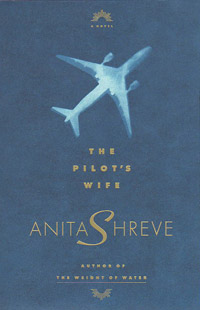
“The Pilot’s Wife” by Anita Shreve

The Pilot's Wife

I first read Anita Shreve’s popular novel, The Pilot’s Wife, shortly after it was published in 1998. While the book was no means a literary sensation or even highly acclaimed by critics, it did gain wide readership by virtue of being chosen as an “Oprah’s Book Club” selection for March 1999. (While this club does not exist anymore, it was quite an honor to be selected, in addition to dramatically boosting sales.) At the time I read The Pilot’s Wife, I also read quite a few other books by Anita Shreve that I recall enjoying, especially her most well-known book, The Weight of Water.  That said, I would not have sought out Anita Shreve to read again, except for a recent first visit to Maine, where its unique geography of multiple islands dotting the coastline reminded me of a fascinating historical fiction set in these islands that I had read a long time ago, and which I wanted to re-read now that I had actually been there. While I couldn’t remember exactly what that book was, I thought it might be an Anita Shreve novel, given that many of her books were set in Maine and along the coast.

Well, as it turned out, it wasn’t – I borrowed several possible Anita Shreve books from the library and needed only a quick perusal to determine that none of them was the one I was looking for. I did not even find myself wanting to re-read them now, even though it had been over 15 years since I had first read them — except for The Pilot’s Wife. I started reading it, and found the plot even more compelling now than when I read it all those years ago. Kathryn, whose husband, Jack, is a pilot for a commercial airliner has just been informed that her husband has died in a plane crash. As the book unfolds, the details begin to emerge – that the crash was caused by an explosion, which in turn was caused by a bomb, and that it may have been Jack himself who took the bomb on board, making him responsible not only for his own death but that of the other crew members and over a hundred passengers that were on board. This notion of “suicide-bombing” is one that we are, unfortunately, all too familiar with now, which makes the book seem eerily timely, even though it was written over 15 years ago. As always, there is some political unrest underlying these tragedies, and while the one in The Pilot’s Wife had to do with Ireland and the IRA, it is not all that different from the political turmoil and terrorism threats we constantly live with today.

Apart from this analogy that makes the book even more relatable now, The Pilot’s Wife primarily revolves around Kathryn and how she copes with not only the death of her husband and the revelation that he may be a suicide-bomber, but also with the fact that there was a side to him about which she knew nothing– that he had a whole other family, including wife and kids, in another country and that he was able to do this without giving her the faintest hint or suspicion that something might be wrong. The suspense is well built up, and the book is a compelling page-turner, keeping you hooked right up the end. Along the way, there are some touching moments highlighting the relationship Kathryn has with her teenage daughter, who is at the height of her turbulent and rebellious years. There is also the customary romance — but with just an inkling of it given the story-line — of Kathryn with the man from the pilot’s union, Robert, who brings her the news of Jack’s plane crash and guides her through its aftermath, including the frenzied publicity, media coverage, and crash investigation.

While I found The Pilot’s Wife a good read even the second time around – and an easy one – the ending was so abrupt that I was sure that there were some pages missing in the library copy of the book that I had. I spent a lot of time searching online for a free electronic copy of the book, but I couldn’t find one (which, by the way, is a testament to how popular the book is even now – its pricing is still the same, even after so many years of being published). Finally, I went to the local library of the place I was on vacation at and found a copy of the book – and discovered, much to my chagrin, that the ending of the book was exactly the same as the one in the copy that I had.

In conclusion, The Pilot’s Wife was a nice, easy, and interesting read, but with an ending that didn’t seem like an ending at all!

The Pilot’s Wife
Author: Anita Shreve
Publisher: Little, Brown
Publication date: May 1998

Contributor: Lachmi Khemlani runs a technology publication in the San Francisco Bay Area.
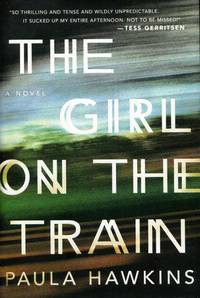
“The Girl on the Train” by Paula Hawkins

The Girl on the Train

The Girl on the Train has had one of longest runs as a New York Times bestseller. Released last year, it topped the list for 16 weeks in 2015, has been on it for 78 weeks so far, and is still on the list at #6. That is a remarkable achievement for any book, let alone a debut novel. It literally came out of nowhere and became an instant success, drawing comparisons with the 2014 crime thriller, Gone Girl, which was also a runaway hit. However, unlike Gone Girl, whose author, Gillian Flynn had published books before which you could read to get a better idea of her earlier work and her path to literary success, the author, Paula Hawkins, of The Girl on the Train was a totally unknown entity in the publishing world, so you can’t go back to read any of her other books, as most of us would do for authors whose books we love. And while I don’t always find New York Times bestsellers terrific reads (such as the book, The Girls, that I wrote about recently), The Girl on the Train was one book that I unequivocally loved.

Set in London in contemporary times, The Girl on the Train is a psychological thriller and murder mystery rolled in one. The mystery at its core is the disappearance of a woman, and the story is told entirely in the form of the narrations of three different characters: Rachel, the main protagonist, who is “the girl on the train” who sees something suspicious related to the missing woman from the train one morning, and whose life, by the way, is falling apart, making her a very unreliable witness; Anna, Rachel’s ex-husband’s current wife, thanks to whom Rachel’s psychological problems and drunkenness are compounded; and finally, Megan, the woman who goes missing. We learn how their lives intersect early on in the book, but not the whole truth. Unlike books like Gone Girl in which a large part of the narration was deliberately misleading to throw readers off the track, the “twist” in The Girl on the Train comes not from an unreliable narration, but from holding something back instead and not divulging the whole truth. The book keeps you on tenterhooks throughout and rather than feeling cheated at the end, it has a very satisfying conclusion that does not make you feel stupid for not having “guessed” the mystery.

Crime thrillers are generally not known for their writing quality, but I found The Girl on the Train not only very clever but also extremely well written. Not only was it thrilling and entertaining the first time I read it last year, I re-read it again recently and I found it just as engaging as the first time—impossible to put down, and having finished it, needing to read it again right away to better understand the clues leading to the resolution of the mystery. For me, the impetus to read it again came from hearing that it was being made into a movie. While I think that The Girl on the Train has an excellent plot and would make for a terrific movie, there is a certain enjoyment of a good book that comes from your own images of the characters before they are overwritten by the images of the actors playing those parts in a movie, and I wanted to experience this again before the movie comes out.

In conclusion, I would say that The Girl on the Train is a terrific book that deserves every bit of its success, and I find it very gratifying that books like this even find a place in—let alone rule—the New York Times bestseller list, where you typically find more “serious” literary fare. The only question now is whether Paula Hawkins will be a one-book wonder, or we will continue to see more from this prodigiously talented author? While it would be hard to match the success of The Girl on the Train, I, for one, am eagerly awaiting her next book.

The Girl on the Train
Author: Paula Hawkins
Publisher: Penguin Group
Publication Date: January 2015

Reviewer: Lachmi Khemlani runs a technology publication in the San Francisco Bay Area.
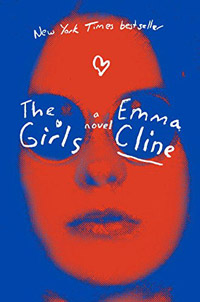
“The Girls” by Emma Cline

The Girls

This debut novel by Emma Cline is the latest “kid” on the bestseller “block.” In what seems to be a phenomenally short span of time, it seems to be everywhere—on the radio and in magazines—and has even made it to the New York Times Bestseller list, where it is currently ranked as #3 in the “Hardcover Fiction” category and #5 in the “Combined Print & E-Book Fiction” category. Does the actual book live up to this sudden fame and hype? Fortunately, I got a chance to find out without having to wait too long and without having to buy the book—a copy was on display in the “New Books” section at my local library and I snatched it up right away to check out.

The Girls tells the story of a teenage girl, Evie Boyd, in the late 60s and how she gets into a cult led by a man, Russell, whose hippie-like, counter-culture, “let’s be free” philosophy seems like a magnet, attracting followers—mostly young and female—who will do anything for him. It is very much like the infamous cult that Charles Manson had in California in the 60s which ended in a series of murders committed by him and his followers, as a result of which he is now serving life in prison. Russell’s cult in The Girls also ends just as badly, with his followers committing four ghastly murders and eventually meeting the same fate. Evie herself was not part of the group that carried out the murders (but only by chance), so she emerges from her experience with the cult physically unscathed but mentally scarred for life. Also, in her case, it was not Russell’s magnetism that drew her to the cult but that of one of Russell’s key female followers, Suzanne, whom she is strongly attracted to.

Despite the lesbian undertone, The Girls however, is far from being a love story, gay or otherwise. Instead, it is an exploration of the mental make-up of someone who can be seduced into giving up everything—home, family, friends, ambitions, creature comforts, in short, a normal life—to go live in a commune where everything is shared, including space (mostly cramped), clothes (mostly bedraggled), food (always scarce, and frequently needing to be scavenged or stolen), chores (cooking, cleaning, farming, etc.), parenting (with no birth control, free sex, and so many girls, there are naturally many pregnancies), and pretty much any other aspect of life. If it sounds awful, it really is, and Cline does a good job of illuminating how someone can be lured to such a life, particularly someone as young and impressionable as Evie. Of course, the fact that she comes from a dysfunctional family with her parents getting divorced seems almost a given—would anyone from a normal, happy family be so susceptible to being brainwashed and exploited?

While I greatly admired the book—it was very well written and especially remarkable coming from someone so young (as the photo of Emma Cline on the jacket cover and her brief bio seem to suggest)—I have to say that I did not find it particularly enjoyable or entertaining. It wasn’t a book I “couldn’t put down,” and it was my curiosity about why it was such a hit that compelled me to stick with it till the end rather than give up on it sooner. Of course, books that are entertaining often do not have a highly evolved writing style and are universally panned by critics, and The Girls seemed more of the reverse kind of book—one which would greatly appeal to critics but not that much to readers.

Books that are beautifully written and impossible to put down are a rarity, but they do exist—unfortunately, I did not find The Girls to be one of them.

The Girls
Author: Emma Cline
Publisher: Random House
Publication Date: June 2016

Reviewer: Lachmi Khemlani runs a technology publication in the San Francisco Bay Area.
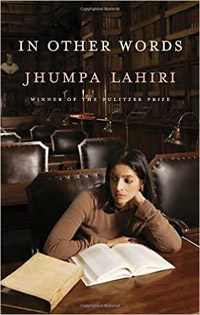
“In Other Words” by Jhumpa Lahiri

In Other Words

Jhumpa Lahiri is one of the best known authors of Indian origin of our times, right up there on par with the most successful American authors. She achieved one of the highest writing accolades there is – the Pulitzer Prize in fiction – for her debut novel, the Interpreter of Maladies, and has not looked back since. Her second novel, The Namesake, not only won critical acclaim but was adapted into a movie by none other than Mira Nair, with top-of-the-line actors like Tabu, Irrfan Khan, and Kal Penn. Her two subsequent novels were also widely regarded, in particular, The Lowland, which was published in 2014. Born and brought up in the US (to Indian immigrants), Lahiri is a native English speaker, and writes, naturally, in English, making her novels readily accessible to the millions of English-speaking folks all over the world, including people like me.

In Other Words, however, is written in Italian and translated into English by a professional translator of Italian books to English. How did this happen? And why? This forms the main theme of the book. Lahiri describes the magical pull that the Italian language has had for her ever since she visited Italy shortly after college, and she spent the next 20 years or so — while writing her novels and getting married and having her kids, in short, living a “regular” life — trying to sporadically learn the language better. Living in New York, she had the advantage of having access to Italian teachers and went through several of them before settling on one that worked well for her. She did get a chance to practice what she was learning on her occasional book tours to Italy, and describes how everyone there was extremely encouraging and helpful when she told them she was trying to learn the language.

A few years ago, she realized that she could never become completely fluent with the language unless she lived there and was fully immersed in it, and that was precisely what she did. She packed up her life in the US, including her family, and they all moved to Italy. In Other Words is a collection of essays chronicling her journey and her progress with the language, right from the time when she first visited Italy to when she had mastered enough of the language to be able to read, write, and even think in Italian. What makes it most remarkable, and sets it apart from other memoirs, that it is written in Italian, a testament to not only Lahiri’s undisputed love for the language but also to the fact that she has gained enough familiarity and fluency with it to be able to do this. The book is a fairly easy read, which is not surprising given that it is written in a language by someone who is not a native speaker of it. For the English translation, Lahiri explains that she didn’t do it herself because she wanted to stay fully immersed in the Italian language and not fall back into her native English. With the publication of the book, the “immersion” which she had sought seems to have been accomplished for the time being, and she is getting ready to return to the US with her family.

While few of us can relate to hearing the siren call of another language as stridently as Lahiri did for Italian and going to the extent that she did of heeding it, there are some aspects to her experiences that are more universal. In particular, those of us from India can relate to the conflicted childhood she experienced, torn between the native Bengali language of her parents — which they sought to hold on even after moving to the US — and the native English language of the country in which she was born — and the American culture she wanted to fit into. She describes how her physical appearance always made people assume she was a foreigner and didn’t know the local language, not just in Italy, but even in the US, her own country. In Italy, the locals invariably assumed that her husband, who is American (of Spanish origin), was Italian and knew the language, even though it was actually she who spoke it well. We can also relate to the change of direction, the process of starting over and the upheaval it causes that she experienced, although in her case it was entirely voluntary and self-imposed, whereas for many of us, change is forced on us by circumstances. Either way, this change can often be a turning point towards a better and more interesting path, and is worth exploring — she cites the example of Matisse who, later in life, began to move away from traditional painting and developed a new artistic technique, which was groundbreaking and is now regarded as his signature style.

In Other Words may not be the most exciting of memoirs, but it gives us the opportunity to “get inside the head” of a highly acclaimed author and understand the overwhelming importance of words and language in, not just her career, but in her life.

Will Lahiri continue to pursue her love for Italian, or get back to writing in English, or do both? She doesn’t know yet, so we’ll just have to wait and see.

In Other Words
Author: Jhumpa Lahiri
Publisher: Knopf
Publication Date: February 2016

Reviewer: Lachmi Khemlani runs a technology publication in the San Francisco Bay Area.
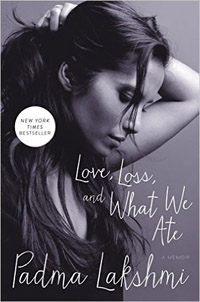
“Love, Loss, and What We Ate” by Padma Lakshmi

LoveLossWhatWeAte-small

I am not really an aficionado of anything that is commonly associated with Padma Lakshmi – Salman Rushdie, her ex-husband; Top Chef, the cooking show for which is a judge; or her earlier modeling career. Thus, it would never even have occurred to me to give this book a try had I not heard an interview with her on NPR, shortly before the book’s release. Prepared to dismiss it as just another publicity stunt by a celebrity I wasn’t at all interested in, I was pleasantly surprised to find that she came across in the interview as an intelligent, articulate woman who had written this book primarily to talk about a painful medical condition she had battled with for a long time — endometriosis, in which tissue that normally lines the uterus grows outside it — and to raise awareness about it. What especially struck me about that interview is that she was very matter-of-fact about her looks and attributed them to genes that she was just lucky to have inherited. I found that to be quite an enlightened attitude in contrast to the vanity most people in the fashion industry seem to have, even if they make a conscious effort to hide it. My curiosity was definitely aroused and it wasn’t long before I had borrowed a copy of Love, Loss, and What We Ate to read.

The blurb on the jacket cover was further promising, according to which, through all her travels in different parts of the world, Padma Lakshmi’s favorite food remained “the simple rice she first ate sitting on the cool floor of her grandmother’s kitchen in South India. “ How could this not tug at the heartstrings of those like me who were born and brought up in India?

It turned out that the actual book, however, was somewhat of a let-down. I found that it was primarily a chronicle of her life to date, from her childhood in India, growing up in the US, her modeling career, her growing interest in cooking which led her to publish some recipe books and eventually led to the Top Chef gig, how her endometriosis was diagnosed and treated, how her marriage to Salman Rushdie happened and why it didn’t last, how she had a baby despite the odds, and her steady relationship after Rushdie with a business tycoon whom she lost to brain cancer a few years ago. As a biography, Love, Loss, and What We Ate is not any more interesting than that of any other person who would take the trouble to write down their life stories. There was nothing particularly insightful in any of the experiences she describes. The writing is decent, but not exceptional in any way; in fact, it tended to be quite rambling at times, with lots of trivial details about her trips to different places, her experiences at modeling shoots and TV sets, and so on. I started reading the book word for word as I usually do, but found myself skimming through it after the first few chapters, looking for something that would justify the time I was spending on it. Sadly, I didn’t find it.

Love, Loss, and What We Ate – a catchy title, by the way – would be most interesting to someone who actually cared to know more about Padma Lakshmi and what makes her tick. For anyone else hoping to get some insights from someone who was – and still it – a celebrity and was married to a well known — and somewhat controversial — author, it would be a disappointing read.

Love, Loss, and What We Ate
Author: Padma Lakshmi
Publisher: Ecco
Publication Date: March 2016

Reviewer: Lachmi Khemlani runs a technology publication in the San Francisco Bay Area.
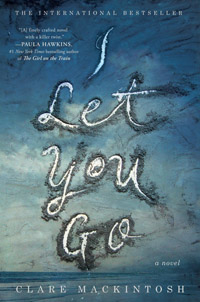
“I Let You Go” by Clare Mackintosh

I let you go-small

I had never heard of this book before seeing it while browsing through the “New” books display at my local library. What prompted me to pick this up and not put it back was a quote on the cover by Paula Hawkins, the author of the best-selling, The Girl on the Train, which was a book that I had loved. I Let You Go seemed to be in the same “crime fiction” genre as The Girl on the Train and Gillian Flynn’s Gone Girl, another book that I had loved (but which was somewhat ruined for me after the movie version), and what seemed to give it instant credibility was the fact that the author had spent twelve years on the police force in England. Also, the book jacket blurb promised a “twist” — another aspect common to both Gone Girl and The Girl on the Train — which is irresistible to die-hard fans of crime thrillers like me and accounts for the enduring popularity of Agatha Christie novels and detectives like Sherlock Homes.

The hallmark of a good crime novel is that it is almost impossible to put down once you start reading it, and from that perspective, I Let You Go definitely makes the cut. The “crime” at the center of the book is a hit-and-run car accident that kills a small boy, and the book focuses primarily on its aftermath, both on the people involved in it as well as the detectives investigating it. It is well written, fast-paced, and keeps you engaged right up to the end. While the promised plot “twist” was a bit too convoluted and the story was eventually resolved a bit too neatly in my opinion, it was still a thrilling and enjoyable read. At times, you just want to be entertained with a good “whodunit” mystery and while Agatha Christie was the master of this genre, she’s not around anymore and it’s great to have books like this coming from other talented writers.

While I found I Let You Go a good thriller that was definitely worth reading, I doubt I would be interested in re-reading it again at some point. It’s the kind of book that captivates you the first time, but once the suspense is over and you know how it ends, it’s done. It’s not the kind of book you re-read to enjoy the way it’s written and how it was cleverly crafted to keep you guessing. So while I bought copies of The Girl on the Train and Gone Girl to have in my collection after reading them (along with Gillian Flynn’s earlier Dark Places — and don’t even get me started on the Cormoran Strike novels by Robert Galbraith, aka J.K. Rowling!), I don’t see myself wanting to re-read I Let You Go. I was glad to have read it, but I have no regrets about returned my borrowed copy back to the library for someone else to enjoy.

I Let You Go
Author: Clare Mackintosh
Publisher: Berkley
Publication Date: May 2016

Reviewer: Lachmi Khemlani runs a technology publication in the San Francisco Bay Area.

“When Breath Becomes Air” by Paul Kalanithi

WhenBreathBecomesAir-small

The buzz surrounding When Breath Becomes Air was heard well in advance of the actual publication of the book. The background of the book was unmistakably tragic – it was authored by a young doctor who discovered that he has terminal lung cancer, and he actually dies before the publication of the book, which was then completed by his wife. The book was thus published posthumously. Written by someone who has only a few months to live – and knows that – the book was undoubtedly unique. A memoir of sorts, it was written by Kalanithi after his diagnosis in an attempt to discover what makes life worth living, and it became one of the key projects that he embarked upon precisely to make the rest of his brief life more purposeful.

Kalanithi was not only a brilliant doctor who scaled great heights in his career at a young age – he studied at Stanford and Yale and returned to Stanford to work as a neurosurgeon – but he also had an abiding interest in literature and history, which makes When Breath Becomes Air an extremely well written book, even without accounting for its theme and subject matter. It was fascinating to learn about Kalanithi’s background and upbringing, about his dual interests in both biology and literature, and how the idea of finding what it is within us that enables us to find meaning ultimately led him to neuroscience. The various neurological cases that he encountered while working at Stanford also made for interesting reading, and of course, his thoughts following his own diagnosis of terminal lung cancer – how to make the best of the little time he has left to live? – was the crux of the book. How often do we have the privilege of learning about anyone’s final thoughts before they die, let alone of someone so remarkable?

However, given that my expectations from the book were sky-high – from all the advance buzz and accolades – even before I started reading it, it seems that it was almost doomed from the start not to be able to live up to them. While this is definitely a must-read book, even a keeper – I bought it rather than just borrowing it from the library or a friend – I did not find it to be as insightful and profound as I had anticipated. I was hoping for some words of wisdom on how to live my life better, in a more meaningful way, but I didn’t find it in this book. Ultimately, for me, it was a very touching narrative about one person’s dilemmas and choices in the face of a rapidly approaching death, but I did not find it life-changing in any way, as I had been led to expect.

While it seems almost blasphemous to be critical of a book like this in any way – almost as if you are walking over the body of a dead person – I do wish that the folks in charge of marketing this book, as well as the media, had not hyped it up so much that it inevitably fell short of what it promised.

When Breath Becomes Air
Author: Paul Kalanithi
Publisher: Random House
Publication Date: January 2016

Reviewer: Lachmi Khemlani runs a technology publication in the San Francisco Bay Area.
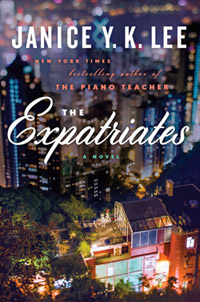
“The Expatriates” by Janice Lee

TheExpatriates-small

I first heard about this book in a recent NPR Fresh Air interview with the author, Janice lee. The plot of the book – a story about a group of expatriates in Hong Kong – seemed interesting, and the author spoke well. The Expatriates is her second book, the first one being The Piano Teacher, which I had not heard of prior to the Fresh Air interview. I borrowed a copy of The Piano Teacher from the library right away, but when I started reading it, it didn’t grip my attention, and I didn’t persist with it. Thus, when my copy of The Expatriates that I had put on hold in the library finally arrived (it took a bit longer as it was a new book), I didn’t think I would like it very much, based on my experience with Lee’s earlier book.

But I was wrong. I found The Expatriates a very well written and engrossing story about three women, all of whom are expatriates in Hong Kong, and whose lives intersect in ways I did not anticipate at all. There is a major tragic event at the core of the story, and although it doesn’t get resolved – which in itself is extremely unusual for a book – the end of the story is still surprisingly uplifting … and totally unexpected. Along the way, the book does an excellent job of capturing the milieu, the minutiae – the feel – of what it is like to live as an expatriate in Hong Kong and how it is different from life in the US, where all the three main protagonists emigrate from. I imagine much of the authenticity of the book comes from the author’s own experience with both Hong Kong – where she was born and raised – and the US – where she was educated and lived as an adult.

Overall, I found The Expatriates a very well-written book that tells a compelling story about both loss and redemption, but without the sentimentality that often goes with these themes. It wasn’t too highbrow for me to enjoy, but at the same time, it was far from a casual flick.

The Expatriates
Author: Janice Y.K. Lee
Publisher: Viking
Publication Date: January 2016

Reviewer: Lachmi Khemlani runs a technology publication in the San Francisco Bay Area.

“A Little Life” by Hanya Yanagihara

llittlelife-cover-small

I first heard of A Little Life a few months ago in the NY Times Book Review podcast, which I often listen to. The host of the podcast referred to it as “a difficult book” to read, a reference that stuck in my mind. I put a hold on the book at my local public library, and in the meantime, I often saw it at bookstores, displayed alongside other new books. While the cover stated it to be a National Book Award finalist, it wasn’t a literary sensation as far as I could tell, of the kind, for instance, that Anthony Doerr’s All the Light We Cannot See or Elena Ferrante’s Neapolitan novels were. Thus, I wasn’t in a tearing hurry to read it and wasn’t watching its progress on my library Hold queue with any kind of desperation. When I finally did get it, I put it along with the other library books I had borrowed, planning to get to it whenever I was done with the book I was currently reading. After I had finished that, I picked up “A Little Life” from my library books collection, primarily because it was a new book and I knew I couldn’t renew it once it became due. Also, the mention of it “being a difficult read” in the NY Times Book Review podcast came back to me and I was intrigued. At 720 pages of fairly dense text, the size of the book was quite daunting, but I had no compunctions about giving up on it if I didn’t find it interesting. I was doing that quite often with books these days – I could borrow so many of them from my public library (a privilege I didn’t have as a child growing up in India) that I borrowed anything that seemed interesting, but then returned it unread if it didn’t grip my attention after a few pages.

But once I started A Little Life, I couldn’t put it down. It is a book about four close friends, one of whom, Jude, has had a horrific childhood – and much of the book, although not all of it, revolves around him. The book traces their lives from their college days to late adulthood, and goes into an incredible amount of detail about everything they experience – their families, their friends, their professional lives, their social lives, their failures and successes, their struggles, their hopes and dreams – everything, in fact, that we as humans experience. The sheer amount of detail in this book is incredible, as is the ability to get inside the heads of the main protagonists – all of them – and feel what they are feeling. As I got deeper and deeper into the story and into the “skin” of the characters, I found myself dreading the “difficult parts” that had been alluded to in the podcast. I assumed that these had to be the details of the abusive childhood and trauma that Jude had been subjected to, which are revealed to us gradually in the book. However, at some point, I realized that what really made for difficult reading what was not what had happened to Jude when he was a child but what it led him to do throughout his adult life. The descriptions of these were so heart-breaking – and so gut-wrenchingly real – that I can unequivocally say that that I found A Little Life the most profoundly sad and moving book I have read so far.

All it says about the author of A Little Life, Hanya Yanagihara, is that she lives in New York City. Apart from the book being set in this city, I could find no trace of any autobiographical element in this book, as it is with most books. I found it mind-boggling that someone who is not even male can get into the skin of four male friends, and of most of the other main characters in the book that are also male, so completely, so authentically. The book also has extremely detailed descriptions of the four completely different professions of the four friends – lawyer, architect, actor, and artist – and I am in awe that one person can write about all of these professionals in so much depth and with so much authenticity. We know that good writers do a lot of research for their books to make sure that all the details are accurate, but I just cannot comprehend how any one person can write about so many things and so many people and capture them so completely and accurately – in all their thoughts, actions, eccentricities, weaknesses, failings, and emotions.

I would definitely not call A Little Life a “fun” or “entertaining” read, but rather, a gripping, searing saga that seems so real that it shakes you to the depths of your soul.

A Little Life
Author: Hanya Yanagihara
Publisher: Doubleday
Publication Date: March 2015

Reviewer:  Lachmi Khemlani runs a technology publication in the San Francisco Bay Area.