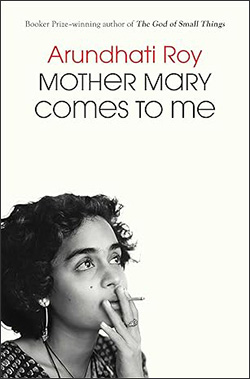
In this raw and honest memoir, Arundhati Roy chronicles her tumultuous relationship with her mother, Mary Roy. She narrates her and her brother’s dysfunctional childhood against the highly conversative Syrian Christian background with a fearless mom who is, in equal measure, both a tyrant who constantly terrorizes her children while also being a social empath and fierce leader driven to demand equal rights for the women in her community.
The multiple characters in Mary Roy’s life are described so vividly, you almost know them or of them in your life — characters that span the good and bad, the light and the fury in human nature. As an example, she describes her dad, Mikkie, who spends time doing nothing, absolutely nothing, his entire life. There is something endearing and tender about a human soul who is free-spirited and finds the world of no use to him, and who the world finds no use for as well. However, for Mary Roy, her husband’s non-engagement with life except for constantly drinking himself to a stupor made her even more enraged and bitter with the men in her life, given her experience of her father’s anger and violence towards her mom as well as her brother’s vindicative inheritance battle against her playing out in public.
While Mary eventually won the inheritance battle in court – she was fighting for equal inheritance rights in the Syrian Christian community and ended up changing the Travancore law through a Supreme Court ruling – all of her life’s misery resulted in her having a terrible temperament towards those around her. Her kids, in particular, bore the brunt of it, causing them to fear her and live lives of perpetual distrust, trepidation, and disquiet. Thus, the mother who was a trailblazer, an embodiment of courage and perseverance, was also the reason why Arundhati was scarred for life.
Arundhati decides to leave home at 16 after a terrifying encounter with her mom’s wrath where her mom smashes plates and glasses almost injuring her. (Her nickname for her mom, quite appropriately, is “the gangster.”) Arundhati enrolls in architecture school (her mom referred to the fees she had to pay as “the mills around her neck,” even though they were subsidized), falls in love, and ends up marrying a wonderful, kind architect. For once, all seems to be well in her life — a loving husband, and a good career. But she has been so scarred by her mother that she finds reasons to leave – any normal relationship unsettles her, in particular, the loving relationship her husband has with his mother, which causes a rift between the couple. She cannot undo her memories of her brother being beaten to a pulp for not coming with all A+s, and she cannot process a normal parent-child relationship without pain and disdain. She ends up leaving this safe place as well.
She is currently separated from her director husband for pretty much the same reason – not sure of safe places, unsure of families with no fights or fury, uncertain of unconditional loving relationships. Time and time again, she refers to herself as “a moth with cold wings ready to fly when the scene is too safe or unsafe.” When her mom is ailing, she often goes to meet her, but she does so like a moth who prepares a path through the spiderweb for it to slide out just in time so that it does not get tangled in the web of her mother’s wrath. The book brilliantly describes the messiness of their lives, the different shades of gray in human relationships (despite Mary’s inheritance fight with her brother, the warring duo end up becoming each other’s best friends, giggling like little children at her death bed), and the inseparable nature of her mom’s identity in her own. When her own brother is baffled of her inconsolable grief at her mother’s death, knowing that she was treated by far the worst of them, she accurately summarizes Mary Roy — “the gangster” — as her shelter and her storm, her compass as well as her cross.
Like Mary Roy, my mom, Rajalakshmi Nair, died of a lung disease last year. The mention of the need for oxygenator, bipap, oximeter, Creatinine level monitors, the constant blood tests, etc., brought me back to my mom’s last few years. The scare of my mom getting COVID (like Arundhati’s mom, she was the only one at home who didn’t get it), the constant load-shedding in Kerala causing the oxygenator to turn off, the need for a generator to make sure there is always oxygen all the time, the long slow ceremonial baths, the feeding of mushed rice and vegetables with spicy pickle, all of this that Arundhati describes so poignantly in her book was exactly what I experienced. Like Mary Roy who fought to the end, my mom, who was slated to live for two years after her diagnosis, lived for another seven. At the end of her time, lying in the last CCU admission tied down with the ventilator and a do-not-resuscitate directive, she asked the nurse who was attending to her about the interesting hairpin she was wearing and if the nurse could get it for her and all of us girls ( this includes literally every girl in the vicinity). She truly lived large.
That was the “gangster” in my house — a wonderfully kind, loving one.
Sorry, Arundhati, can’t help but use your line: “ByeO Mummy, I will be seeing you.”
Mother Mary Comes to Me
Author: Arundhati Roy
Publisher: Scribner
Publication Date: Sep 2025
Contributor: Sanjana Nair
 Books We've Read