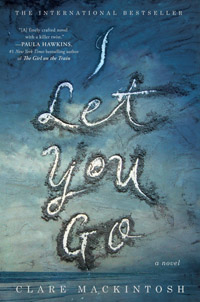
“I Let You Go” by Clare Mackintosh

I let you go-small

I had never heard of this book before seeing it while browsing through the “New” books display at my local library. What prompted me to pick this up and not put it back was a quote on the cover by Paula Hawkins, the author of the best-selling, The Girl on the Train, which was a book that I had loved. I Let You Go seemed to be in the same “crime fiction” genre as The Girl on the Train and Gillian Flynn’s Gone Girl, another book that I had loved (but which was somewhat ruined for me after the movie version), and what seemed to give it instant credibility was the fact that the author had spent twelve years on the police force in England. Also, the book jacket blurb promised a “twist” — another aspect common to both Gone Girl and The Girl on the Train — which is irresistible to die-hard fans of crime thrillers like me and accounts for the enduring popularity of Agatha Christie novels and detectives like Sherlock Homes.

The hallmark of a good crime novel is that it is almost impossible to put down once you start reading it, and from that perspective, I Let You Go definitely makes the cut. The “crime” at the center of the book is a hit-and-run car accident that kills a small boy, and the book focuses primarily on its aftermath, both on the people involved in it as well as the detectives investigating it. It is well written, fast-paced, and keeps you engaged right up to the end. While the promised plot “twist” was a bit too convoluted and the story was eventually resolved a bit too neatly in my opinion, it was still a thrilling and enjoyable read. At times, you just want to be entertained with a good “whodunit” mystery and while Agatha Christie was the master of this genre, she’s not around anymore and it’s great to have books like this coming from other talented writers.

While I found I Let You Go a good thriller that was definitely worth reading, I doubt I would be interested in re-reading it again at some point. It’s the kind of book that captivates you the first time, but once the suspense is over and you know how it ends, it’s done. It’s not the kind of book you re-read to enjoy the way it’s written and how it was cleverly crafted to keep you guessing. So while I bought copies of The Girl on the Train and Gone Girl to have in my collection after reading them (along with Gillian Flynn’s earlier Dark Places — and don’t even get me started on the Cormoran Strike novels by Robert Galbraith, aka J.K. Rowling!), I don’t see myself wanting to re-read I Let You Go. I was glad to have read it, but I have no regrets about returned my borrowed copy back to the library for someone else to enjoy.

I Let You Go
Author: Clare Mackintosh
Publisher: Berkley
Publication Date: May 2016

Reviewer: Lachmi Khemlani runs a technology publication in the San Francisco Bay Area.
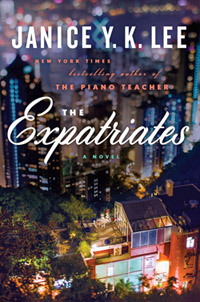
“The Expatriates” by Janice Lee

TheExpatriates-small

I first heard about this book in a recent NPR Fresh Air interview with the author, Janice lee. The plot of the book – a story about a group of expatriates in Hong Kong – seemed interesting, and the author spoke well. The Expatriates is her second book, the first one being The Piano Teacher, which I had not heard of prior to the Fresh Air interview. I borrowed a copy of The Piano Teacher from the library right away, but when I started reading it, it didn’t grip my attention, and I didn’t persist with it. Thus, when my copy of The Expatriates that I had put on hold in the library finally arrived (it took a bit longer as it was a new book), I didn’t think I would like it very much, based on my experience with Lee’s earlier book.

But I was wrong. I found The Expatriates a very well written and engrossing story about three women, all of whom are expatriates in Hong Kong, and whose lives intersect in ways I did not anticipate at all. There is a major tragic event at the core of the story, and although it doesn’t get resolved – which in itself is extremely unusual for a book – the end of the story is still surprisingly uplifting … and totally unexpected. Along the way, the book does an excellent job of capturing the milieu, the minutiae – the feel – of what it is like to live as an expatriate in Hong Kong and how it is different from life in the US, where all the three main protagonists emigrate from. I imagine much of the authenticity of the book comes from the author’s own experience with both Hong Kong – where she was born and raised – and the US – where she was educated and lived as an adult.

Overall, I found The Expatriates a very well-written book that tells a compelling story about both loss and redemption, but without the sentimentality that often goes with these themes. It wasn’t too highbrow for me to enjoy, but at the same time, it was far from a casual flick.

The Expatriates
Author: Janice Y.K. Lee
Publisher: Viking
Publication Date: January 2016

Reviewer: Lachmi Khemlani runs a technology publication in the San Francisco Bay Area.

“A Little Life” by Hanya Yanagihara

llittlelife-cover-small

I first heard of A Little Life a few months ago in the NY Times Book Review podcast, which I often listen to. The host of the podcast referred to it as “a difficult book” to read, a reference that stuck in my mind. I put a hold on the book at my local public library, and in the meantime, I often saw it at bookstores, displayed alongside other new books. While the cover stated it to be a National Book Award finalist, it wasn’t a literary sensation as far as I could tell, of the kind, for instance, that Anthony Doerr’s All the Light We Cannot See or Elena Ferrante’s Neapolitan novels were. Thus, I wasn’t in a tearing hurry to read it and wasn’t watching its progress on my library Hold queue with any kind of desperation. When I finally did get it, I put it along with the other library books I had borrowed, planning to get to it whenever I was done with the book I was currently reading. After I had finished that, I picked up “A Little Life” from my library books collection, primarily because it was a new book and I knew I couldn’t renew it once it became due. Also, the mention of it “being a difficult read” in the NY Times Book Review podcast came back to me and I was intrigued. At 720 pages of fairly dense text, the size of the book was quite daunting, but I had no compunctions about giving up on it if I didn’t find it interesting. I was doing that quite often with books these days – I could borrow so many of them from my public library (a privilege I didn’t have as a child growing up in India) that I borrowed anything that seemed interesting, but then returned it unread if it didn’t grip my attention after a few pages.

But once I started A Little Life, I couldn’t put it down. It is a book about four close friends, one of whom, Jude, has had a horrific childhood – and much of the book, although not all of it, revolves around him. The book traces their lives from their college days to late adulthood, and goes into an incredible amount of detail about everything they experience – their families, their friends, their professional lives, their social lives, their failures and successes, their struggles, their hopes and dreams – everything, in fact, that we as humans experience. The sheer amount of detail in this book is incredible, as is the ability to get inside the heads of the main protagonists – all of them – and feel what they are feeling. As I got deeper and deeper into the story and into the “skin” of the characters, I found myself dreading the “difficult parts” that had been alluded to in the podcast. I assumed that these had to be the details of the abusive childhood and trauma that Jude had been subjected to, which are revealed to us gradually in the book. However, at some point, I realized that what really made for difficult reading what was not what had happened to Jude when he was a child but what it led him to do throughout his adult life. The descriptions of these were so heart-breaking – and so gut-wrenchingly real – that I can unequivocally say that that I found A Little Life the most profoundly sad and moving book I have read so far.

All it says about the author of A Little Life, Hanya Yanagihara, is that she lives in New York City. Apart from the book being set in this city, I could find no trace of any autobiographical element in this book, as it is with most books. I found it mind-boggling that someone who is not even male can get into the skin of four male friends, and of most of the other main characters in the book that are also male, so completely, so authentically. The book also has extremely detailed descriptions of the four completely different professions of the four friends – lawyer, architect, actor, and artist – and I am in awe that one person can write about all of these professionals in so much depth and with so much authenticity. We know that good writers do a lot of research for their books to make sure that all the details are accurate, but I just cannot comprehend how any one person can write about so many things and so many people and capture them so completely and accurately – in all their thoughts, actions, eccentricities, weaknesses, failings, and emotions.

I would definitely not call A Little Life a “fun” or “entertaining” read, but rather, a gripping, searing saga that seems so real that it shakes you to the depths of your soul.

A Little Life
Author: Hanya Yanagihara
Publisher: Doubleday
Publication Date: March 2015

Reviewer:  Lachmi Khemlani runs a technology publication in the San Francisco Bay Area.