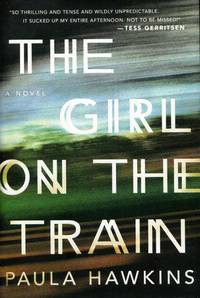
The Girl on the Train has had one of longest runs as a New York Times bestseller. Released last year, it topped the list for 16 weeks in 2015, has been on it for 78 weeks so far, and is still on the list at #6. That is a remarkable achievement for any book, let alone a debut novel. It literally came out of nowhere and became an instant success, drawing comparisons with the 2014 crime thriller, Gone Girl, which was also a runaway hit. However, unlike Gone Girl, whose author, Gillian Flynn had published books before which you could read to get a better idea of her earlier work and her path to literary success, the author, Paula Hawkins, of The Girl on the Train was a totally unknown entity in the publishing world, so you can’t go back to read any of her other books, as most of us would do for authors whose books we love. And while I don’t always find New York Times bestsellers terrific reads (such as the book, The Girls, that I wrote about recently), The Girl on the Train was one book that I unequivocally loved.
Set in London in contemporary times, The Girl on the Train is a psychological thriller and murder mystery rolled in one. The mystery at its core is the disappearance of a woman, and the story is told entirely in the form of the narrations of three different characters: Rachel, the main protagonist, who is “the girl on the train” who sees something suspicious related to the missing woman from the train one morning, and whose life, by the way, is falling apart, making her a very unreliable witness; Anna, Rachel’s ex-husband’s current wife, thanks to whom Rachel’s psychological problems and drunkenness are compounded; and finally, Megan, the woman who goes missing. We learn how their lives intersect early on in the book, but not the whole truth. Unlike books like Gone Girl in which a large part of the narration was deliberately misleading to throw readers off the track, the “twist” in The Girl on the Train comes not from an unreliable narration, but from holding something back instead and not divulging the whole truth. The book keeps you on tenterhooks throughout and rather than feeling cheated at the end, it has a very satisfying conclusion that does not make you feel stupid for not having “guessed” the mystery.
Crime thrillers are generally not known for their writing quality, but I found The Girl on the Train not only very clever but also extremely well written. Not only was it thrilling and entertaining the first time I read it last year, I re-read it again recently and I found it just as engaging as the first time—impossible to put down, and having finished it, needing to read it again right away to better understand the clues leading to the resolution of the mystery. For me, the impetus to read it again came from hearing that it was being made into a movie. While I think that The Girl on the Train has an excellent plot and would make for a terrific movie, there is a certain enjoyment of a good book that comes from your own images of the characters before they are overwritten by the images of the actors playing those parts in a movie, and I wanted to experience this again before the movie comes out.
In conclusion, I would say that The Girl on the Train is a terrific book that deserves every bit of its success, and I find it very gratifying that books like this even find a place in—let alone rule—the New York Times bestseller list, where you typically find more “serious” literary fare. The only question now is whether Paula Hawkins will be a one-book wonder, or we will continue to see more from this prodigiously talented author? While it would be hard to match the success of The Girl on the Train, I, for one, am eagerly awaiting her next book.
The Girl on the Train
Author: Paula Hawkins
Publisher: Penguin Group
Publication Date: January 2015
Reviewer: Lachmi Khemlani runs a technology publication in the San Francisco Bay Area.

 Books We've Read