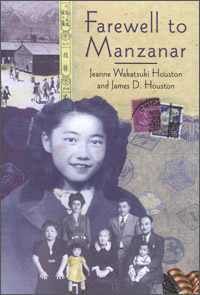
“Farewell to Manzanar” by Jeanne Wakatsuki Houston and James D. Houston

farewell-to-manzanar

When the Japanese bombed Pearl Harbour in December 1941 at the climax of World War II, every American of Japanese descent suddenly became suspect. The Franklin Roosevelt government reacted by rounding up all Japanese Americans and carting them off to remote camps, where they were forced to subsist in sub-human conditions. Manzanar was one such camp on the edge of California’s Mojave Desert and in this book a former inmate gives a first person account of her family’s interment in this hellhole. After decades of silent denial, the author relives long forgotten memories and recollects heart-wrenching details to produce this deeply disturbing memoir.

Jeanne’s father (a native of Hiroshima) was interrogated, taken into custody and deported to North Dakota. Ko Wakatsuki had come to Hawaai at the age of 17 in search of work, moved to Idaho and later California, where he married a Japanese girl and had 9 children. His arrest and three year incarceration changed him. He became despondent, alcoholic, abusive, violent and eager to be invisible. In 1945 after the war ended, the family returned to Southern California and in 1952 they moved to San Jose.

Jeanne was seven years old and the youngest of the brood when the tragedy enveloped her family. Manzanar effectively robbed her of the simple joys of childhood. Growing up in this strange new place with minimal facilities, communal toilets and communal kitchens, deeply affected her – and the return to civilization was just as difficult when the camp was disbanded after three years.

Jeanne recounts her father’s behavior during a school visit by her parents: “I was standing at the head of the table shaking the principal’s hand, when papa rose, his face ceremoniously grave, and acknowledged the other parents with his most respectful gesture. He pressed his palms together at his chest and gave them a slow deep Japanese bow from the waist. They received this with a moment of careful, indecisive silence. He was unforgivably a foreigner then, foreign to them, foreign to me, foreign to everyone but Mama, who sat next to him smiling with pleased modesty. Twelve years old at the time, I wanted to scream. I wanted to slide out of sight under the table and dissolve.”

The California born author describes the incredible pain of growing up Japanese in post-war America. “Easy enough as it was to adopt white American values, I still had a Japanese father to frighten my boyfriends and a Japanese face to thwart my social goals.”

Jeanne met James D. Houston while attending San Jose State University and they were married in 1957. Her husband co-authored her autobiographical novel, which was published in 1973 and won many accolades before being adapted into a TV film in 1976. The book has since become a part of many school curricula to inform pupils about the Japanese American experience during WWII. It presents a thought-provoking account of a dark and embarrassing chapter in American history.

Overall Assessment: Must read, especially if you are Japanese American.

Farewell to Manzanar
Authors: Jeanne Wakatsuki Houston and  James D. Houston
Publisher: Houghton Mifflin
Date of Publication: 1973

Contributor: Pushpa Kurup lives in Trivandrum, India and works in the IT sector.
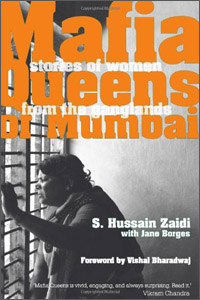
 

“Mafia Queens of Mumbai ” by S. Hussain Zaidi with Jane Borges

mafia-queens-of-mumbai

There is high drama, there is intrigue, there is gang warfare, there is crime and punishment – and in the midst of it all, in the soft dark under-belly of the Mumbai underworld. there are ‘crime madonnas.’ We in India have heard of the notorious triumvirate that ruled India’s commercial capital then known as Bombay – the Tamilnadu born Haji Mastan, the Chennaiite Varadharajan Mudaliar and the Afghanistan born Karim Lala – until the Emergency intervened to bring about a reversal of their fortunes. When Vardha (as Varadharajan Mudaliar was known) died in Chennai in 1988, Mastan chartered an aircraft to bring his body back to Bombay for a funeral that any king would have envied. Mastan was the darling of Bollywood and we have seen pictures of him with Dilip Kumar, Sunil Dutt, Madhubala and countless others. We have also heard of Dawood Ibrahim, Chota Rajan and other sundry characters, many of whom are absentee ganglords, rather than hands-on local dons. But the names of the women in mafia-land are new to us. Thus this book is an eye-opener in more ways than one. It tells us the mafia is not a male club.

Take Jenabai (Zainab) Chaavalwali, who participated wholeheartedly in the Independence movement and opted to remain in Bombay with her five children in 1947 when her husband Darwesh chose to migrate to Pakistan. In times of acute grain shortage, she acted as a middle-woman between wholesale grain merchants and dealers. Wow! Later she married Iqbal Gandhi but never called herself Mrs. Gandhi. She met Vardha who initiated her into the art of bootlegging in the early sixties. Soon she became rich and famous as Jenabai Daaruwali. Vardha introduced her to Mastan. Dawood Ibrahim was then a teenager and his parents Ibrahim Kaskar and Aamina were close friends of Jenabai. It was Jenabai who intervened to bring about a truce between the Pathan gang and the Ibrahim brothers, Dawood and Sabir, sometime in 1980. The truce was short-lived, but Jenabai herself lived until the ripe old age of 74.

The women in the book are spectacular – and that’s a gross understatement. Kudos to Zaidi for bringing them into the public gaze! Ever heard of Gangubai, the matriarch of Kamatipura? Well she owned a black Bentley and met Prime Minister Jawaharlal Nehru to lobby for the decriminalization of prostitution. She smoked bidis, drank Ranichaap (whatever that is!), chewed paan and gambled to her heart’s content. And yet, they say she had a heart of gold. She never married but adopted several children.

Did you know that from the early nineties the Mumbai drug trade (vaguely estimated at 1000 crore) was dominated by a female troika – Jyoti Adiramalingam, Mahalaxmi Papamani and Savitri? You won’t find them on Wikipedia. Google their names and you’ll draw a blank. But the authors actually met two of them. Sapna Didi, who tried her best to avenge her husband’s murder by Dawood’s men and lost her life in the attempt and Bollywood starlet Monica Bedi, the love interest of Abu Salem, are also featured in the book, perhaps to attract new-gen readers.

Is the female of the species more deadly than the male? Read the book and find out. Written by India’s best known crime reporter, “Mafia Queens” delivers a lot more than it promises. The style of the master storyteller is unmistakable. Faction and fiction are artfully blended together to present a fascinating experience. “Mastan called for his black Mercedes and walked Jenabai to the car. As the car left Baitul Suroor, the lights in the villa gradually dimmed and faded to black.”

Overall Assessment: Not to be missed.

Mafia Queens of Mumbai: Stories of Women from the Ganglands
Author: S Hussain Zaidi with Jane Borges
Publisher: Tranquebar Press (an imprint of Westland Ltd.)
Date of Publication: 2011

Contributor: Pushpa Kurup lives in Trivandrum, India and works in the IT sector.
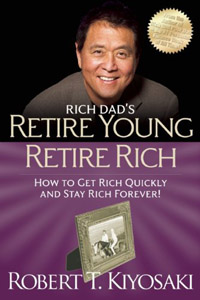
“Retire Young, Retire Rich: How to Get Rich Quickly and Stay Rich Forever” by Robert T Kiyosaki with Sharon L Lechter

retire-young-retire-rich

I read ‘Rich Dad, Poor Dad’ several years ago and I was greatly impressed. It presented a wholly new perspective on the accumulation of wealth. So I had great expectations of Kiyosaki’s ‘How to Get Rich Quickly and Stay Rich Forever’. I was a little disappointed. What’s most annoying is that there are umpteen repetitions. After reading this one, I don’t feel inclined to read the other books in the series.

The author’s focus on financial literacy is probably the most important aspect of the book. It is also a matter that does bear repetition. Some home-truths really need to be repeated – only then do they sink in. Kiyosaki reminds us that, “Saving money is slow. You can become rich by saving money, but the price is time… your lifetime.” He adds that, “Many people today are not in the same professions as their parents…….but when it comes to money, investing, and retirement, they do exactly the same things. When it comes to money, many people are still swinging their parents’ axe.” How true!

I like the way the author explains the principle of leverage making it ever so simple: ‘Doing more with less’. The examples he gives are illuminating. “In the beginning, animals could run faster than humans, but today humans can travel faster and further than animals because they created tools of leverage, such as bicycles, cars, trucks, trains and planes. In the beginning, birds could fly and humans could not. Today, humans fly higher, further and faster than any bird.”

Kiyosaki points out that Bill Gates, Michael Dell, Ted Turner, Henry Ford and Thomas Edison did not finish school. I can’t help wondering what the world would have been like if Edison had concentrated on making money rather than on conducting his experiments. Of the Wright brothers Kiyosaki says, “They are prime examples of people who studied because they wanted to learn and not for grades; they worked hard for free without guarantees, took risks intelligently, and pushed themselves and the world into another reality.” Such examples are bound to inspire and motivate – and they certainly add spice to the core message of this book.

The author also points out some simple facts that every investor ought to know from the start. “Out of ten investments, the odds are two to three will be bad, two to three will be good, and everything in the middle just lies around like a lazy dog.”

Overall Assessment: This book could have been written in 100 pages instead of 550. Then it would have been another masterpiece.

Retire Young, Retire Rich: How to Get Rich Quickly and Stay Rich Forever!
Author: Robert T Kiyosaki with Sharon L Lechter
Publisher: Warner Books
Publication Date:: 2002

Contributor: Pushpa Kurup lives in Trivandrum, India and works in the IT sector.