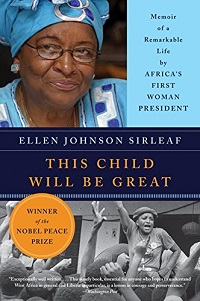
“This Child Will Be Great: Memoir of a Remarkable Life by Africa’s First Woman President” by Ellen Johnson Sirleaf

This Child Will Be Great

Ellen Johnson Sirleaf was Africa’s first woman president and this book is her memoir. She recounts how she came to power in her native Liberia and the tremendous odds she had to overcome to get there. Sworn in as President in January 2006 at the end of a fourteen year long civil war, she remained at the helm for 12 years and oversaw a peaceful transition. Liberia went to the polls in October 2017 to elect a new leader.

The book reveals the complexities of Liberia’s links with the New World and its long and painful history. While the slave trade saw Africans shipped from West Africa to the Americas to undergo forced labour, there was a reverse flow of freed slaves to these shores in the early 19th century. Monrovia, the capital of Liberia is named after US President James Munroe and the country’s flag resembles the American flag. The settlers thought they were somehow superior to the indigenous peoples and the seeds of conflict were sown. Liberia’s first President was a man born in Virginia.

Ellen’s paternal grandfather has eight wives and god knows how many children. Her maternal grandfather, a German trader, had married a local woman and the couple had one daughter. At the start of World War I, Liberia expelled all Germans, to demonstrate its loyalty to the US. The grandfather returned to Germany and was never heard of again.
Ellen’s father was the first indigenous man to be elected to the legislature. He suffered a paralytic stroke while in his early forties and soon the family fortunes nose-dived.

At 17, Ellen fell in love and married James “Doc” Sirleaf, who had just returned from college in Alabama. They both found jobs and had four children in quick succession. When James moved to Madison, Wisconsin to study further, Ellen went too, leaving the grandmothers to care for the little ones. She studied at the Madison Business college, and worked part time, sweeping floors and waiting tables.

“In Madison I was so cold I sometimes feared my tears would freeze.” James was alcoholic and abusive and Ellen had to learn to cope. “Doc always did enough to hurt but not enough to maim or kill. Just enough to keep me in a state of fear.” Twice he put a gun to her head but did not shoot. She knew that if she walked away, or even if her husband did, she would lose custody of the children. When they returned to Liberia, James did, in fact, take away the children from her. Following their divorce, he remarried and moved to Florida with the youngest child.

Ellen had a government job and soon she had an opportunity to study at Boulder, Colorado and Harvard. She had already created ripples in government circles by criticizing the powers that be. Her American education, work experience and contacts stood her in good stead as she returned to Liberia and slowly but surely worked her way up the political ladder. When the President of Liberia died in 1971 and a new President came to power, Ellen was offered a new job- that of Deputy Minister of Finance. Eight years later there was a coup. Ellen left the country and took up a position with the World Bank.

Liberia had enjoyed political stability for century but glaring economic disparities threatened the delicate equilibrium and the insensitivity of the men in power brought things to ahead. The Rice Riots saw police fire upon a crowd of demonstrators killing at least 41. Soon thereafter at a conference of the OAU (Organization of African Unity – now African Union) in July 1979, President Tolbert remarked that the most pressing problem of the continent was apartheid in South Africa. The following month Ellen was made the first female Finance Minister in the nation’s history. A year later there was a coup and president Tolbert was killed. Only four ministers were spared – and Ellen was one of them.

The United States bolstered the new government and Liberia soon became the CIA’s main station in Africa. Ellen went back to the World Bank and later worked for Citibank. By then three of her sons were studying in the US.

Ellen never ceased political activity. She was arrested and sentenced to 10 years of hard labour for speaking out against the government. But she was offered clemency due to intense pressure from Citibank and elsewhere. One of the messages passed to her in prison had read, “We’d rather have a live ant than a dead elephant.” Of her subsequent flight from her homeland Ellen writes, “As much as I wanted to stay in Liberia, I wanted even more to stay alive. It was time to go.”

In 1990 civil war erupted and there were massacres in Monrovia followed by a massive exodus to neighbouring countries and total internal displacement of indigenous peoples. A Boston Globe reporter was told by a local, “The dogs ate the dead, and we ate the dogs.”

The book is one long politico-historical story that almost eclipses the personal. But there are interesting insights too, not entirely about Africa. For instance, the Confederate general Robert E Lee freed most of his slaves before the Civil War and offered to pay for their passage to Liberia. Wow! Do you think his statues ought to stay?

Overall assessment: Good read.

This Child Will Be Great: Memoir of a Remarkable Life by Africa’s First Woman President
Author: Ellen Johnson Sirleaf
Publisher: Harper Collins
Year of Publication: 2010

Contributor: Pushpa Kurup lives in Trivandrum, India and works in the IT sector.

“Reminiscences of the Cuban Revolutionary War” by Ernesto ‘Che’ Guevara

Reminiscences_of_the_Cuban_Revolutionary_War

This is a book about the Cuban Revolution by one of its legendary heroes. It was compiled in 1963, four years after the triumph of the guerrilla war that brought Fidel Castro to power on 1st January 1959. Argentine doctor-turned-guerrilla fighter Ernesto Guevara de la Serna had fought shoulder to shoulder with his Cuban comrades to overthrow the US-backed dictatorship of Fulgencio Batista. A universal symbol of resistance to oppression and injustice, Che believed that revolutionary uprising was the only path to liberation of oppressed peoples.

Talking of his harrowing experiences in the first few days after the small band of warriors landed in Cuba on 2nd December 1956, and all but 20 of the 82 men died in combat, Che writes, “I immediately began to think of the best way to die, since in that minute all seemed lost. I remembered an old Jack London story in which the hero, aware that he is about to freeze to death in Alaskan ice, leans against a tree and prepares to die with dignity. That was the only thing that came to my mind.”

The innocence of youth is striking. “As a trophy from the Battle of La Plata, I had taken a helmet from one of Batista’s corporals, and I wore it with great pride.” The helplessness of the invalid is apparent. “My asthma was somewhat aggravated and the lack of medicine meant I was almost as immobile as the wounded.”

The mind of the quintessential revolutionary is evident. “The people in the Sierra Maestra grow like wild flowers, untended and without care, and they wear themselves out rapidly, working without reward. We began to feel in our bones the need for a definitive change in the life of the people.”

The sensitive humanist also surfaces from time to time. “Blind and unrewarded sacrifices also made the revolution. Those of us who today see its achievements have the responsibility to remember those who fell along the way, and to work for a future where there will be fewer stragglers.”

Che describes his efforts at dentistry with characteristic humour. “Besides the meagerness of my skill, we had no anaesthetic, so I frequently used ‘psychological anaesthesia’ – a few harsh epithets when my patients complained too much about the work going on in their mouths.” When Batista’s forces leave behind a trail of destruction after failing to find the guerrillas, Che observes: “In the midst of the smoking ruins we found nothing but some cats and a pig; they had escaped the destructive fury of the invaders only to fall into our gullets.”

Che recounts his meeting with Fidel Castro in Mexico City in 1955, tells us how they both landed in jail, how they bribed their way out and how they made the dangerous sea crossing to land on Cuban shores after running out of food, water and fuel. “It was a shipwreck rather than a landing,” he writes. He describes how they ate raw crabs, horse meat and anything they could lay their hands on, how they drew water from holes in the rocks using hollowed out sticks, and how they dealt ruthlessly with traitors and informers.

There is deep pathos in his references to fallen comrades. “We must make time to weep for our fallen companeros while we sharpen our machetes.”

If Che Guevara hadn’t become a guerrilla commander he could have been a best-selling author. He was such a prolific writer – and he had so much to say.

Overall Assessment: Must read.

REMINISCENCES OF THE CUBAN REVOLUTIONARY WAR
AUTHOR: ERNESTO ‘CHE’ GUEVARA
PUBLISHER: OCEAN PRESS
YEAR OF PUBLICATION: 2006 (first published in Spanish in 1963)

Contributor: Pushpa Kurup lives in Trivandrum, India and works in the IT sector.

“Misery” by Stephen King

Misery1

This was one of the few “page turners” that I’ve read. I got pulled into Misery the moment I read the plot summary. Technically, it is something that could happen to anyone, any unlucky celebrity to be precise.

It starts with a back-breaking accident to a famous novelist and thankfully he gets rescued by his number one fan. Hold on. It’s a Stephen King novel. The man who is famous for his thrillers and killers. I’ll have to take that “thankfully” back… I won’t spoil anything here, but I guarantee you that it’s not a horror story (but a scary one).

There are books that can give us surprises, good scares, heart breaks, adrenaline rush and so forth. For this book, courtesy the title, I was expecting a miserable time for our lead character and was prepared to sympathize with him even before I started reading. But I got a surprise right away when I learned that “Misery” was, in fact, a character’s name in the book (Misery Chastain is a beautiful name). And our lead did not have a miserable time. He had something worse!

Here’s some more leverage to get you start reading. The book was adapted into a movie in 1990 and Anne Wilkes (the female lead character) was portrayed by Kathy Bates. Ms. Bates won the Best Actress Oscar and the Golden Globe for the role.

Then again, if you have already read the book then you might be a tad disappointed with the way the film turned out. I can’t say it was totally bad but it could have been much better. I’m not sure how to put it. Let’s just say that there’s a big difference in using an axe to hack someone versus using a hammer for the same thing.

Ouch. Gruesome! I know. But it’s Stephen King. Not me. So the example demands gruesomeness… 🙂

You can expect some heart-thumping moments in the book. And it beautifully (or should I say, rather casually) portrays a writer’s agony and thought process in creating something new.

With Halloween around the corner, you could get your share of thrills by reading Misery or by watching the movie. I won’t suggest both.

Misery
Author: Stephen King
Publisher: Viking Press
Publication Date: June 1987

Contributor: Anoop Mukundan is a casual reader and a cyber wanderer.

“Rules of Civility” by Amor Towles

Rules of Civility

I picked up this book at the recommendation of my daughter, who told me she read it in one day. While I didn’t find it so gripping that it was impossible to put down, I did find it engaging enough to hold my interest and keep reading — which was remarkable to me given the number of books I started recently that I couldn’t read beyond the first chapter. Going through somewhat of a dry spell with regard to reading fiction, I was happy to get out of the doldrums and be reassured that books could still give me the enjoyment they always have.

Rules of Civility is set in New York in the late 1930s, a time period that is so reminiscent of The Great Gatsby by F. Scott Fitzgerald that it is impossible not to be reminded of it. Rules of Civility fares quite well in the comparison, and while it comes nowhere to achieving the classic status of The Great Gatsby, it is far from being a cheesy rip-off. It is extremely well written and strongly evocative, bringing vividly to life all the details of the Big Apple in the 30s — the people, the culture, the parties, the music, the smoking, the clothes — the overall milieu.

The story is told from the point of view of a 25 year old single girl, Katey Kontent, and of the most eventful year in her life, 1938. What sets it off is a chance meeting that she and her best friend and roommate, Eve, have with a wealthy, handsome banker, Tinker Grey, at a jazz bar on the last night of 1937. Both fall for him, but instead of a someway predictable storyline in which the “heroine” eventually gets the “hero,” the plot takes several twists and turns, including a car crash, a move to Los Angeles, a relationship between a wealthy older woman and a younger man, a friend who enlists in the war and is killed, and dropping out of high society to become a blue-color worker. In the course of that one year, Katey goes from becoming a secretary to the editor’s assistant of a high-profile magazine, and further leaves behind her working class roots by moving and socializing in the upper echelons of New York society.

I found Rules of Civility less of a story with a definite plot and more of an experience, an indepth look at what life in New York must have been like in the 1930s. The details are so rich and seem as authentic that it really makes the city and the characters come alive. Even more so than The Great Gatsby, I found that this book is inextricably tried to its setting, so for those who can’t get enough of reading about New York, this book is a must-read.

PS: And by the way, the title of the book comes from “Rules of Civility and Decent Behaviour In Company and Conversation,” a list of 110 rules compiled by George Washington as part of a school exercise when he was sixteen. They are used in Towles’ Rules of Civility as a reference by one of the key characters to appear refined in high society. To name the character would be giving too much away!

Rules of Civility
Author: Amor Towles
Publisher: Penguin Books
Publication Date: June 2012

Contributor: Lachmi Khemlani runs a technology publication in the San Francisco Bay Area.

“Heretic: Why Islam Needs a Reformation Now” by Ayaan Hirsi Ali

Heretic

Somalian born Ayaan Hirsi Ali is undoubtedly one of the most powerful liberal voices of the present century. She puts forth powerful arguments in order to prove that Islamic extremism is rooted in Islam itself. As the Muslim world struggles to come to terms with the challenges of modernity, believers have no option but to reconsider their stance on crucial concepts such as jihad, polygamy, talaq, inheritance rights, and a host of other issues. The attempt to adapt 7th century teachings to 21st century aspirations is causing much heartburn. The Arab Spring and Islamic State are manifestations of the soul-searching that is happening within the Muslim world.

“The UN estimated in November 2014 that some 15000 foreign fighters from at least eighty nations have travelled to Syria to join the radical jihadists,” she points out. The threat posed by terrorist groups is very real and the need to tackle the root causes is urgent.

“The call to violence and the justification for it are explicitly stated in the sacred texts of Islam,” the author opines. Her reasoning is not unsound. Demonstrating the power of indoctrination, she writes of her own intolerant past self, “When Ayatollah Khomeini in Iran called for the writer Salman Rushdie to die after he published The Satanic Verses, I didn’t ask if this was right…….Everyone in my community believed that Rushdie had to die; after all he has insulted the Prophet. My friends said it, my religious teachers said it, the Qur’an said it, and I said it and believed it, too.”

Ayaan focuses on five areas that need re-thinking: (1) Muhammad’s infallible status (2) the Sharia (3) the glorification of the afterlife (4) the call to wage holy war (5) the practice of empowering individuals to enforce Islamic law. “I bear witness that there is no God but Allah; and Muhammad is His messenger.” The author notes that today the Shahada is not merely the Muslim profession of faith but the banner of IS, Al Qaeda, and Boko Haram. She says, “We must reject the notion that only Muslims can speak about Islam, and that any critical examination of Islam is inherently ‘racist’”.

The author expresses the hope that the movement for reform is already under way. She recounts certain events that give room for hope. On New Year’s Day 2015, the President of Egypt, Abdel Fattah el-Sisi, gave an astonishing speech at Al-Azhar University. He asked, “Is it possible that 1.6 billion people (Muslims) should want to kill the rest of the world’s inhabitants – that is 7 billion – so that they themselves may live? Impossible!” He went on to say: “I say and repeat again that we are in need of a religious revolution. You, imams, are responsible before Allah. The entire world, I say it again, the entire world is waiting for your next move…..because this umma is being torn, it is being destroyed, it is being lost – and it is being lost by our own hands.”

Yusuf Al-Qaradawi, a prominent leader of the Muslim Brotherhood once said: “If they had gotten rid of the apostasy punishment, Islam would not exist today. Islam would have ended with the death of the Prophet, peace be upon him.”

I can’t help thinking Ayaan ought to have visited India, especially Kerala, where peace-loving Muslims are in a massive majority. Or Indonesia. Or Malaysia. Perhaps she might modify some of the harsher postulates based on her own experience of militant Islam in Africa and Arabia. Moreover, she would realize that Hindus comprise only 15% of the world population, and they too indulge in honour killings and inhuman punishments.

Overall Assessment: To describe this book as thought-provoking and path-breaking would be an understatement. But I suggest you read “Infidel” first.

TITLE: HERETIC: WHY ISLAM NEEDS A REFORMATION NOW
AUTHOR: AYAAN HIRSI ALI
PUBLISHER: HARPER COLLINS
PUBLICATION DATE: 2015

Contributor: Pushpa Kurup lives in Trivandrum, India and works in the IT sector.

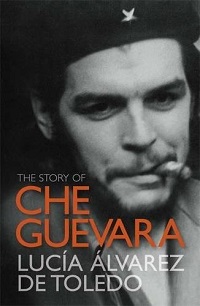
“The Story of Che Guevara” by Lucia Álvarez de Toledo

The Story of Che Guevara

Among the innumerable authorized and unauthorized biographies of the legendary Che, this one – by an Argentine author – surely stands out.

Che Guevara is the ultimate symbol of rebellion and idealism. He rejected the trappings of power and embraced the hard life of the guerrilla fighter. He was born in Argentina and had Cuban citizenship conferred on him, but his outlook was global and his spirit truly Latin American. He condemned the United States at the UN General Assembly in 1964. The following year he criticized the Soviet Union at an international conference in Algeria. He was not one to toe anybody’s line. Even Fidel Castro let him do as he pleased.

Ernesto Guevara de la Serna, a chronic asthmatic, decided early in life that he would overcome. He practised swimming, sports, riding, and shooting and enjoyed the outdoors. In 1947 he evaded military service by having a cold shower before turning up at the barracks for his medical examination, knowing full well that it would trigger a severe asthmatic attack. As a consequence, he was declared medically unfit. He qualified as a doctor in 1953.

Ernesto’s paternal grandmother Ana Lynch was born in San Francisco and came to Argentina at the age of 12. His parents were unconventional people.

In 1950 Ernesto’s 4700 km bicycle trip was featured on the cover of a sports magazine. Besides, he met Chinchina Ferreyra and fell in love. In 1951 he worked as a male nurse on a merchant ship that took him to Brazil, Trinidad, Curacao, British Guyana and Venezuela. En route he wrote a short story titled ‘Anguish – the only Certainty’ wherein he interspersed his own philosophical musings with quotes from Sartre, Nehru and others. Realizing that sailing was not his destiny, he returned home and sought out Chinchina. The immensely rich Ferreyra family did not favour Ernesto’s marriage-plus-travel proposal.

Then began the famed motorcycle trip with Alberto Granada in December 1951. In July 1952, their paths diverged, Alberto landing a job in Venezuela and Ernesto ending up in Miami with one dollar in his pocket. A month later Ernesto returned home in a cargo plane, and in July 1953 set off again, this time with Calica (Carlos Ferrer). They meant to go to Venezuela but ended up in Bolivia. One day, while having coffee at a cafe in La Paz, they noticed a family seated alongside them and eating sandwiches. Their Indian maid was sitting on the floor beside them and the children were throwing crumbs to her as if she were a dog. Calica’s diary recounts how this incident shocked them to the core.

Ernesto then made his way to Panama, Costa Rica, Nicaragua, Honduras and El Salvador and eventually Guatemala, where he meet Hilda Gadea, a Peruvian revolutionary who would later become his wife. Guatemala had plenty of left-wing exiles from right-wing Latin American dictatorships. Che met some Cuban exiles who had been part of the Moncada Barracks attack in July 1953 and were biding their time until Fidel Castro would be freed from prison. Nico Lopez became his first Cuban friend- and nicknamed him Che.

Che was in Guatemala when the government of Jacobo Arbenz was overthrown in a US-backed coup. He took refuge in the Argentine embassy and obtained safe passage to Mexico. In mid 1955 in Mexico City Che and Hilda became a couple. Che met Raul Castro in June and Fidel Castro in July. The bonding was instantaneous. Soon they established a guerrilla training hideout and ended up spending two months in jail when it was discovered. In a letter to his mother in September Che expressed his thoughts about the fall of the Peron government and informed her of his marriage to Hilda. In February 1956 his daughter Hilda Beatriz was born. In November he sailed to Cuba to fight a long drawn out guerrilla war to oust Fulgencio Batista. In the Sierra Maestra during the long campaign Che picked up the habit of smoking Havana cigars, which soon became his trademark.

In a 1958 radio interview to Jorge Ricardo Masetti, Che was asked why he was fighting for Cuba. He replied, “In the first place I consider my country not only Argentina, but the whole of America. When asked whether Castro was a communist, he said, “Fidel is not a communist. Politically one can call him a revolutionary nationalist.”

When the Revolution triumphed Che became head of the National Bank of Cuba. There is an amusing story relating to his appointment. During a core group meeting Castro enquired whether any of the attendees were economists. Che raised his hand. Castro remarked, “I didn’t know were an economist.” Che replied, “Oh, I thought you said ‘communist.’” And that’s how he landed the job. Later he became Minister for Industry.

Aleida March had joined Che’s group towards the end of 1958. On 2nd June 1959 he divorced his first wife and married Aleida on the same day. They had four children together.

Che did a lot of diplomatic networking, leading Cuban delegations to Europe, Africa and Asia. He visited the Taj Mahal and Hiroshima. In 1965 Che went on a secret mission to the Congo with 150 black Cuban volunteers to foment revolution. Seven months later he had to beat a retreat. When Che wrote about his Congo campaign he began with the words, “This is the story of a failure…”

Che’s Bolivian mission in 1966-67 was doomed from the start. The Bolivian communists failed to support and the peasants did not enlist, so the rag-tag band of outsiders didn’t stand a chance. Che was wounded and captured on 8th October 1967 and executed the following day, presumably under orders from Washington.

Che Guevara had all the qualities of a true revolutionary – fearlessness, intelligence, ideology, passion and ruthlessness. To say that the story of his life is fascinating would be a gross understatement.

Overall assessment: Meticulously researched. Must read.

The Story of Che Guevara
AUTHOR: Lucia Alvarez de Toledo
PUBLISHER: Quercus
YEAR OF PUBLICATION: 2010

Contributor: Pushpa Kurup lives in Trivandrum, India and works in the IT sector.

“My Italian Bulldozer” by Alexander McCall Smith

My Italian Bulldozer

This is a recent “one-off” novel by Alexander McCall Smith, by which I mean that it is not part of a series. He is best known for his No. 1 Ladies’ Detective Agency series, which I absolutely love – I own all of those books. He also writes many other serialized books including the 44 Scotland Street series, The Sunday Philosophy Club series, and the Corduroy Mansions series. While he is continuing, fortunately, to write books in these series (such as Precious and Grace, which I wrote about earlier this year), he does occasionally write stand-alone books such as My Italian Bulldozer. Although I haven’t become addicted to any of his other series as I have to his No. 1 Ladies’ Detective Agency series, he is such a good writer, and such a prolific one, that you can be assured of a good read whenever you pick up one of his books.

This is exactly how I would describe My Italian Bulldozer. It tells the story of Paul Stuart, a successful food writer in Scotland, who is heartbroken after his girlfriend, Becky, dumps him for another man (that too, her personal trainer, which seems to add insult to injury!), and goes to stay in Italy for a few weeks. He is ostensibly going to wrap up his cookbook on Tuscan food and wine at the suggestion of his editor, Gloria, who is secretly in love with him and thinks it would do him good to get away and have a change of scene. Once he lands in Italy, some unexpected snafus cause him to first be arrested and spend some time in a jail, and once he is released, to have a bulldozer as the only rental option available to him. And that is how he comes to be driving around on a bulldozer on Italy.

That, in itself, is funny when you visualize it – driving around the Italian countryside in a bulldozer! During the course of his trip, a lot happens in a similar humorous vein – he knows a smattering of Italian and is able to have some really interesting conversations with the people he meets; Becky unexpectedly visits to say she is sorry for leaving him, but he realizes he doesn’t really want to get together with her and encourages her to go back home; he develops a crush on an attractive, intelligent American woman he happens to help out when her car breaks down, but she is already with another guy and can’t reciprocate; and finally, he comes to realize that his deep friendship with Gloria is the solid foundation of a meaningful and loving relationship. Also, he is able to finish his book, so at least “mission accomplished” on that front.

I found My Italian Bulldozer to be a delightful and entertaining read, in the author’s trademark witty style with lots of tongue-in-cheek humor. And as with all his other writing, his humor never degenerates to becoming outlandish or slapstick in the least. Another typical characteristic of McCall Smith’s fiction is that it is always lighthearted, never dark or depressing. Even the “villains” – which in this book would be the rental car agent who duped Paul and made him go to jail – are bad in a funny way. In McCall Smith’s world, there is some humor in every situation. It’s a world that I, for one, would very much like to live in.

My Italian Bulldozer
Author: Alexander McCall Smith
Publisher: Pantheon
Publication Date: April 2017

Contributor: Lachmi Khemlani runs a technology publication in the San Francisco Bay Area.