“The Child” by Fiona Barton

The Child

The Child follows up on Fiona Barton’s debut novel, The Widow, which I had written about last year. I am an aficionado of the mystery/thriller genre and I had found The Widow a very good book in that genre. It was not spectacular by any means – far from contemporary hits like Gone Girl or The Girl on the Train, let alone classics such as Agatha Christie’s many books – but it was a well written, entertaining, and gripping read. Barton’s new book, The Child, is in the same genre, and while it is as well written as The Widow, I would have to say that its entertainment and gripping quotient was a notch lower.

The mystery in The Child is that of a dead newborn baby, whose remains are discovered when some buildings are demolished in a London neighborhood and the construction site is being dug up for a new development. While the exact year of death cannot be determined from the remains as they have been buried for many years, the fact that they are wrapped up in a specific kind of plastic bag provides some clues on a possible time frame. A DNA test reveals a match with a woman, Angela, whose newborn baby mysteriously disappeared shortly after it was born from the maternity ward of the hospital she was in. While Angela has two other children who are now grown up and have kids of their own, she has never gotten over the disappearance of Alice, the name they had given the baby. The discovery of the remains on the building site gets her hopes up so she can know once and for all what happened to her baby and get some closure, even though it means definitively knowing that Alice is dead.

Just when everyone was certain the dead baby was Alice, a wrench is thrown into the mystery when further testing shows that the remains had been buried on the site at least ten years, if not more, after the date that Alice disappeared. So it is still Alice? If so, were the remains hidden somewhere else for over a decade and then buried at the building site? Is that even possible? And if, does that make any sense? Or is this another baby? But no other baby was reported missing in that time. And what about the DNA match?

This is the central mystery in The Child, and while Angela is one of the main characters in the book, there is also Kate, the intrepid reporter who is fascinated by the case and keeps digging into it, and Emma, another woman who happened to live at the housing development at the time when the remains were buried. Emma has a deeply disturbed past and secrets of her own, and for some reason, the story of the baby’s remains becomes one she gets obsessed with.

The mystery is, of course, resolved at the end of the book, and just as in The Widow, in a satisfying, entirely believable way, without any “curve ball” type of plot twists. While there is sufficient intrigue in the story to make The Child as much of a page-turner as The Widow, it wasn’t a book that I couldn’t put down — I read it over the course of a week rather than a day — and in that respect, I would have to say that it was not as gripping as Barton’s first book.

The Child
Author: Fiona Barton
Publisher: Berkley
Publication Date: June 2017

Contributor: Lachmi Khemlani runs a technology publication in the San Francisco Bay Area.

“Villette” by Charlotte Brontë

Villette

I decided to read Villette by Charlotte Brontë because I wanted to become more familiar with her works. I had only read Jane Eyre before.

I’ve also always been intrigued by Charlotte Brontë’s life. She was a woman who experienced a lot of sorrow through the loss of some of her family members. It also seemed like she experienced rejection by people who held to certain religious views. This is why I was really interested in reading another one of her works.

Another thing that caught my attention was the idea that this story took place in a fictional town, “Villette.” I was interested to see what kind of town she would create. I imagined that she would create a fictional world, so that I thought it would be something entirely different from Jane Eyre.

Interestingly enough, it wasn’t what I expected. Although she did create a fictional town, Villette actually turned out to be another novel largely inspired by real events in her life. Which made it, in some ways, very similar to events that occurred in Jane Eyre. If you have read Jane Eyre, you might enjoy picking up on these similarities and figuring out how each of the similarities could have been inspired by events that were real to her.

I must say that it was really hard for me to get into this story because it was so confusing to me. At first, I thought that a lot of the earlier chapters were pointless. The main character, Lucy Snowe, spends a lot of time talking about two other characters, Graham and Pauline, and I couldn’t understand why. But everything comes together in a lovely way eventually. Every component serves its purpose in bringing the characters and novel together. Something that I learned through reading this book is to be patient in allowing the story to unfold and the characters to develop.

Another thing that made it really confusing for me, at first, was that there was a lot of dialogue in French (as the story is set in France). It wasn’t until halfway through the book that I decided to read using a translation app on my phone which did a great deal in helping me understand and enjoy the story a lot more.

Once I was able to sort out all the confusion and understand the story, I began to enjoy this book so much! Very much like Jane Eyre, Charlotte Brontë creates a strong passionate woman named Lucy Snowe. What intrigued me about Lucy Snowe was the circumstances she found herself in. She was lonely young woman who had to find a way to support herself.

“Thus, there remained no possibility of dependence on others; to myself alone could I look. I know not that I was of a self-reliant or active nature; but self-reliance and exertion were forced upon me by circumstances, as they are upon thousands besides.”

This is when I first became gripped by the novel. I wanted to learn about how she would survive. This to me, was the central idea throughout the novel and as events unfold surrounding this issue of her finding a way to support herself, she proves herself to be so resilient which was truly an inspiration to me.

A few things that stood out to me were her descriptions with battling depression due to loneliness. This story is told through the perspective of Lucy Snowe, so we are following her journey through her mind and how she perceives people and experiences around her. She’s also very poetic and passionate in her expressions, which was also something I enjoyed. There were many memorable quotes and descriptions very much like Jane Eyre.

I also think Charlotte Brontë did a great job at bringing her characters to life. Although we are in Lucy’s mind, she helps us understand those she encounters through Lucy Snowe’s dialogue and interaction with others. It was really pleasant to read about the relationships she develops with some of these characters. There were lots of moments that I laughed.

There were also scary moments! Several times, she describes Lucy Snowe’s encounter with a scary apparition that makes its occasional appearance throughout the story.

I almost forgot to add that there is a “possible” love interest in this story. However, it wasn’t quite clear who it might be until much later in the story. Therefore, the ambiguity between the two possible characters that could be the male protagonist caused me to stick with the story to see who it might be.

All in all, it was so pleasant to follow Lucy Snowe’s story. She was another woman who I found to be very strong. I really admired her work ethic and her resilience in finding a way to sustain herself and overcoming any emotional hardship. She was also true to herself and her convictions, and a sincere friend. It was definitely worth all the initial confusion and the brain work that went in to understanding this one.

Villette
Author: Charlotte Bronte
Original Publication Date: 1853
Edition: Penguin Classics, December 2004

Contributor: Nathalie Dorado-Fields is a stay at home mother who lives in Mount Vernon, Ohio.

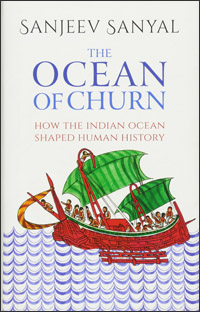
“The Ocean of Churn: How the Indian Ocean Shaped Human History” by Sanjeev Sanyal

Ocean of Churn

A delightful book by an erudite scholar with a penchant for genuine research and a superb style of presentation. Easy to read, easy to understand, difficult to put down. A masterly blend of history, geography, politics, biology, geology, genetics, and archaeology, interspersed with anecdotes and personal testimonies. This book ought to be adapted as a school textbook.

The author eschews the traditional narratives of history presented from the western viewpoint and gives us rare insights into the goings-on in the Indian Ocean rim from pre-history to the present. From the Ranis of Ullal who consistently resisted Portuguese incursions to Marthanda Varma of Travancore who decisively defeated the Dutch at Colachel, and the Chinese Admiral Zheng He’s whose ‘treasure fleet’ visited many Indian ocean ports, the author chronicles the crucial events in India’s history and deftly places everything in perspective.

“When Prithviraj Chauhan, ruler of Delhi, fended off a raid by Muhammed Ghori in 1191, he allowed the invader to return home to Afghanistan! Ghori returned the following year to defeat and kill Prithviraj. This led to the establishment of the Delhi Sultanate and opened up the rest of India to conquest.” Around 1200 Nalanda University was laid waste by Bakhtiyar Khilji.

The book begins with the fascinating story of Pallava king Nandivarman II whose 65 year reign ended in A.D.796. He was shipped in from a faraway kingdom in south-east Asia at the tender age of 12 to fill the vacant throne. Five generations ago, the brother of the Pallava king had migrated to the remote kingdom, married a princess and inherited the throne. When the time came to send an heir to Kanchi, the youngest of the four sons of the reigning monarch was chosen. And, boy, did he prove his mettle!

Apart from debunking the Aryan Invasion Theory and a host of other myths such as the pacifism of Emperor Ashoka and the patriotism of Tipu Sultan, Sanyal tell us how Britain acquired the island of Manhattan, what they gave the Dutch in exchange, why the merchant Naruttam helped the Omanis recapture Muscat from the Portuguese, how the Bali islanders chose to make their last desperate stand against the Dutch in the chilling style typical of Indian warrior clans, and a lot more. The book is a treasure trove of historical facts that have been painstakingly researched, verified and cross-checked.

Remains of a 23000 year old farming settlement have been discovered near the Sea of Galilee in Israel. Europeans may have acquired their fair skin as recently as 5000 B.C. The Harappans exported ghee and cotton textiles. Many of the so-called ‘Indian spices’ were from Indonesia, e.g. cloves and nutmeg.

The Rig Veda indicates no knowledge of Central Asia or southern India. Its geographical canvas is the Sapta Sindhu or land of the Seven Rivers. The river Saraswathi mentioned in the Hindu texts is the Ghaggar River that rose in the Himalayas in the Punjab-Haryana region and finally flowed into the Rann of Kutch. The Sutlej and the Yamuna were among its tributaries. The Indus also used to flow into Kutch until an earthquake in 1819 diverted its course.

Indian soldiers were a global tribe long before the two World Wars. They had seen action at Gaugamela in 311 B.C. when Alexander of Macedon and Darius of Persia came face to face. The Indian cavalry continued fighting even after Darius had fled the battlefield. In 326 B.C. Alexander massacred 7000 Indian soldiers of the Massagan army because they refused to join his invasion of India. Seleucus Nikator gained an edge over the other generals of Alexander when he acquired 500 war elephants from Chandragupta Maurya (in exchange for Baluchistan and Afghanistan). Not to be outdone, Ptolemy managed to get elephants from Ethiopia and smuggled in Indian mahouts to train them for battle.

The Periplus of the Erythraean Sea tells us there were a large number of Indians in Socotra Island (Yemen). Sanyal tells us the name is derived from the Sanskrit word ‘Sukhadhara’.

Nearly half a century after Ashoka’s death, Kharavela of Kalinga sacked Pataliputra and sounded the death knell of the Maurya empire, yet his name is absent from history books.

The Kingdom of Funan in the Mekong delta, the first Indianized kingdom in southeast Asia, was established in the first century B.C. Nalanda University was partly funded by the Srivijaya kings of Sumatra. Roman women used to consult Indian astrologers. Madagascar was colonised by the Indonesians. By the Pallava period there were large Indian communities living in Chinese port towns. One of the largest merchant guilds called ‘The Five Hundred’ was established in Aihole, Karnataka.

Answers to many intriguing questions can be found in this book. How long have the Tamils been in Sri Lanka? Where did the Sinhalese come from? Why does Cuttack in Odisha have an annual fair called ‘Bali Yatra’? Why do the Mohyal Brahmins of Punjab join the Shia Muslims during the ritual mourning during Muharram? Why was Muhammad bin Qasim executed soon after his invasion of Sindh? Who first owned the Kohinoor diamond? And so on.

Observing that humans carry the DNA of Neanderthals and Denisovans in small proportions, Sanyal remarks tongue in cheek, “Given all this mixing, forget racial purity, it seems most of us are not even pure Homo sapiens!”

Overall Assessment: Truly a masterpiece. One of the best books I’ve read in recent years.

The Ocean of Churn: How the Indian Ocean Shaped Human History
AUTHOR: Sanjeev Sanyal
PUBLISHER: Penguin
YEAR OF PUBLICATION: August 2016

Contributor: Pushpa Kurup lives in Trivandrum, India and works in the IT sector.

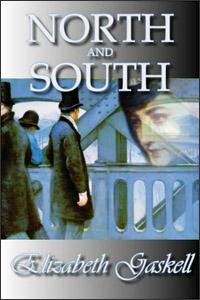
“North and South” by Elizabeth Gaskell

North and South.jpg

Two of my all-time favorite books are Victorian classics — Pride and Prejudice by Jane Austen and Jane Eyre by Charlotte Brontë – and I have been so starved of books in this genre that discovering North and South was like coming across a gem I never even knew existed. I stumbled upon its 2004 BBC adaptation — in the form of a four-part miniseries — on Netflix last week, remembered the recent write-up of the book by Nathalie Dorado-Fields, and started watching it – and couldn’t stop. It made me then get the book which I first obsessively read cover to cover, and then went right back and re-read it. It was simply that good.

As with most Victorian classics, North and South is, at its heart, a love story, and as with most books like it, the romantic tension between the hero and the heroine is sustained throughout the book, literally right down to the last page. The heroine here is Margaret Hale, the daughter of a clergyman who is forced to move with her family from the idyllic pastoral community in the south of England to the gritty industrial and manufacturing community in the north. The hero is a mill-owner in her new surroundings, John Thornton, who is taken with her right away, but whom she finds too harsh and unfeeling until it is almost too late.

While it would be easy to write North and South off as just another romance, what makes it so much more is how it captures the weighty social issues of that time related to industrialization — the growth in manufacturing, the increase in factories, the economic disparity between the mill owners and the workers employed in them, and the class divide. It provides an unflinching look at the lives of the mill workers, their extreme poverty, and their poor health, attributable in large measure to the unhealthy working conditions and polluted air inside the mills. A large portion of the novel is centered around a strike by the mill workers, and the part played in it by the workers’ union. This was when unionization was first starting, and while the strike didn’t end up benefitting the workers in this case, the perspectives of both the workers and the mill owners are the subject of extensive debate and discussion between the various characters. Also, the book does not shy away from the harsh realities of life at that time — there are quite a few deaths and even a suicide. It reminded me a lot of Oliver Twist by Charles Dickens, which portrayed the brutality of criminals and the pitiful treatment of orphans in mid-19th century London in the same heart-rending vein. You feel like you are there and can viscerally experience the pain.

Usually, novels like this are written entirely from one point of view, such as Elizabeth Bennett in Pride and Prejudice or Jane Eyre in Jane Eyre. But North and South was unique in that respect — it takes you inside the head of both the hero and the heroine. You can feel both of their feelings, their emotions, their reactions to each other, and to the world around them. It made the book so much more richer and the story so much more vivid.

I am thrilled to have discovered a new book to add to my much-loved collection of classic literature as well as another author in this genre that I so much admire. I have already added Elizabeth Gaskell’s other books to my reading pipeline.

North and South
Author: Elizabeth Gaskell
Original Publisher and Publication Date: Chapman & Hall, 1855
Edition: Norilana Books, Nov 2007

Contributor: Lachmi Khemlani runs a technology publication in the San Francisco Bay Area.
“The Time Machine” by H.G. Wells

The Time Machine

I had the privilege of reading this book along with a friend. I wasn’t sure what to expect from this book, since I didn’t know too much about it except from what the title suggested, that it would be about time traveling.

When I first started to read this story, it reminded me a little of the Sherlock Holmes’ series because we are introduced to the time traveler through the perspective of another character, very much like how Watson recounts his observations of Holmes. The time traveler is passionately proposing his idea of time traveling and introducing the machine he has invented to a group of men who are very skeptical of him.

On their second meeting, the time traveler shows up late to their dinner meeting and when he arrives, he is looking very haggard. It turns out that he had just returned from visiting the future. What follows from then on is the time traveler sharing the story of his journey into the future and what he experienced there.

I was really excited and curious to know what happened to him over there. Why was he looking the way he was? Would they finally believe him? Was he even telling the truth? Those were some of the questions that sustained me throughout this book.

Another thing that intrigued me about this story was that it was a science fiction book written in the Victoria Era. I was curious to know how science fiction would play out during that time period. Moreover, it was my first science fiction novel. Some of the science fiction aspects that I really enjoyed were the descriptions of the actual travel into the future and the descriptions of the world and inhabitants he encounters over there. I look forward to continuing to explore this genre thanks to this book.

The author, H.G. Wells, seemed to be very passionate about issues and changes that were going on during his time period due to industrialization. His beliefs come through heavily in his story. It seemed like he believed that the type of progress that was happening during his time would bring about moral decline. These are themes and questions that arise throughout his story. I enjoyed this part as well because I was able to understand what aspects of society were important to him, and it caused me to question where I stood on the issues he would bring up.

This was something I wasn’t expecting. I thought it would mostly be fantasy-like but I enjoyed that he was able to create a fantasy world that symbolized real issues. It was fun to read about this world and imagine it, but it was also interesting to think about the heavier issues that each of these aspects represented.

Overall, it was a fun book to read, especially since I read it with a friend. It was fun to briefly be part of this world and also discuss the heavier topics that were brought up. It was also a short book. If you enjoy the morality aspects that are often brought up in Victorian literature, along with the fantasy elements from science fiction, you might enjoy this book.

The Time Machine
Author: H.G. Wells
Original Publisher and Publication Date: William Heinemann, 1895
Edition: Signet Classics, October 2002

Contributor: Nathalie Dorado-Fields is a stay at home mother who lives in Mount Vernon, Ohio.

“Hit Refresh: The Quest to Rediscover Microsoft’s Soul and Imagine a Better Future for Everyone” by Satya Nadella

Hit Refresh

I typically do not read business books. However, the author of this book, Microsoft CEO Satya Nadella, recently appeared on a talk show that I watch, and I was intrigued. Not just by the premise of the book — when do you hear the word “soul” in the context of a technology company? — but by Nadella’s own story. I found out that his son has severe cerebral palsy, and this topic only came up because he was talking about the power of technology to do good, exemplified by some students from the local university who had rigged his son up with a device that allowed him to play music on his own. While that was a truly inspiring example of how technology can help, what I found even more inspiring is how he had achieved so much, risen to lead the leading technology company of the world, all while having a very challenging personal life. Usually when I read about highly successful people, I assume that they must have a charmed personal life which allows them to achieve the great things that they have achieved. But clearly, this was not the case with Satya Nadella.

They say that what doesn’t kill you makes you stronger, and having a child with special needs would, I think, certainly make you more empathetic, more generous, and overall, a nicer person. But I didn’t think it could actually make you capable of also rising all the way to the top as a business and technology leader, which is typically a highly competitive, cut-throat field. But, as it turns out, it can, as evidenced in Hit Refresh, in which Nadella describes how his personal experiences have shaped the way he leads Microsoft. It’s no longer just about being the market leader and increasing profit margins, but more about making a difference. It’s being able to steer Microsoft to use its vast engineering talents to continue developing devices and software that can improve the lives of millions of people around the world, using cloud connectivity, mobile access, data analytics and other technologies. It calls for cooperation with companies that were once bitter rivals, such as Apple, along with younger powerhouses such as Google. When the focus is more on doing good rather than on under-cutting rivals and being the “best,” even employees can feel imbued with a sense of purpose and meaning that makes their everyday work much more life-affirming.

For those curious about Nadella himself, Hit Refresh does provide a brief account of his background and journey from India to the US — a journey which will be familiar to many Indians who also came to the US to work in engineering and software — as well his many years working at Microsoft as he rose through the ranks before finally becoming CEO. The book also discusses upcoming technologies such as artificial intelligence, machine learning, mixed reality, and quantum computing, all of which seem promising to our continued improvements as a society and which Microsoft is exploring. Hit Refresh also has some discussion about politically sensitive issues such as privacy, security, and globalization, but not as much as I had hoped. It would have been very illuminating to know how a progressive technology company, which wants to have a global impact, can operate in a political climate that is protectionist and nationalistic, almost regressive?

While the subtitle of this book, The Quest to Rediscover Microsoft’s Soul and Imagine a Better Future for Everyone, is somewhat grandiose, it is a simple, non-pretentious, non-erudite, straight-from-the-heart account of how Satya Nadella — only the third CEO in Microsoft’s 42 year old history — has been inspired by his personal experiences to make empathy rather than competitiveness the essence of Microsoft, so it can contribute to making the world a better place for everyone.

Hit Refresh: The Quest to Rediscover Microsoft’s Soul and Imagine a Better Future for Everyone
Author: Satya Nadella
Publisher: HarperCollins Publishers
Publication Date: September 2017

Contributor: Lachmi Khemlani runs a technology publication in the San Francisco Bay Area.