“Wives and Daughters” by Elizabeth Gaskell

Wives and Daughters

After being introduced to North and South, a Victorian classic novel by Elizabeth Gaskell that I absolutely loved, I picked up Gaskell’s Wives and Daughters, hoping that it would assuage the withdrawal symptoms I was suffering from after finishing North and South and looking for another book that could inspire the same level of emotion. Wives and Daughters was Gaskell’s last novel before her sudden death in 1865; in fact, she was not able to finish it and it was completed by another writer of that time.

Wives and Daughters is centered around the life of Molly Gibson, a young girl living with her widowed father in a small English town in the 1830s. Her mother died when she was very young, but she still leads a very happy life, adored by everyone in the town, with many friends of her mother who watch out for her, and a very close and loving relationship with her father, who is a highly respected doctor. This tranquil state of affairs is completely upended when her father gets remarried. The new Mrs. Gibson is far from being the “evil stepmother” that is almost a caricature in most stories when the father remarries, but she is somewhat of an airhead, with not much sense, intelligence, and depth of character — all of which Molly has in abundance. This makes it very difficult for Molly to really respect her stepmother, and she finds her very wearying at times, but she puts up with it in good spirit — helped enormously by the fact that her stepmother has a daughter, Cynthia, whom Molly takes to right away. There is even less of the “evil stepsister” angle here that we are used to from our Cinderella fairy tale days — Molly and Cynthia form an instant sisterly bond that only grows stronger as time passes and it is their relationship that is the real highlight of the book.

There is, of course, the obligatory romance, and in Wives and Daughters, it is in the form of Roger Hamley, the son of a local squire who develops a close friendship with Molly but then falls head-over-heels in love with Cynthia when he sees her. This is not surprising, given that Cynthia is exceptionally beautiful and has that effect on most men. However, she does not have Molly’s character and depth of feeling — and she is the first person to acknowledge that. In contrast to Cynthia, Molly’s feelings for Roger are very intense, but she never lets them be known and does not ever feel jealous or envious of Cynthia for capturing Roger’s attention.

Of course, eventually, everything is resolved, and Roger and Molly do get together — it wouldn’t be much of a story if they didn’t. That said, this wasn’t really the point of the book. As evidenced by its title, the story was more about the close relationship between Molly and Cynthia and the experiences they go through together, including how they deal with a somewhat villainous character, Mr. Preston, the aristocratic lords and the ladies of the neighboring manor, and the gossip of the local townsfolk. At over 600 pages, Wives and Daughters is a long, extensive, minutely detailed book that captures much of the life of those times and the thoughts and feelings of all the characters, so much so that reading it is an experience in and of itself. For those who love reading about Victorian times, there’s so much of the book to sink into — the author seemed to be in no rush at all to wrap things up.

On my part, while I enjoyed the book, I didn’t fall in love with it as I did with North and South, and this brought home to me an important realization — that the inspiration behind any great work of art cannot be manufactured at will. Thus, there is no guarantee that anyone who has created an outstanding book, movie, painting or song will continue to do so with the same level of success. Inspiration has to strike, and while the creator cannot force it, he or she can make the best of it when it comes and create something truly remarkable that can bring joy to millions of others. And for those of us who are fortunate enough to enjoy the fruits of their labor, we should appreciate that these could be “once in a lifetime” creations and savor them as such.

Wives and Daughters
Author: Elizabeth Gaskell
Original Publisher and Date: Elder and Company, 1866
Reprint Publisher and Date: Norilana Books Classics Norilana Books Norilana Books, April 2008

Contributor: Lachmi Khemlani runs a technology publication in the San Francisco Bay Area.
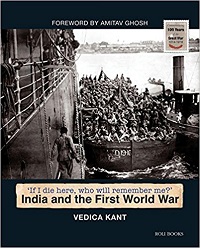
“‘If I Die Here Who Will Remember Me?’ India and the First World War” by Vedica Kant

India and the First World War

A collector’s delight, this book has more photos than text. Even if you aren’t a serious reader you can enjoy the pictures and their captions. The gruesome realities of war come alive through the pages. According to Max Weber, the British and French armies comprised “niggers, Gurkhas, and the barbarians of the world.”

One and a half million Indians participated in the war. Over 70,000 were martyred. Gandhi, Tilak and Sarojini Naidu persuaded Indians to serve the imperial cause. Gandhi’s ‘Appeal for Enlistment’ leaflet said: “If we want to learn the use of arms with the greatest possible dispatch, it is our duty to enlist ourselves in the army.” The 700 odd princely states saw the war as an opportunity to curry favour with the British.

The soldiers left behind hardly any traces of their thoughts, feelings and experiences. Most of the information was gleaned by reading their censored letters. There is only one first person account of soldier’s war experiences. Two Bengali gentlemen, Dr. Kalyan Mukherjee and Sisir Sarbadhikari, who wrote their memoirs, were part of the medical corps.

Havildar Abdul Rahman wrote to a friend in May 1915: “For God’s sake, don’t come don’t come don’t come to war in Europe…and tell my brother Mohammed Yakub Khan for God’s sake do not enlist. If you have any relatives, my advice is don’t let them enlist.” Amir Khan in a letter to wrote to Khan Zaman in Rawalpindi district, “…our guns have filled the German trenches with the dead and made them brim with blood. God grant us grace, for grace is needed. Oh God, we repent! Oh God, we repent!” Gulab Singh wrote, “Many men have had their feet cut off for they had been burnt by the frost.” Santa Singh wrote to his mother, “As a man climbs a plum tree and shakes down the plums (so that) they fall and lie in heaps, so are men here fallen….They too are the children of mothers.”

When a sepoy decided to marry a Frenchwoman, a fellow sepoy wrote, “Mahomed Khan, the lance dafadar, is engaged to a Frenchwoman on the condition that he becomes a Christian. The marriage ceremony is to take place in two or three days. We have done our best to prevent it, but all has been in vain.”

Ragbir Singh wrote, “I have been wounded twice, and now this is the third time that I am being sent to the trenches….If Parmeshwar (God) allows I will escape but the butcher does not let the goat escape.”

The Home Office sanctioned cremation at a site near Brighton, although the 1902 Cremation Act virtually banned open-air cremation. When ghee was in short supply and there was talk of serving margarine to the wounded sepoys, the War Office intervened with a note: “If it got about that we were using margarine, there might be an explosion similar to the old cartridge trouble of the Mutiny.”

By January 1915 Germany had decided to build a mosque near Berlin to cater to Muslim POWs. The Germans had initially protested against the use of Indian and African soldiers in the war – something they viewed as a breach of racial etiquette. A few months later these barriers crumbled and new liaisons emerged.

The story of the two Afridi Pathan brothers, Mir Dast and Mir Mast, makes interesting reading. The former won the Victoria Cross for bravery in war. The other defected to the German side along with twenty two others and later joined a German mission to Afghanistan to convince the Emir to invade India. The British had increased the Emir’s stipend so he was in no mood to rebel. Both Mir Dast and Mir Mast survived the war.

206 Indian POWs lie buried in a forgotten cemetery fifty miles outside Berlin. In fact the Indian dead are scattered all over Europe, some with memorials, some without. The question ‘who will remember me’ hangs heavy.

It wasn’t just Europe. 40% of Indian soldiers served in Mesopotamia in the blazing heat and chilling winters of the Arabian Desert. Sarbadhikari describes an incident where he and another soldier, after marching continuously for three days in hunger and cold, set off to look for food and found a piece of bread in the haversack of a dead white soldier. “We divided it between us and were eating it in the dark, when we realized that the bread had a peculiar taste. Then we understood. The bread had soaked up the soldier’s blood…”

In April 1916, 17000 British- Indian troops under Captain Townshend surrendered to the Turks after enduring a five month long siege at Kut al-Amara. They were marched off through the desert to a location in present-day Syria to build the Baghdad-Istanbul railway. They witnessed the Armenian genocide. A small Armenian boy who was the lone survivor of his family was adopted by an Indian sweeper, given the name Babulal, and brought back to India after the war.

The vast majority of sepoys took their sad stories with them to their graves. As Amitav Ghosh states in the Foreword, “…silence was one of the sepoy’s most enduring traits; it goes so far back and is so consistent that it is hard not to see it as an act of resistance in itself.”

The troops were demobilized after the war and many were out of work. Their story too remains untold. During the clashes that preceded the burning of the police station at Chauri Chaura in February 1922, Bhagwan Ahir, a Mesopotamia veteran, was thrashed by the police. The rest is history.

Overall Assessment: Invaluable for the photos.

‘If I Die Here Who Will Remember Me?’ India and the First World War
AUTHOR: Vedica Kant
PUBLISHER: Roli Books
Date of Publication: 2014

Contributor: Pushpa Kurup lives in Trivandrum, India and works in the IT sector.

“Rebecca” by Daphne du Maurier

Rebecca.jpg

Rebecca is, by far, Daphne du Maurier’s most famous book, and while I had read it years ago, I was inspired to read it again after reading My Cousin Rachel a few months ago. Billed as a “classic tale of romantic suspense,” I found this to be very true even though I had read the book before and vaguely remembered what the suspense was. It’s a testament to how good the book was that I still enjoyed it so much.

The story is that of a young girl who gets married to a middle-aged man, Maxim De Winter, whose first wife has died. She meets him in Monte Carlo – where she is employed as a companion to a rich American woman on holiday – falls in love with him, accepts his proposal of marriage, and returns with him to Manderlay, his stately estate in England. However, she finds herself continuously haunted by the presence of his first wife, Rebecca, at Manderlay. This is not a physical haunting – Rebecca is not a ghost story – but an emotional one. Rebecca seems to be everything she is not – beautiful, gregarious, bold, stately, decisive, stylish, with impeccable taste, the life and soul of a party. It seemed that she could do anything and was adored by everyone. The girl, now the new Mrs. De Winter – whose Christian name we are never told – is engulfed by extreme feelings of inadequacy. These are compounded by the housekeeper at Manderlay, Mrs. Danvers, who was devoted to Rebecca and makes no bones about how she feels towards the new Mrs. De Winter, despite continuing to do her housekeeping duties. She, the new Mrs. De Winter, also thinks her husband is still in love with Rebecca and can’t get over her death.

What exactly happened to Rebecca? How did she die? Why does Maxim look so haunted at times? Why is Mrs. Danvers so sinister, and so contemptuous of the new Mrs. De Winter? What does Frank Crawley, who handles the affairs of the estate for Maxim, know about Rebecca? And who is the shady Jack Favell, who comes to Manderlay to meet Mrs. Danvers and is supposedly a cousin of Rebecca, but is strongly disliked by Maxim and has therefore to keep his visit a secret?

While Rebecca is not a detective story — there is no “investigator” as such — it does have a strong element of mystery about it, with so many lingering questions that persist for most of the book. While that, in and of itself, is not unique to a novel, what sets this book apart is the masterful quality of the writing. It gradually builds up the suspense and captures the increasingly haunted feeling experienced by the protagonist — and thus, by extension, the readers — so vividly that I could almost viscerally experience a growing feeling of dread as I was reading it. And this is despite having read it before and guessing what the suspense was.

I can see why Rebecca has secured Daphne du Maurier a secure place in the annals of literary history. It is truly a timeless classic.

Rebecca
Author: Daphne du Maurier
Original Publisher and Date: Victor Gollancz Ltd, 1938
Reprint Publisher and Date: William Morrow Paperbacks, September 2006

Contributor: Lachmi Khemlani runs a technology publication in the San Francisco Bay Area.

“The Kind Worth Killing” by Peter Swanson

The Kind Worth Killing

It seemed like fate when Ted Severson accidentally met the beautiful Lily Kintner in an airport pub. Eventually he starts talking about his personal life and how his marriage with Miranda is going down the spiral and soon enough … Lily offers to help.

A deadly game begins there.

The author seems to have got the inspiration from Patricia Highsmith’s Strangers on a Train. However, the best thing about this book was that at a certain point when we, the reader, think everything is predictable about this story, it suddenly takes a dangerous turn.

That single factor makes it a much better read than other similar works. I was literally like, “Oh, where did that come from,” at that point.

The story is narrated from a first-person point of view. So the story gets explained by each major character separately. However, the author has not taken any special care to make them “sound” different. The writing style remains a constant throughout the book for all characters.

Out of the lot, Lily Kintner was the most interesting one. You will start rooting for her and supporting a particular “obsession” of hers even if you suspect that she may not be doing the right thing.

It’s hard to write more about this book without spoiling anything. Some of the tactics used in the book to kill have zero logic if you think hard about them, but it doesn’t matter really since it is a thriller. The book is a good read. Yes, perhaps the ending could’ve been slightly different.

But then again, some of them are the kind worth killing!

The Kind Worth Killing
Author: Peter Swanson
Publisher: William Morrow
Publication Date: February 2015

Contributor: Anoop Mukundan is a casual reader and a cyber wanderer.

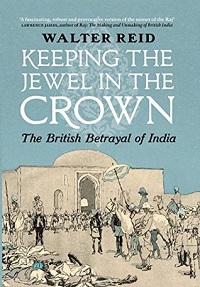
“Keeping the Jewel in the Crown: The British Betrayal of India” by Walter Reid

Keeping the Jewel in the Crown.jpg

A brilliant book detailing the last three decades of the British Raj. The tactics used by successive British leaders to bring about irreconcilable differences between Hindus and Muslims are clearly outlined. The Brits used every weapon in their armoury to keep India in the crown. These weapons included deceit, dilly-dallying and divisiveness.

Britain’s prosperity had long depended upon the exploitation of faraway colonies. When the American colonies bid goodbye in 1776, India became the ‘jewel in the crown’. After the First World War, when the danger of losing India loomed large, the Brits acquired new territories in Palestine, Jordan and Iraq. Their commercial instincts remained uppermost.

A million Indians fought overseas in World War I and 54,000 died. The Brits followed different protocols for burying their own dead, whereas dead Indians were dumped in mass graves. The Memorial of the Missing at Basra (Mesopotamia) mentions about 8000 Brits by name. 665 Indian officers are named too but 33,222 Indian soldiers are reduced to a mere number. This was the pattern all over Europe: Cemeteries, tombstones and markers for the Brits, nothing for the Indians.

Churchill wrote in the Daily Mail in November 1929: “The rescue of India from ages of barbarism, tyranny and internecine war, and its slow but ceaseless forward march to civilization constitute upon the whole the finest achievement of our history. This work has been done in four of five generations by the willing sacrifices of the best of our race.”OMG! I’d always believed Churchill was a consummate racist but reading this statement really gave me the creeps!

When the Gandhi Irwin Pact was debated in the House of Commons on 12th March 1931, Baldwin made his infamous speech quoting a line from his cousin Rudyard Kipling, about the press having “power without responsibility…the prerogative of the harlot throughout the ages.”

When Lord Willingdon, Viceroy of India, was refused entry to the Royal Bombay Yacht Club because he was accompanied by Indian friends, he established the Willingdon Sports Club which was open to all races. Lord Linlithgow, who became Viceroy in 1936, was prone to chasing butterflies in the Shimla hills. The book has a sprinkling of uncharitable observations on political opponents by various personages. The author even mentions that Nehru’s Gandhi cap was made by Scot of London. And Jinnah owned over 300 suits.

On 3rd September 1939 Britain declared war on Germany and the same day Linlithgow coolly made a radio announcement that India was at war with Germany. Earlier in August he had already sent Indian troops to Aden, Egypt and Singapore.

“Gandhi…thought that in the face of Hitler’s aggression, German Jews and Czechs should simply resort to non-violence and Britain should submit to German occupation.” When VK Krishna Menon was asked whether he’d rather see India occupied by the Japanese or the British, he said, “You might as well ask a fish whether it preferred being fried in butter or margarine.” The remark ‘a post dated cheque on a crashing bank’ is usually attributed to Gandhi but it was Nehru who said it.

The League’s demand for partition was by no means unique. Elsewhere in the empire there were similar instances. Though the dominion of Canada was created in 1867, Manitoba, British Columbia and Prince Edward Island came in years later, and Newfoundland joined as late as 1949. When Australia became free, New South Wales and Western Australia chose to stay apart for years – and New Zealand became a separate country.

“Until the war, India had owed money to Britain. As the war went on she became a substantial creditor…” By 1945 Britain owed India 1260 million pounds. When the war ended Britain was indebted to the United States – and the loan was finally repaid only in 2006!

Of the INA, the author states: “The facts are that (1) about 40,500 Indian troops were captured in Malaya/Singapore of which 16,000 joined the INA; (2)a second unit of the INA was set up in 1943 and perhaps 24,000 Indian POWs were recruited; (3) at the war’s end there were thus about 40,000 men in the INA.” I tried to do the math. Only 500 soldiers were unaccounted for. Perhaps they had died or disappeared. In any case it looks like 100% of Indian POWs joined the INA, if British records are to be believed.

1942 was turbulent year. The Japanese captured Singapore-Malaya, Burma and the Andamans in quick succession. Gandhi launched the Quit India movement. “Rail and telegraph communications were struck at. In Madras, Bihar and the united Province, British servicemen were attacked and murdered…..The Government responded with enormous force……Rioters were fired at and aircraft were used to strafe saboteurs who were tearing up railway lines. In Bombay demonstrators were beaten with rattan canes. Order was not restored for six weeks.” It was estimated that 4000 to 10000 Indian lost their lives in the crackdown. On 31st August the Viceroy informed Churchill, “I am engaged here in meeting by far the most serious rebellions since that of 1857, the gravity and extent of which we have so far concealed from the world for reasons of military security. Mob violence remains rampant over large tracts of the countryside.”

“American forces had been arriving in India from the beginning of the year (1942) and by the end of the war there were half a million American troops there.” We learn a few interesting facts about America’s attitude to British imperialism. Just before the Cripps Mission set off for India, Roosevelt wrote to Churchill suggesting that a temporary dominion government be set up in India.

Churchill in his war memoirs claimed that “…the peoples of Hindustan…were carried through the struggle on the shoulders of our small island.” Feel like throwing up? So do I.

Overall assessment: Worth reading.

Keeping The Jewel in the Crown: The British Betrayal of India
Author: Walter Reid
PUBLISHER: Viking – Penguin Random House
Year of Publication: 2016

Contributor: Pushpa Kurup lives in Trivandrum, India and works in the IT sector.