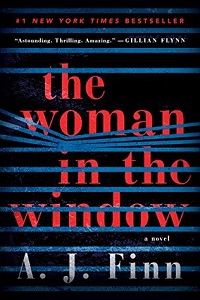
“The Woman in the Window” by A. J. Finn

The Woman in the Window

How and why I picked up this book to read is an interesting story. I had vaguely heard of The Woman in the Window as being similar to the two hugely successfully thrillers of the last few years — Gone Girl by Gillian Flynn, published in 2012, and The Girl on the Train by Paula Hawkins, published in 2015. Both had gone on to being made into movies. While I didn’t care for their movie adaptations, I absolutely loved both these books and had bought copies of them to add to my permanent collection. Yet I did not feel particularly compelled to read The Woman in the Window. With a name so much like The Girl on the Train and the story also being similar — a woman sees something from a window, similar to how the protagonist in The Girl on the Train saw something from a train — it seemed like a knockoff, something I was not particularly interested in. Also, the buzz surrounding it was nothing like it had been for Gone Girl and The Girl on the Train. In my experience, thrillers have to be really, really good, otherwise you just end up feeling stupid after reading them, feeling like you have wasted your time.

Then, just a couple of days ago, I happened to come across an article in the Feb 11, 2019 issue  of The New Yorker magazine which was a detailed exposé of the author of The Woman in the Window. The author’s name, A.J. Finn is a pseudonym — he is actually a guy called Dan Mallory. The article in The New Yorker was 14 pages long  — I was surprised to see such an in-depth investigative report on one person! It described how Mallory had lied his way throughout his career, climbing up the corporate ladder in the publishing world on false pretenses; how he used his good looks and charm to full advantage to dazzle bosses, peers, and subsequently, readers on book tours. He faked illnesses and deaths in his family to write touching essays to get into college, to evoke sympathy in his colleagues, and justify his absences.  He pretended to have two Ph.D.s, including one from Oxford, which he did not have. (He was enrolled in Oxford — again by lying on his application — but never completed his Ph.D.) It was almost unbelievable that someone would go to such lengths to promote themselves and get a leg up in the literary world.

Coincidentally, I had to go to the library later that day to pick up a book and I happened to see a copy of The Woman in the Window sitting on the shelves, available to borrow. In the past, I had simply glossed over it, but now I checked it out. I was curious, first of all, to see if it was any good, and second, to find out if, knowing what I knew now about the author, whether that would affect what I thought about the book. I had a free evening and was able to read it right away.

What I found is that Dan Mallory is a very good writer. The pacing of the book is excellent –almost like a movie. (A movie is already in the works, and the script-writers should have no trouble adapting it.) The protagonist is a thirty-something woman who has gone though a very traumatic experience fairly recently which has made her extremely agoraphobic. She used to be a child psychologist, but now she never leaves her house and passes her time drinking, taking lots of medications, playing chess online, chatting with fellow agoraphobes in an online chat room, and following the goings-on in the lives of her neighbors in whose houses she can see (apparently, no one believes in closing their blinds or shutting the curtains in her neighborhood!) One day, she sees a murder in a neighboring house through her window and calls the police, even venturing out of her house to help, despite her agoraphobia. But it turns out that no one will believe her — they think she is crazy. And this is not just because she is almost always drunk and drugged, but also because of the lies she is always telling about her family. (These lies are related to the traumatic experience which made her agoraphobic to begin with.) But she knows what she saw, and in the end, it turns out that she was right. The book ends with a dramatic confrontation between her and the killer. (This, by the way, is on the roof of her house and in the pouring rain —  already movie-ready!)

In addition to being well written — whatever his failings, Dan Mallory (writing as A.J. Finn) is a good writer — I found The Woman in the Window riveting enough to read all the way through. And it was an easy read — I finished it in the course of a single evening. The pacing was great, with very short, fast-moving chapters — almost like staccatos in a piece of music — and the tension was maintained throughout.

However, while I was easily able to read the book all the way though, the final reveal about the murderer was quite a let-down. It was too easy and too glib — it just made you feel cheated. Simply put, the ending didn’t live up to the rest of the book, and when I finished it, it wasn’t with the sense of fulfillment at having read a good book but instead with a feeling of dissatisfaction at having wasted my time. It’s a pity that a writer who is obviously talented and can write well could not come up with a gripping ending to a promising story of crime and suspense. The Woman in the Window was stylistically excellent but ultimately lacking in substance.

And with regard to that exposé in The New Yorker, I think it is a credit to Mallory’s writing that I forgot all about it when I was reading The Woman in the Window. It shows that art and creativity can transcend all of our failings and foibles as human beings — you don’t have to be a perfect person to create a perfect piece of art.

The Woman in the Window
Author: A. J. Finn
Publisher: William Morrow
Publication Date: January 2018

Contributor: Lachmi Khemlani runs a technology publication in the San Francisco Bay Area.

“Still Me” by Jojo Moyes

Still Me

Still Me is the third and final book in the Me Before You trilogy, which started with the publication of Me Before You in 2012. That book was a huge hit and was subsequently made into a movie. At the time it was published, it was not intended to be a trilogy — it was only after the critical and commercial success of the book that Jojo Moyes, the author, wrote two more books that continued to tell the story of the main protagonist, Louisa. (In a recent interview I heard, Jojo Moyes disclosed that she was motivated to write more books by the large number of enquiries from fans who wanted to know how Louisa went on to live her life.)

I wish she hadn’t. It seems to me that sometimes when you create something so spectacular, you should just leave it alone rather than try to continue with it, hoping that the continuation will be just as brilliant and successful. It usually is not. A case in point — Harper Lee’s recent Go Set a Watchman which purports to continue her much-loved classic, To Kill a Mockingbird, but has ended up almost destroying its legacy.

First, some background. I read Me Before You a few years ago at the recommendation of a friend and was blown away by how good it was. It tells the story of Louisa, a regular girl in a small town in England, who loses her job when the local café she was working in suddenly closes down; she then starts working as a companion to a young man, Will, who is confined to a wheelchair after a terrible accident that leaves him a quadriplegic, a condition where all four of limbs are paralyzed and which is incurable. Unknown to Louisa, Will is planning to end his life in six months in a facility in Switzerland which provides medically assisted suicide. While Louisa and Will get off to a rocky start, they come to develop a very close friendship and she falls in love with him. But despite her best efforts to change his mind, and unlike a traditional happily-ever-after romantic ending, Will chooses to go through with his assisted suicide plan and dies. The book ends with Louisa reading Will’s last letter to her in a café in Paris that he had visited and loved. The book was beautifully written, the story was so poignant and sad, and at the same time, so fill of wisdom and profound insights on life and living. Will’s letter ends with this:

“Don’t think of me too often. I don’t want to think of you getting all maudlin. Just live well.

Just live.”

I absolutely loved Me Before You.

I read the second book, After You, some months later. It lacked the punch of the first book — that was a really hard act to follow — but it was still a decent read. We find Louisa still mourning Will’s death, unable to pick up the pieces and not knowing how to live until a teenage girl, who turns out to be Will’s daughter from his younger philandering days (he didn’t know about her at all) shows up at her doorstep, with a lot of issues that need to be sorted out. While this plot line does seem quite contrived, along with Louisa meeting and falling in love with a new guy, Sam, there are some good things in this book like the descriptions of a support group that Louisa joins for those who have lost loved ones, as well as the descriptions of Louisa’s small closely-knit family in England, their individual eccentricities, and their family dynamics. The second book was nowhere close to the first book in terms of the plot or the quality of the writing, but it was still very readable.

I wish I could say the same for the third book, Still Me, which came out a year ago. The fact that it didn’t generate any kind of buzz should have warned me. The reason that it even appeared on my radar at all was because I recently heard Jojo Moyes on a BBC Books podcast that I listen to. She mostly talked about Me Before You and also read parts of it. It brought back the memories of how much I had loved it. I hadn’t read the concluding book in the series, Still Me, so I picked it up. I also got the first two books in the series and reread them so that I could go back to the beginning and remember how the story unfolds. I was delighted to find that I loved the first book, Me Before You, even more than I had done before. Being older and with a more mature perspective on life, I was able to appreciate its wisdom and insights a lot better. And it was just an incredibly sweet romantic story, even though it had such a sad ending.

I found the second book, After You, just as I had done before — not a great book but still enjoyable.

Still Me, unfortunately, was a real letdown. In this book, Louisa gets a job as a companion to the wife of an extremely wealthy man in Manhattan, and the book is centered around the dysfunctions of this family, the trivial details of their lives, and how eventually Louisa is betrayed by the wife and loses her job. Fortunately, her cranky neighbor comes to her rescue and she ends up reuniting the old woman with her long estranged family. And she and Sam, her boyfriend from the second book, temporarily end their relationship and she starts seeing a man in New York, who, get this — looks just like Will, the former love of her life — but she eventually breaks it up with him because he turns out to be a typical shallow New Yorker. And if all of this wasn’t unbelievably melodramatic enough, there is a whole Sleepless in Seattle type finale to the book in which Louisa has to go to the top of 30 Rockefeller Plaza in Manhattan to be reunited with Sam who comes to New York for her!

All in all, it was so ludicrous that I wish that I could go back and “unread” Still Me. What a disappointing, run-of-the-mill, movie-potboiler ending to such a lovely story! It has almost spoiled Me Before You for me. While I can appreciate that authors, just like any of us, have their highs and lows, and cannot always write brilliantly (“You can’t live on a permanent high,” I was once told), I do wish that authors would realize this too. Not everything they write is going to be as inspired as something spectacular they may have written at some point. They should not mess with perfection. If any of their creations turns out to be a masterpiece, they should be thankful for the inspiration that led them to create it and move on to create something else. Leave the masterpiece alone for the rest of us to enjoy.

Still Me
Author: Jojo Moyes
Publisher: Pamela Dorman Books
Publication Date: January 2018

Contributor: Lachmi Khemlani runs a technology publication in the San Francisco Bay Area.