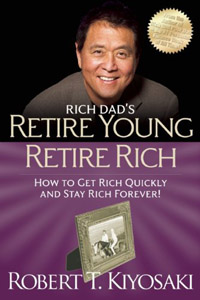
“Retire Young, Retire Rich: How to Get Rich Quickly and Stay Rich Forever” by Robert T Kiyosaki with Sharon L Lechter

retire-young-retire-rich

I read ‘Rich Dad, Poor Dad’ several years ago and I was greatly impressed. It presented a wholly new perspective on the accumulation of wealth. So I had great expectations of Kiyosaki’s ‘How to Get Rich Quickly and Stay Rich Forever’. I was a little disappointed. What’s most annoying is that there are umpteen repetitions. After reading this one, I don’t feel inclined to read the other books in the series.

The author’s focus on financial literacy is probably the most important aspect of the book. It is also a matter that does bear repetition. Some home-truths really need to be repeated – only then do they sink in. Kiyosaki reminds us that, “Saving money is slow. You can become rich by saving money, but the price is time… your lifetime.” He adds that, “Many people today are not in the same professions as their parents…….but when it comes to money, investing, and retirement, they do exactly the same things. When it comes to money, many people are still swinging their parents’ axe.” How true!

I like the way the author explains the principle of leverage making it ever so simple: ‘Doing more with less’. The examples he gives are illuminating. “In the beginning, animals could run faster than humans, but today humans can travel faster and further than animals because they created tools of leverage, such as bicycles, cars, trucks, trains and planes. In the beginning, birds could fly and humans could not. Today, humans fly higher, further and faster than any bird.”

Kiyosaki points out that Bill Gates, Michael Dell, Ted Turner, Henry Ford and Thomas Edison did not finish school. I can’t help wondering what the world would have been like if Edison had concentrated on making money rather than on conducting his experiments. Of the Wright brothers Kiyosaki says, “They are prime examples of people who studied because they wanted to learn and not for grades; they worked hard for free without guarantees, took risks intelligently, and pushed themselves and the world into another reality.” Such examples are bound to inspire and motivate – and they certainly add spice to the core message of this book.

The author also points out some simple facts that every investor ought to know from the start. “Out of ten investments, the odds are two to three will be bad, two to three will be good, and everything in the middle just lies around like a lazy dog.”

Overall Assessment: This book could have been written in 100 pages instead of 550. Then it would have been another masterpiece.

Retire Young, Retire Rich: How to Get Rich Quickly and Stay Rich Forever!
Author: Robert T Kiyosaki with Sharon L Lechter
Publisher: Warner Books
Publication Date:: 2002

Contributor: Pushpa Kurup lives in Trivandrum, India and works in the IT sector.

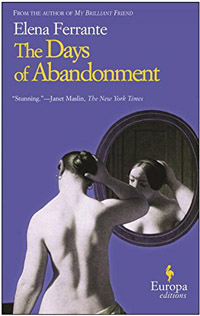
“The Days of Abandonment” by Elena Ferrante

the-days-of-abandonment

I wish I hadn’t read this book. It’s about how a woman goes to pieces slowly and painfully after being abandoned by her husband of fifteen years. The opening line sets the stage for what is to follow: One April afternoon, right after lunch, my husband announced that he wanted to leave me. He did it while we were cleaning the table, the children were quarrelling as usual in the next room….”

An all too familiar tale told in excruciating detail by a famous author who has preferred to remain incognito. Her Neapolitan novels are making waves, and that’s what prompted me to pick out this earlier work of hers (or is it ‘his’?). I must confess I’m sorely disappointed. The book begins with a whimper and ends with a whimper. I’m not without empathy for suffering women, but I prefer the strong ones who face life squarely. I can’t help thinking that J K Rowling is a single mother too and look at what she accomplished. I know it isn’t fair to compare, but it’s just that I hate sob stories, and this one really takes the cake.

The book is not without merit though. For women in similar situations, it might strike a familiar chord. A plethora of negative emotions, the sinking of the woman’s spirit into a deep, dark abyss of despair is vividly and convincingly portrayed. That’s why I wish I hadn’t read it.

The author is undoubtedly a master at portraying intense emotions. “After my marriage, I had quit and followed Marc through the world, wherever he was sent by his work as an engineer. New places, new life. And to keep under control the anxieties of change, I had, finally, taught myself to wait patiently until every emotion imploded and could come out in a tone of calm, my voice held back in my throat so that I would not make a spectacle of myself.”

Every sentence weighs heavy upon the heart. Sad, sad, sad – that’s all there is to it.

Overall assessment: Read only if you enjoy wallowing in pain.

The Days of Abandonment
Author: Elena Ferrante (translated from Italian by Ann Goldstein)
Publisher: Europa Editions
Publication Date: 2005 (first published in 2002 in Italy)

Contributor: Pushpa Kurup lives in Trivandrum, India and works in the IT sector.

“A Place to Stand” by Jimmy Santiago Baca

a-place-to-stand

A brutally honest memoir by a person born to deprivation and abandonment. Born in the southern state of New Mexico to parents of Mexican and Apache Indian descent, Baca’s early life is the very antithesis of the American dream. This book enables you to see the indifferent face of America, the very existence of which many in the developing world are unaware. Poverty in America? Don’t tell me! Here is a man lucky enough to be born in America and yet living a most horrendous and nightmarish existence from early childhood to adulthood. “I’d begun to feel early on that the state and society at large considered me a stain on their illusion of a perfect America. In the American dream there weren’t supposed to be children going hungry or sleeping under bridges.”

Baca and his two siblings were abandoned in childhood by both parents – their father drifting through life in an alcoholic haze and their mother eloping to California with a lover in her quest for a more settled lifestyle. Brought up by their grandparents for a while, the children keep yearning for their parents’ return. When their grandfather passes way, the boys are sent to an orphanage. Baca runs away again and again – and ends up in a detention center at the age of thirteen. From there, he moves on to street life marked by vagrancy, aimlessness, petty crimes, intermittent jail terms, violence and substance abuse, for a while reuniting with his brother and then losing him again. “And somewhere along the line, I started fighting just for the sake of fighting, because I was good at it and it felt good to beat other people up.”

Baca is sentenced for drug peddling and ends up in jail. During his five-year incarceration at a maximum security prison, he learns to read and write. He attained real literacy only when he was in his early twenties – and it turned out to be his path to salvation. While he speaks of the sub-human conditions that prevail in prison, something that the vast majority of us cannot even imagine, his language espouses a dark beauty and is more poetry than prose. “The rage that came out of him was the kind of rage that transcends friendship. It’s the kind of rage that can be created only in prison. The seeds of that rage are nourished by prison brutality and fertilized by fear and the law of survival of the fittest. It grows and grows, hidden deep in souls that have died from too many beatings, too many jail cells, and bottomless despair, contained like a ticking bomb.”

Of life in jail, he has this to say, “Three meals a day and a warm cot with a roof over my head was a vacation. It was often better in jail than on the streets; I didn’t have to worry for a while about surviving.” And “Handcuffs had become as normal to me as a wristwatch is to a free man.”

Baca draws plausible portraits of everything that is wrong with a system that recognizes human beings only when there is a perceived need to punish and restrain them. “You could see the narrowing of life’s possibilities in the cold, challenging eyes of the homeboys in the detention center; you could see the numbing of their hearts in their swaggering postures. All of them had been wounded, hurt, abused, ignored; already aggression was in their talk, in the way they let off steam over their disappointments, in the way the expressed themselves. It was all they allowed themselves to express, for each of them knew they could be hurt again if they tried anything different.”

The emotional content of the book is stupendous. It doesn’t come as surprise that Baca soon became an acclaimed writer. He had endured so much and he had so much to say. And most significant of all, he had overcome. Through the world of letters, the human spirit had broken out of the vicious circle of drugs, crime and depravity and settled down to the peaceful pursuit of true happiness. This memoir has the potential to awaken hope in the hearts of people who are going through similar travails and plumbing the depths of despair, not only in America but elsewhere. In the author’s own words, “I was a witness, not a victim. I was a witness for those who for one reason or another would never have a place of their own, would never have the opportunity to make their lives stable enough because resources weren’t available or because they just could not get it together.”

Overall Assessment: Definitely worth reading.

A Place to Stand
AUTHOR: JIMMY SANTIAGO BACA
PUBLISHER: GROVE PRESS, NEW YORK
DATE OF PUBLICATION: 2001

Contributor: Pushpa Kurup lives in Trivandrum, India and works in the IT sector.

“The Last Lecture” by Randy Pausch with Jeffrey Zaslow

the-last-lecture

I read ‘The Last lecture’ on a flight from Dubai to New York. The book was published in 2008, the year Randy Pausch died of pancreatic cancer. The fatal diagnosis had come in 2006 and the following year Pausch delivered “The Last Lecture” at Carnegie Mellon on the topic “Really Achieving Your Childhood Dreams.” Ironically, the speech was part of a series Carnegie Mellon called “The Last Lecture,” where speakers were asked to think about what mattered to them most and give a hypothetical last lecture. Pausch’s speech soon became a sensation on Youtube and the book (supposedly dictated over cellphone to WSJ journalist Jeffrey Zaslow) later turned out to be a New York Times bestseller.

Pausch, a computer scientist and university professor, recognized as a pioneer of virtual reality research, married with three little infants, finds out he has very little time left. This book is his last and final legacy. It is both touching and thought-provoking, leaving the reader sad and elated at the same time. Though it is about death and man’s helplessness in the face of the inevitable, it maintains a humorous vein throughout. Here are a few samples:

  • I quote my father to people almost every day. Part of that is because if you dispense your own wisdom, others often dismiss it; if you offer wisdom from a third party, it seems less arrogant and more acceptable
  • After I got my PhD, my mother took great relish in introducing me by saying: “This is my son. He’s a doctor but not the kind who helps people.
  • Throughout my academic career, I’d given some pretty good talks. But being considered the best speaker in a computer science department is like being known as the tallest of the Seven Dwarfs
  • While I went through treatment, those running the lecture series kept sending me emails. “What will you be talking about?” they asked. “Please provide an abstract.” There’s a formality in academia that can’t be ignored, even if a man is busy with other things, like trying not to die.

The book encompasses many quotable quotes, sound business advice and much wisdom. A few examples:

  • There is more than one way to measure profits and losses.
  • On every level, institutions can and should have a heart.
  • A good apology is like an antibiotic, a bad apology is like rubbing salt in the wound.

Overall Assessment: Definitely worth reading.

The Last Lecture
AUTHOR: Randy Pausch with Jeffrey Zaslow
YEAR OF PUBLICATION: 2008
PUBLISHER: Hodder & Stoughton

Contributor: Pushpa Kurup lives in Trivandrum, India and works in the IT sector.

“The Millionaire Next Door: The Surprising Secrets of America’s Wealthy” by Thomas J. Stanley and William D. Danko

the-millionaire-next-door

It’s evident that extensive research has gone into the making of this masterpiece. Thomas J. Stanley studied wealthy individuals for decades before he co-authored this book along with William D. Danko. There are quite a few ‘get rich’ books on the market. This one is undoubtedly special.

The good news is that anyone with a decent job can accumulate a fortune over time. The bad news is that high income does not automatically translate into great wealth. What do the wealthy folks in America have in common? Have they merely inherited a fortune? Not so, say the authors. One thing they all have in common is frugality. We all know of Warren Buffet, but hey, there are dozens of others! And the rich are not who we think they are.

The authors state that affluent persons tend to answer ‘yes’ to three questions they were asked in routine surveys:

  1. Were your parents very frugal?
  2. Are you frugal?
  3. Is your spouse more frugal than you are?

“Most people will never become wealthy in one generation if they are married to people who are wasteful. A couple cannot accumulate wealth if one of its members is a hyper-consumer. This is especially true when one or both are trying to build a successful business. Few people can sustain profligate spending habits and simultaneously build wealth.” So high living is just not cool.

Tighten your belt folks! Take a deep breath. Do you really need that new Lamborghini?

You can also learn new ways of calculating what your net worth ought to be. “Multiply your age times your realized pre-tax annual household income from all sources except inheritances. Divide by ten. This, less any inherited wealth is what your net worth should be.” Check it out. Do you pass the test? No? Then buy another copy of the book and give it to your spouse.

Overall assessment: Wanna become rich? Try this one!

The Millionaire Next Door: The Surprising Secrets of America’s Wealthy
AUTHORS: THOMAS J STANLEY & WILLIAM D DANKO
PUBLISHER: TAYLOR TRADE PUBLISHING
DATE OF PUBLICATION: 2010

Contributor: Pushpa Kurup lives in Trivandrum, India and works in the IT sector.

“So Long a Letter” by Mariama Bâ

so-long-a-letter

This book by a Senegalese woman writer in French was widely acclaimed and translated into several languages. The English translation was published in 1981, the same year the author died following a tragic illness.

“To warp a soul is as much a sacrilege as murder.” The status of women in polygamous social structures is gracefully outlined in this teeny weeny semi-autobiographical novel that appears in the form of a long letter from a woman to her friend. Sensitive, without being sentimental, it recounts the tragic story of a woman’s life in the simplest of ways. As a woman born into a patriarchal conservative Islamic society with all its inherent contradictions, Ramatoulaye remains stoic through multiple childbirths, watches helplessly as her husband takes a younger second wife, and later battles the emotional storms of widowhood.

“My voice has known thirty years of silence, thirty years of harassment,” the epistle states in a matter-of-fact tone. “It bursts out, violent, sometimes sarcastic, sometimes contemptuous.” When her husband’s much-married brother proposes to wed her in accordance with the prevailing custom, Ramtoulaye reacts, “Did you ever have any affection for your brother? Already you want to build a new home for yourself, over a body that is still warm. While we are praying for Modou, you are thinking of future wedding festivities.” Not content with this admonition she goes on to question the social order with its unfair tradition of unearned male privilege: “What of your wives, Tamsir? Your income can meet neither their needs nor those of your numerous children. To help you out with your financial obligations, one of your wives dyes, another sells fruit, the third untiringly turns the handle of your sewing machine.”

When Daouda, a former suitor, now a distinguished member of the National Assembly, turns up at the funeral, Ramatoulaye brings up the subject of women’s representation in the august house. “Four women, Daouda, four out of a hundred deputies! What a ridiculous ratio! Not even one for each province.” Daouda’s response is as meaningful as it is amusing. “But you women, you are like mortar shells. You demolish. You destroy. Imagine a large number of women in the Assembly. Why, everything would explode, go up in flames.”

The oppressed woman’s yearning for freedom is subtly and powerfully expressed in crystal clear language: “Daouda Dieng was savouring the warmth of the inner dream he was spinning around me. As for me, I was bolting like a horse that has long been tethered and is now free and reveling in space.” Ramatoulaye’s letter delivered by a messenger to Daouda and his reply are both heart-breaking.

The novel is entertaining, thought-provoking and soul-stirring. It undoubtedly has feminist overtones as it highlights the imbalance between the sexes and the helplessness of women. Every woman will love it.

The translator, Modupe Bode-Thomas, deserves commendation for the professional touch that makes the book so very special.

Overall Assessment: Well worth a read –especially if you are a Muslim woman.

So Long a Letter
AUTHOR: Mariama Bâ
DATE OF PUBLICATION: French original in 1979, English translation in 1981.
PUBLISHER: Waveland Press

Contributor: Pushpa Kurup lives in Trivandrum, India and works in the IT sector.

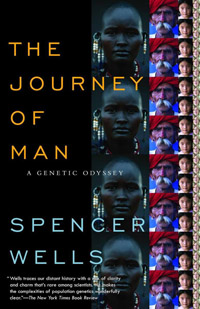
“The Journey of Man: A Genetic Odyssey” by Spencer Wells

the-journey-of-man

You are descended from a man who lived in Africa about 59,000 years ago. Do you find this hard to believe or accept? Well, that’s not all. Every other guy living on Planet Earth today is also descended from the same man! Man, wasn’t he a lucky man! The poor savage wouldn’t have imagined this level of success even in his wildest dreams!

How did the descendants of all the other ancients disappear into thin air? And if all of us have a common male ancestor then why do we all look so different? What accounts for our different colors and characteristics? Does race mean anything at all? How did the descendants of this super grandpa spread all over the planet? Where did they go first? How long did they remain in Africa?

This path-breaking book tries to answer all these questions. Earlier studies had revealed that all of us are descended from a single female ancestor (called Mitochondrial Eve) who lived about 150,000 years ago in Africa. Charles Darwin wrote in 1871, “It is therefore probable that Africa was formerly inhabited by extinct apes closely allied to the gorilla and chimpanzee, and as these two species are now man’s nearest allies, it seems somewhat more probable that our early progenitors lived on the African continent than elsewhere.” How right he was!

Today we know that apes lived in Africa some 23 million years ago. We went searching for the so-called ‘missing link’ and we found Homo Erectus, the first stand-up man. We wondered whether some of us are descended from the Neanderthals. We were puzzled about the Java Man, the Peking Man and so many others. It appears now that the Southern Ape is more likely to be our direct ancestor than any of these guys. The oldest genetic lineages are found in people living in eastern and southern Africa.

The sequencing of the human genome provided several answers and threw up just as many questions. Humans were in Australia 50,000-60,000 years ago. They are the only primates on the continent. This means they must have colonized the continent from elsewhere. The DNA trail leads to Africa. Homo erectus never made it to Australia, though they inhabited the island of Java. The aborigines of Australia have a lot in common with the Bushmen of southern Africa. How did homo sapiens travel to Australia so long ago? Did they make boats? Traces left by modern humans in Europe date back to a mere 40,000 years! And Europeans claim they ‘discovered’ Australia! Obviously 21st century humans need to unlearn much that they had learnt.

There is evidence to show that early moderns arrived in India from the south rather than the north. The Dravidian languages are completely unrelated to the Indo-European languages. And DNA markers seem to indicate that the Aryan invasion theory is not without substance.

As early as 1787, Thomas Jefferson wrote, “The resemblance between the Indians of America and the Eastern inhabitants of Asia would induce us to conjecture that the former are the descendants of the latter, or the latter of the former…” We know now that Jefferson had hit the nail on the head. It was across the Bering Strait that modern man came to the new World – and it took him only a thousand years to reach the southern tip of South America. Spencer Wells adds that, “Three-quarters of the large mammals in the Americas were driven to extinction around this time, among them mammoths and horses – the latter weren’t to reappear in the Americas until the Spaniards introduced them in the fifteenth century.”

Overall Assessment: A fascinating read. Biologists, anthropologists, geneticists, truth-seekers, DO READ!

The Journey of Man: A Genetic Odyssey
Author: Spencer Wells
Publisher: Random House
Date of Publication: 2003

Contributor: Pushpa Kurup lives in Trivandrum, India and works in the IT sector.

“Empires of the Indus: The Story of a River” by Alice Albinia

empires-of-the-indus

This first book by a young author made me feel thoroughly ashamed of my ignorance of history. A splendid piece of meticulous research, it ought to be read by every Indian and Pakistani, not to mentions Afghans, Tibetans, and others. The author traces the path and history of the mighty Indus River in an altogether novel narrative, and portrays the lives and aspirations of the peoples who inhabited the lands surrounding it. The book is at once a delightful travelogue, and a superb historical narrative spanning thousands of years. It is serious, yet entertaining, cerebral but not incomprehensible.

Consider these snippets of information:

  1. Islam had a complex relationship with slavery. As in the Bible, slaves were an important part of the Quran’s social system. Mohammed himself sold the Jewish women of Medina into slavery – and the Quran, which has a rule for everything, scripted a strict code regarding their treatment. Slaves were not objects but human beings and they were to be considered a part of the family.
  2. The 10th century Baghdad Caliph had 7000 black eunuchs (and 4000 white ones).
  3. As Islam’s reach into Africa deepened, and the number of black slaves being exported to Arabia increased, so did Arab racism about Africans. Some historians trace this to the revolt by black slaves working in the mines and plantations of Mesopotamia in 883CE.
  4. Arabs imported/exported 2 million sub-Saharan slaves between 900 and 1100.
  5. When the first Muslim-Arab army arrived on the shores of Sind in 711CE, it arrived with plenty of African slaves.
  6. In 1240 Razia Sultan was deposed for having an affair with her Abyssinian (Ethiopian) slave minister Jamaluddin Yaqut, though Razia herself belonged to the ‘Slave Dynasty’ which was of Turkish origin.

All this has to do with slavery but that’s not what the book is about. There’s lots of information about many things, people and events. There are profound sentiments and an overall sense of pathos. The unstated is as powerful as the stated. Babur hunted rhinoceros in the jungles of northern Punjab. (Now the region has no more rhinos.) Ashoka’s edict at Kandahar was scripted in Aramaic and Greek. The land where the Golden Temple of Amritsar stands was donated by Emperor Akbar to the fourth Sikh Guru. (This is fiercely contested.)

Overall Assessment: If you have any intellectual pretensions, do read the book. If you have an interest in history, sociology and the environment, it’s a must-read. Flippant readers, keep away – this book is not for you!

Empires of the Indus: The Story of a River
Author: Alice Albinia
Publisher: John Murray (An Hatchette UK Company)
Date of Publication: 2008

Contributor: Pushpa Kurup lives in Trivandrum, India and works in the IT sector.

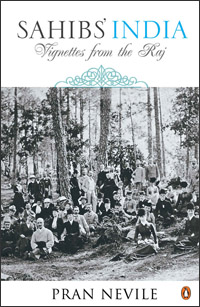
“Sahibs’ India: Vignettes from the Raj” by Pran Nevile

sahibs-india

This is a meticulously researched work, yet the author eschews boring details and tells us only what informs and entertains. “In the royal household of the Viceroy, Lord Lytton, there were 300 indoor servants, of whom a third were cooks.” My heart stops, my head spins, my hair stands on end! While we do know that the British in India lived in opulent splendor, the actual details and descriptions are revealing if not shocking. We are left wondering whether the kings and queens of England enjoyed such luxuries as the sahibs did.

The chapters have interesting titles, indicating the shape of things to come: Sex and the Sahib, Memsahibs and the Indian Marriage Bazar, When Sahib was Hooked to Hookah, Nautch Parties, Fun and Frolic in Simla, Shikar and Pig-Sticking, Sadhus, Sufis and Sanyasis, Banning of an Indian Erotic Epic, and so on. “David Ochterlony, the British resident in Delhi (1803) popularly known as ‘Loony Ahktar’, lived like a royal prince and used to take the air in the evening accompanied by his thirteen Indian bibis riding elephants.” Similarly, William Frazer who was the British commissioner in the 1830s maintained seven Indian wives and had several children, who were either Hindu or Muslim depending on the faith of their mothers.

We learn that “The cost of landing a European wife in Calcutta worked out to Rs.5000 – far beyond the means of ordinary company officials. On the other hand, according to Captain Williamson’s Guide book published in 1810, the expenses that had to be incurred on an Indian mistress worked out to Rs.40 per month.” We also learn than white-skinned girls from Eastern Europe and Japan were procured to staff the brothels of Bombay and Calcutta. Robert Clive in the 18th century described Calcutta as “one of the most wicked places in the Universe.” In 1828 there was a general strike by palanquin bearers in Calcutta. Interestingly, all of them were natives of Orissa. The rickshaw was introduced from Japan in the 1880s. The Kumbh Mela at Haridwar attracted pilgrims from China, Persia and Bokhara.

“All accounts emphasize the fact that Muslims celebrated their festivals just like the Hindus, with the same earnestness and ostentation and amused themselves with dance and song and other entertainments, including feast and sports,” the book informs us. Persian songs were as popular in India as Hindi songs until the end of the 19th century. “Tazah ba tazah, nu ba nu”, a ghazal by Hafiz (Shirazi) dominated the nautch scene for over a century. By the early 20th century, thanks to the fervor of the missionaries and the campaigns of the vigilantes, the nautch had fallen out of favour and the nautch girls had faded into oblivion.

The book has several amusing anecdotes. Here’s a sample: As the story goes, Nobel laureate C.V. Raman was once performing religious rituals with offerings of food to his ancestors in Gaya when someone said to him, ‘Sir, you are such a great scientist – how can you believe this food would reach your ancestors? Sir Raman smiled and replied, ‘I cannot prove that it will not reach them.’

The author, Pran Nevile, was born and educated in Lahore and served in the Indian Foreign Service and the United Nations. He has written several books on the British Raj, including Beyond the Veil: Indian Women in the Raj, Rare Glimpses of the Raj, and Nautch Girls of the Raj.

Overall Assessment: Worth reading

Sahibs’ India: Vignettes from the Raj
Author: Pran Nevile
Publisher: Penguin
Publication Date: November 2010

Contributor: Pushpa Kurup lives in Trivandrum, India and works in the IT sector.

“The Travels of Ibn Battuta” by Ibn Batuta (Abridged and Edited by Tim Mackintosh-Smith)

Travels of Ibn Battutah

“They told me that one of the Hindu infidels had died, that a fire had been kindled to burn him, and his wife would burn herself along with him.” Describing the practice of sati in 14th century Hindustan, Ibn Battuta observes that, “The burning of the wife after her husband’s death is regarded by them as a commendable act, but is not compulsory; but when a widow burns herself her family acquire a certain prestige by it…”

Abu Abdallah Ibn Battuta is undoubtedly the greatest traveller in world history. Born in Tangier, Morocco in 1304, he set out for Mecca and Medina at the age of 22 and returned home a quarter of a century later, having visited much of the old world from Hangzhou in China to Timbuktu in Mali, and traversed an estimated 75,000 miles between 1325 and 1354. On his return he wrote his epic travelogue wherein he mentioned more than 1500 persons by name. Ibn Battuta (that’s his family name) was a Sunni Muslim and a scholar of Islamic jurisprudence.

He described Al Iskandariya (Alexandria) in Egypt as one of the most beautiful places he has ever seen. “Among all the ports in the world I have seen none to equal it except the ports of Kawlam (Quilon) and Qalicut (Calicut) in India……..and the port of Zaitun (Quanzhou) in China.” [Alexandria is still beautiful, but Kollam and Calicut are ports no longer.] Ibn Battuta observed the famed lighthouse of Alexandria (Pharos), one of the wonders of the ancient world, on his outward journey and also on his return. When he saw it for the first time, only one face had been ruined but when he returned in 1349, it had virtually become inaccessible.

At Delhi, Sultan Muhammad bin Tugluq appointed him as Maliki Qadi and he spent six years there, referring to his benefactor as king of Al-Sind and Al-Hind. His description of the Qutub Minar and the metal pillar are revealing. There are some descriptions that would make painful reading for devout Hindus. “At the eastern gate of the mosque there are two enormous idols of brass, prostrate on the ground and held by stones, and everyone entering or leaving the mosque treads on them. The site was formerly occupied by a budkhanah, that is an idol temple, and was converted to a mosque on the conquest of the city.” (Delhi was sacked by Muhammad Ghori in 1192, Prithviraj Chauhan was defeated, and a few years later Qutbuddin Aibak established the Slave Dynasty.)

Of the holy man Shaikh Ala al-Din he wrote, “He preaches to the people every Friday and multitudes of them repent before him and shave their heads and fall into ecstasies of lamentation, and some of them faint.” Sounds familiar? These practices persist even today, but not necessarily in the Islamic world.

“No person eats with another out of the same dish,” Ibn Battuta noted. He also spoke of the Indian habit of eating betel leaves with areca nuts, sprinkling rose water and eating samosas. He recounted the common scenes in the capital, telling us a great deal about life in Delhi in the 14th century. “Every day there are brought to the audience hall hundreds of people chained, pinioned and fettered, and those who are for execution are executed, those for torture tortured, and those for beating beaten.” The shifting of the capital from Delhi to Daulatabd in the Deccan is recounted, probably with a little exaggeration.

Of the Syrian city of Aleppo he said, “The spirit feels in the environs of the city of Halab (Aleppo) an exhilaration, gladness and sprightliness which are not experienced elsewhere, and it is one of the cities which is worthy to be the seat of the Caliphate.” Well, if Ibn Battuta were to see the state of Aleppo today he would just sit down amidst the rubble and weep.

These teeny-weeny tales are just the tip of the iceberg. There’s lots more! Overall Assessment: Very, very interesting.

The Travels of Ibn Battuta
Author : Ibn Battuta (Abridged and Edited by Tim Mackintosh-Smith from the translation by Sir Hamilton Gibb and C F Beckingham)
Publisher: Picador
Date of Publication: December 2002

Contributor: Pushpa Kurup lives in Trivandrum, India and works in the IT sector.

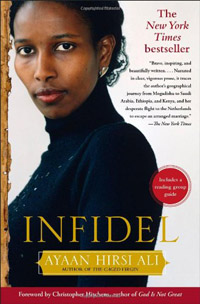
“Infidel” by Ayaan Hirsi Ali

Infidel

Everything about this book is shocking. The words are gentle, yet the message is powerful and the story spectacular. It’s an autobiographical account of a woman’s birth in Somalia, growing up in Saudi Arabia, Kenya and Ethiopia, and migrating first to the Netherlands where she is elected to Parliament and then to the United States, where she is on a mission to exorcise the ghosts of Islam.

“We froze the moral outlook of billions of people into the mindset of the Arab desert in the seventh century,” she writes. “We were not just servants of Allah, we were slaves.”

The author’s account of her early life in Somalia is hair-raising. She gives a blood-curling description of her experience of forced circumcision at the age of five, as also that of her elder brother and younger sister, all performed on the same day at the initiative of her maternal grandmother. “Female genital mutilation predates Islam. Not all Muslims do this, and a few of the peoples who do are not Islamic. But in Somalia where virtually every girl is excised, the practice is always justified in the name of Islam.” Though she squarely condemns FGM, she does not ask the question why boys need to be circumcised.

Ayaan Hirsi Ali talks of her stay in Saudi Arabia, where gender based segregation was strictly enforced and public beheadings were commonplace. “It was a normal, routine thing: after the Friday noon prayer you could go home for lunch, or you could go and watch the executions. Hands were cut off. Men were flogged. Women were stoned.” The author points out that the Prophet did say, “Wage war on the unbelievers.” She adds, “Christians can cease to believe in God. But for a Muslim, to cease believing in Allah is a lethal offence. Apostates merit death: on that the Quran and the hadith are clear.”

She prayed five times a day and wore the veil. But soon she began to question her own beliefs. Was her religious instructor Boqol Sawm translating the Quran properly? “Surely Allah could not have said that men should beat their wives when they were disobedient? Surely a woman’s statement in court should be worth the same as a man’s?” She describes her gradual loss of faith, her life in Europe where she learnt that human rights and dignity were cherished values, her outspokenness and the heavy price she had to pay for it, the murder of her friend Theo Van Gogh in the Netherlands, her persecution by religious extremists, and her eventual escape to America, the land of the free.

Today she continues to write and speak out. Fearlessly – but with bodyguards. Her speeches and debates are all over Youtube. As there is a fatwa against her anyway, she can keep writing anything and it can’t get any worse. She says in the Introduction to this book: “People ask me if I have some kind of death wish, to keep saying the things I do. The answer is no: I would like to keep on living. However, some things must be said, and there are times when silence becomes an accomplice to injustice.”

Overall Assessment: Thought provoking. Ayaan Hirsi Ali is possibly one of the most impressive voices of the 21st century.

Infidel
AUTHOR: Ayaan Hirsi Ali
PUBLISHER: The Free Press
Date of Publication: 2007

Contributor: Pushpa Kurup lives in Trivandrum, India and works in the IT sector.

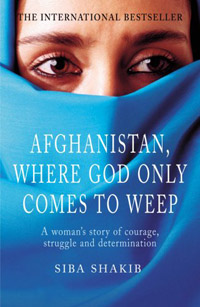
“Afghanistan, Where God Only Comes to Weep” by Siba Shakib

Afghanistan, Where God Only Comes to Weep

This book by an Iran-born author and documentary film-maker paints a grim picture of life in Afghanistan. The Russian invasion. The haphazard resistance. The growth of the Taliban. Violence, oppression, opium addiction and human helplessness are woven into the fine threads of this fascinating story. The characters are powerful and convincing. It is a sordid tale of suffering and endurance, hope and determination.

Shirin-Gol, the lead female character, is a woman of substance. Though unleterred, she taught herself to read ‘three and a half books.’ The plight of women in this war-ravaged country is deeply disturbing. Where girls cannot study, where women cannot work, where the veil is all-pervading, an Afghanistan that god and the world forgot. The reader feels a numbing pain that is beyond tears. Shock, disbelief, sorrow, and a train of inexplicable emotions.

The author has an uncanny knack of saying so much using so few words. “In all likelihood Shirin-Gol’s mother, like all mothers in the world, suffered terrible pains at the birth of her fourth daughter, her ninth child, and in all likelihood she wondered at that moment how she would feed another child with her already weakened body and her empty breasts. And she was probably glad when she pulled the child from her body and saw that it was only a girl, because if Shirin-Gol had been a boy, that boy would have needed even more milk, even more attention. His mother would have had to carry him more often in her arms, they would have had to give a party to celebrate his birth and slaughter a sheep, rustle up some money for his circumcision and send him to the mullah to learn the Koran.”

The cycle of poverty, repression and hopelessness is self-perpetuating — it moves across generations with a cold tenacity. Shirin-Gol goes through multiple deprivations in childhood, is married at a young age, has several children, and lives life at a sub-human subsistence level, yet her spirit soars high above the mundane level. She stands out without being spectacular, and her never-say-die attitude inspires respect.

The book informs, educates, enlightens. It also entertains and tugs at your heart-strings. Amidst the pathos, there is a dark humour. Don’t miss any page, not even the acknowledgments, gracefully titled, ‘Thanks’. There are gems even there. “I thank Malalai and her brother who saved my life. I thank Rahmat, who protected me from stepping on a mine.”

Overall Assessment: Mind-blowing. Siba Shakib is undoubtedly a writer of substance. BTW, ‘Samira and Samir’ is another interesting book.

Afghanistan, Where God Only Comes to Weep
AUTHOR: Siba Shakib
PUBLISHER: CENTURY
Date of Publication: 2002

Contributor: Pushpa Kurup lives in Trivandrum, India and works in the IT sector.

“JFK’s Forgotten Crisis: Tibet, the CIA, and The Sino-Indian War” by Bruce Riedel

JFK's Forgotten Crisis

In 1950, Mao claimed he had ‘liberated’ Tibet. The monks at Lhasa were powerless, the Dalai Lama was 15 years old, and the world ignored the event. Nehru, at the time, had friendly relations with China. The US was understandably nervous about China. Moreover, a subtle power struggle had commenced between Russia and China leaving everyone confused.

The CIA sprang into action, setting up a surveillance operation near Dhaka (in the erstwhile East Pakistan) and flying U2 spy planes over Tibet in the late fifties. They had been doing this from Lahore and Peshawar earlier – until one of their planes was shot down by the Russians. Soon they discovered the Lop Nor nuclear testing facility – and Mao found out about the spy planes. Perhaps he suspected Nehru of complicity as the planes had to cross Indian air space.

The Dalai Lama’s escape in 1959 and the Tibetan resistance were masterminded by the CIA. India gave him asylum and accommodated him at Dharamsala. Meanwhile in Pakistan Ayub Khan came to power in a military coup. India soon discovered that China had built a major highway across the Aksai Chin region which was a part of Kashmir. Nehru demanded China’s withdrawal but Mao stood his ground. From then on, relations between the two countries deteriorated. Nehru’s Forward Policy of pushing forward military outposts in disputed territories in Aksai Chin and the northeast sparked off violent incidents.

In January 1961, John F Kennedy assumed office as President of the United States. He chose John Kenneth Galbraith as Ambassador to India. In time, both men would prove themselves to be true friends of India in her hour of need.

On 17th August 1962, the USSR and India signed a treaty of Peace, Friendship and Cooperation. China invaded India on 20th October 1962. At that precise moment, JFK was grappling with the Cuban missile crisis as the world came to the brink of nuclear war. Khrushchev was too busy to worry about India. Mao reportedly told him about his plans to attack India and the Russian didn’t bother to warn Nehru. (The treaty and his personal rapport with Nehru mattered little.) Khrushchev played a game with Fidel Castro as well, assuring Kennedy he would withdraw the nuclear warheads from Cuba, without consulting or informing Castro. It’s almost certain that Khrushchev had not told Mao about the nuclear missiles he had positioned in Cuba. Looks like he managed to fool everyone – except Kennedy.

Well, China grabbed Aksai Chin. And on 27th October, the hostilities ceased. The following day Khrushchev made a deal with Kennedy agreeing to remove the missiles from Cuba. The world breathed a sigh of relief. Nehru, however, had to eat humble pie, abandon his policy of nonalignment and send an SOS to Kennedy.

Washington’s response was swift and decisive. Besides Galbraith, the British and Canadian ambassadors in New Delhi appealed to their respective governments to join the effort to defend India. On 1st November, the USAF and RAF began airlifting arms and ammunition. Kennedy dispatched a high-level delegation to India. Ayub Khan demanded a slice of Kashmir as an inducement for staying out of the conflict. Kennedy, egged on by Galbraith, told him ‘don’t you dare’.

China attacked again on 16th November. The Indian army was completely routed on the north-eastern front and the narrow Siliguri corridor linking Assam, Nagaland Manipur and Tripura with the rest of India was on the verge of capture. India suffered heavy casualties. Thousands were taken prisoner, including Brigadier J P Dalvi who later wrote “Himalayan Blunder” castigating Nehru, Defence Minister Krishna Menon and Army Chief B M Kaul for their multiple follies. Indian politicians stayed away from the war zone. Indira Gandhi visited Tezpur near the Chinese frontline on 19th and 20th November. On 1st December China unilaterally withdrew from the occupied territories in India’s north-eastern sector. However, the Chinese held on to Aksai Chin. The war ended as abruptly as it had started.

Did Kennedy call up Mao and issue an ultimatum? Or was Mao dissuaded by the American response? It was revealed later had Mao had been making preparations for this assault for several years, building roads, infrastructure, and even POW camps along the border. Kennedy’s intervention undoubtedly saved India from dismemberment. His statesmanship during the Cuban missile crisis saved the world from Armageddon.

The following year the young president was assassinated in Dallas. Six months later Nehru died. In 1965 Pakistan attacked India and after 23 days of intense fighting, agreed to a ceasefire. Mao did not help Ayub Khan and his Defence Minister Zulfikar Ali Bhutto who made several visits to China to seek help. During the 1971 Indo–Pak war that culminated in the liberation of Bangladesh, China remained aloof, despite some prodding by Nixon and Kissinger. Senator Edward Kennedy on the other hand visited India in August 1971, toured the refugee camps in Bengal and deplored that American weapons had facilitated the massacre in East Pakistan. By the time the Kargil conflict erupted in 1999, India’s nuclear capability was no secret – and naturally China refused to get involved.

Bruce Reidel has done a decent job of analyzing data from various sources and drawing plausible conclusions. The book leaves us wondering if the fate of Asia would have been different if Kennedy had lived just a while longer.

Overall Assessment: Eminently readable – and historically valuable.

JFK’s Forgotten Crisis: Tibet, the CIA, and The Sino-Indian War
AUTHOR: BRUCE RIEDEL
PUBLISHER: Bookings Institution Press.  (HarperCollins India in 2016)
PUBLICATION DATE: November 2015

Reviewer: Pushpa Kurup lives in Trivandrum, India and works in the IT sector.
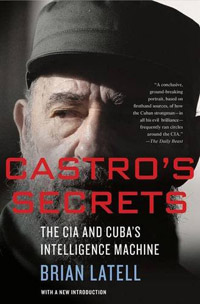
“Castro’s Secrets- Cuban Intelligence, the CIA and the Assassination of John F Kennedy” by Brian Latell

Castro's Secrets

Did Fidel Castro mastermind the assassination of John F Kennedy? This book by a CIA veteran throws new light on the mystery. The author gives details about the assassin Lee Harvey Oswald, his adoration of Castro, his failed attempt to migrate to Cuba, his brief sojourn in the Soviet Union, and a host of other clues that serve to deepen the mystery rather than provide open-and-shut answers.

In June 1987 when Florentino Aspillaga Lombard sought asylum at the American embassy in Vienna, his spectacular revelations about Cuba’s clandestine operations sent shock waves through American intelligence circles. How terribly the CIA had underestimated this impoverished Caribbean island! Lombard was no ordinary spy. He had in July 1979 played a crucial role in ensuring of the victory of the Sandinistas in Nicaragua. He had been in Angola where Castro had engineered a Marxist revolutionary takeover. He provided the CIA with a goldmine of information. Cuban intelligence had knowledge about the Bay of Pigs invasion in 1961. No wonder it turned out to be such a disaster! It comes as no surprise that the head of Cuban intelligence was Fidel himself.

Through the book, we get a rare glimpse of Castro’s spectacular intelligence network. We also glean interesting details of the now well-known Armageddon Letter of 1963 where Castro urged Nikita Khrushchev to launch a nuclear attack on the USA, the role played by Cubans in fomenting revolution elsewhere in the Americas, and the impressive scale of training and indoctrination provided to wannabe revolutionaries. Latell opines that Che Guevara’s Bolivian venture was a suicidal mission. As he puts it, “Fidel always thought strategically, many moves ahead, like a grand master moving pieces on a giant chess board. Venezuela was an opponent’s queen, Bolivia a pawn. …..If by some fluke, Guevara were to win, he, Fidel, could take credit for sponsoring and masterminding the victory. And if the roving Argentine incendiary were to die in the quest, that would reverberate even more enduringly. Cuba would have a martyred patron saint.”

Latell also suggests the possibility that Hugo Chavez or his elder brother, Adan, could have been spotted and recruited by Cuban intelligence long before the former won power in Venezuela. How else could a career military officer become an adoring disciple of the leader of another country?

Overall Assessment: Must read! History, politics and intrigue make a deadly cocktail!

TITLE: Castro’s Secrets- Cuban Intelligence, the CIA and the Assassination of John F Kennedy
AUTHOR: Brian Latell
PUBLISHER: PALGRAVE MACMILLAN
DATE OF PUBLICATION: 2012

Reviewer: Pushpa Kurup lives in Trivandrum, India and works in the IT sector.
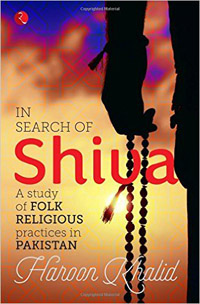
“In Search of Shiva- a Study of Folk Religious Practices in Pakistan” by Haroon Khalid

In Search of Shiva

“Dama dam mast Qalander……” The peppy tune echoed in my mind as I breezed through Haroon Khalid’s book. Whether sung by Bangladeshi singer Runa Laila or Pakistani Abida Parveen or the Wadali brothers, the song has a universal appeal. Hazrat Lal Shahbaz Qalandar, the 12th century Sufi saint is not the subject of this book though. The author, an Islamabad-based journalist and educationist takes us on an unusual journey through little known villages in Pakistan, where religious shrines cling to relics and rituals of a long-forgotten pre-Islamic past, virtually presenting an alternative and liberal version of Islam. Khalid expresses concerns about the rising tide of extremism and intolerance in Pakistan and suggests that many of these quaint practices may soon be wiped out or driven underground.

“But nothing had prepared me for this, a Muslim shrine dedicated to the fertility cult, where women offer phallic-shaped offerings to the patron saint while praying for a child, ideally a boy.” Here, the author recounts his visit to the shrine of Aban Shah Shirazi. Glass bangles and white turbans were among the offerings. No sign of any shivling! Khalid and his fellow travellers finally discovered that an elderly woman had removed all the phallic symbols to hide them from prying eyes. It appears that concerns for modesty played a part rather than Islamic beliefs, or the other items would have been hidden too. When asked about the offerings, the woman said, “These are presented to the shrine by women praying for children. Some of them also bring toys for children and tie them around the trees outside…..Women sometimes come to pray for their cows to give birth to calves.” This in an Islamic country where Hindus comprise less than 2% of the population!

A 25-year old woman confessed that when she remained childless after five years of marriage and her mom-in-law threatened her with divorce, a simple phallic offering to the saint did the trick and she was soon blessed with two sons and a daughter. Wonder what the Prophet Muhammad, PBUH, would say to that!

The shrine of Baba Mast where thousands of eunuchs congregate, that of Peer Abbas, where dogs abound, the shrine at Kallar Kahar where peacocks are venerated (Babur camped here on his way to conquer India), the shrine of Ghore Shah where toy horses are offered, a shrine for the master of crows, what more do you need? A 75-year old dervish tells the author, “All langar provided to the devotees at the shrine is offered to the crows before anybody else. Children who stutter or have other speaking problems drink water from the same vessel as the crows and are cured.” He continues, picking up a little ash from under a pot, “This ash here is also sacred. Devotees eat it and all their problems are solved.”

In the city of Jhang, where the legendary lovers Heer and Ranjha lie buried in a single grave, the site has become a place of pilgrimage. The story is part of the oral tradition of South Asia, supposedly written by Damodardas Arora during the reign of Akbar and rewritten by Waris Shah in the 18th century. And young people come here in droves to seek the blessings of the long-gone lovebirds.

The book offers many glimpses of life in Pakistan. Here are some interesting examples: ‘Jihad is an obligation, now or never,’ said an advertisement sponsored by the Jamaat ud dawa organization, on the back of a rickshaw. “The (Friday) prayer would be preceded by a sermon from the local maulvi, who while stoking his oiled beard would pray for the demise of the United States, Israel and India, our own local version of the axis of evil…” The author notes the disappearance of kittens from the Billiyonwala Mazaar at Lahore and its rapid transition from a Sufi shrine to a regular mosque. He observes that the Eid Milad un Nabi celebrations are modeled on the Hindu festival of Ram Navami, and while the fervor with which Eid is celebrated has increased, its opposition from puritanical Muslims has also increased. Qawwali singing at Sufi shrines also irks the orthodox maulvis who believe that music is un-Islamic.

“I have often been told that there are certain topics pertaining to religion one should avoid writing about because of the negative backlash they are likely to invite. I, on the other hand, argue that one can get away with writing anything in Pakistan as no one reads,” Khalid explains. I hope his luck holds. We don’t want the young man to attract a fatwa or anything. We need sane voices from every country to keep speaking out, to keep writing, to move the dialogue forward.

The publishers could have could have done a better job of editing — I found several blatant errors in the text. But my overall assessment is still: Eminently readable.

‘IN SEARCH OF SHIVA- A STUDY OF FOLK RELIGIOUS PRACTICES IN PAKISTAN’
AUTHOR: HAROON KHALID
PUBLISHER: RUPA PUBLICATIONS PVT. LTD.
DATE OF PUBLICATION: 2015

Reviewer: Pushpa Kurup lives in Trivandrum, India and works in the IT sector.