“Small Great Things” by Jodi Picoult

small-great-things

Jodi Picoult is a prolific novelist. She has written over 25 novels in a span of 24 years, many of which I have read. Her writing is not high literature by any means, the kind that would win prestigious awards, but her books are very entertaining, absorbing, and well-written, making her a highly successful writer whose books are extremely popular. She also typically touches upon some weighty issues in each of her novels, such as organ transplant (Change of Heart), a school shooting (Nineteen Minutes), religious belief (Keeping Faith), autism (House Rules), genetic engineering (My Sister’s Keeper, a riveting book that was also made into a movie), and many others.

In her new novel, Small Great Things, she takes on the hot-button issue of racism, which has emerged to the forefront in the U.S. in the last couple of years, with the shootings of black men, the Black Lives Matter movement, and of course, the 2016 Presidential election (which, at the time of writing this, is still 11 days away). The title of the novel comes from this quote by Dr. Martin Luther King, Jr.: “If I cannot do great things, I can do small things in a great way.” Almost all of Picoult’s novels revolve around a lengthy court case, where the issue at the heart of the novel is taken to court and ultimately settled—usually favorably—after the requisite back and forth between the prosecution and the defense, and Small Great Things is no different in this regard.

The story revolves around Ruth, a black woman (albeit lighter-skinned than the average African-American), who is a nurse in a the maternity ward of a hospital and has been doing this devotedly for 20 years—she is very good at her job and is widely respected as being the best there is. Her world turns upside down when a hate-filled white supremacist couple comes in to have a baby, and then after the baby is born, specifically ask that Ruth be taken off her nursing duties for their baby because she is black. The baby dies after a complication and Ruth was present in the room when the death happened, and before she knows it, she is slapped with a lawsuit by the parents accusing her of murdering their baby. If it seems preposterous, it really is, and I thought the weakest aspect of this book was in its premise—a white couple suing a black nurse for killing their baby. Really?

Once you get past this issue, however, the book is as well-crafted as any of Picoult’s other books. She has mastered the art of writing books with a certain style, and Great Small Things is no different. It is substantial, and comprises equally of internal dialog and external action. The story is told from the points of views of three different narrators—another quintessential Picoult approach. And as with her other books, a large part of this one takes place in court with witnesses, testimonies, cross-examinations, opening and closing statements, and other legal paraphernalia. There is also a twist at the end, which again usually happens in all Picoult’s novels. Thus, Small Great Things is quite formulaic, coming unmistakably from Picoult’s oeuvre. I would have known she had written it even if was published anonymously!

Where this book is different is that it does not just highlight racism—similar to how her other novels highlight different issues—but that it also digs a lot deeper and exposes the difference between overt racism—of the kind blatantly exhibited by white supremacists­—and implicit bias—which most white people have but are not aware of it. They take their place in the world for granted, the opportunities that they have, how they fit right into society, the common courtesies they receive, the professionalism they encounter in most places, and so on, without even being aware that it is different for black people, even if they are just like them in all other respects. The public defender who takes on Ruth’s case is a white woman, who would never think she was racist in any way; however, it is in the very act of not wanting to be racist, or not seeming to be racist, where the implicit bias comes in—the fact that you are conscious that the person is different so you need to behave in a certain way, be extra nice, or be extra polite. You would never feel like this if the person has the same skin color as you.

Picoult explains in an Afterword that she realized she had the same experience being a white woman and wanted to write about racism and bring this issue to the forefront. I think she has accomplished this very well. While the plot of the story in Small Great Things is far-fetched, the exploration of racism, both explicit and implicit, is very well done. In particular, the implicit bias will hit everyone hard because it applies to most people. To a certain extent, it is human nature to take your own privilege for granted, especially if it does not seem like one and most people around you are just like you. But it’s important to be reminded of it, as usually it is so subtle that we’re not even conscious about it. If not for anything else, Small Great Things should be read just for this.

Small Great Things
Author: Jodi Picoult
Publisher: Ballantine Books
Publication Date: October 2016

Contributor: Lachmi Khemlani runs a technology publication in the San Francisco Bay Area.

“The Millionaire Next Door: The Surprising Secrets of America’s Wealthy” by Thomas J. Stanley and William D. Danko

the-millionaire-next-door

It’s evident that extensive research has gone into the making of this masterpiece. Thomas J. Stanley studied wealthy individuals for decades before he co-authored this book along with William D. Danko. There are quite a few ‘get rich’ books on the market. This one is undoubtedly special.

The good news is that anyone with a decent job can accumulate a fortune over time. The bad news is that high income does not automatically translate into great wealth. What do the wealthy folks in America have in common? Have they merely inherited a fortune? Not so, say the authors. One thing they all have in common is frugality. We all know of Warren Buffet, but hey, there are dozens of others! And the rich are not who we think they are.

The authors state that affluent persons tend to answer ‘yes’ to three questions they were asked in routine surveys:

  1. Were your parents very frugal?
  2. Are you frugal?
  3. Is your spouse more frugal than you are?

“Most people will never become wealthy in one generation if they are married to people who are wasteful. A couple cannot accumulate wealth if one of its members is a hyper-consumer. This is especially true when one or both are trying to build a successful business. Few people can sustain profligate spending habits and simultaneously build wealth.” So high living is just not cool.

Tighten your belt folks! Take a deep breath. Do you really need that new Lamborghini?

You can also learn new ways of calculating what your net worth ought to be. “Multiply your age times your realized pre-tax annual household income from all sources except inheritances. Divide by ten. This, less any inherited wealth is what your net worth should be.” Check it out. Do you pass the test? No? Then buy another copy of the book and give it to your spouse.

Overall assessment: Wanna become rich? Try this one!

The Millionaire Next Door: The Surprising Secrets of America’s Wealthy
AUTHORS: THOMAS J STANLEY & WILLIAM D DANKO
PUBLISHER: TAYLOR TRADE PUBLISHING
DATE OF PUBLICATION: 2010

Contributor: Pushpa Kurup lives in Trivandrum, India and works in the IT sector.

“Temporary Answers” by Jai Nimbkar

temporary-answers

I came upon this book at a second-hand bookstore when I growing up in India, at a time when I pretty much devoured any kind of book that seemed remotely interesting. While most of the books I read during that phase were eminently forgettable, I really liked Temporary Answers and have held on to my copy of it all these years. Given that the book was originally priced at Rs. 4 and I bought it second-hand for Rs. 2, and that I have held on it all these years, and the fact that it is no longer even available—it seems like an unprecedented bargain! Family members and friends who read the book on my recommendation also really liked it, and I recently read it again to re-discover what was it about this unknown book by a relatively unknown author that had made me hold on to it and actually bring it with me to the US when I moved here from India.

Temporary Answers is very much an Indian story with Indian sensibilities written by an Indian author. It tells the story of Vineeta, a woman in her late twenties, who comes back to live with her parents after the sudden death of her husband, as per the custom at that time—the story is set in the 1960s, when women were not as financially and emotionally independent as they are now. Yet, Vineeta is far from a docile widow and soon breaks free from the claustrophobic confines of her childhood home to get her own place and start on a career as a pediatrician, for which she was trained but never practiced while she was married. The book charts her gradual independence as she navigates her way through tricky situations and complicated relationships. Her mother is a non-nonsense, working woman, but she tends to be somewhat autocratic and also very traditional in the sense that she cares deeply about what society thinks; her father is non-confrontational but also quite spineless; her younger sister is not just uncommunicative, but seems to actively dislike her; her U.S.-returned childhood male friend, who had a crush on her when they were kids, would now like to marry her, giving her an easy way out; and she is strongly attracted to an older man, a professor and playwright, and gets involved with him, but he has his own demons to deal with. Along the way, there are also lots of issues stemming from her fledgling pediatric practice and her work in a non-profit for poor kids.

None of these problems really go away or are neatly resolved; what changes is Vineeta’s gradual realization that there are no permanent answers to her existential crisis—she first has to come to terms with her own feelings of insecurity and “find herself” before she can find comfort and support through others.

What I really liked about Temporary Answers is how authentic it is. All the characters, including the protagonist, are flawed human beings, like we all are, so we can readily identify with them. Vineeta herself is far from a conventional heroine—she often says or does the wrong things and is propelled by her baser instincts, by feelings that are far from elevated. At the same time, she is very introspective and we get a chance to step inside her mind and witness the conflicting feelings she has about so many things, her ruminations on marriage and love, the difficulties of being a doctor including not just the helplessness but also the guilt for not always feeling the sympathy and empathy people expect doctors to have. Not only is this internal dialogue in the protagonist’s head so fascinating, Temporary Answers also has a lot of philosophical discussions between its characters about the meaning of life and death, which is something you don’t find that often in books. In essence, this is really a cerebral book, focused more on what the protagonist feels rather than on what she does.

Given that the book is set in India—in the city of Pune, or Poona as it was called then—in the 60s, I found it surprisingly contemporary, with Vineeta eventually living by herself and being visited often by the man she is in a relationship with, who often spends the night. And while she does not flaunt the relationship, she makes no attempt to hide it either, which would not have been easy in those conservative times. Also, while Temporary Answers is, by and large, a serious book, I did appreciate some occasional bits of tongue-in-cheek humor, usually as part of a conversation between characters. For instance, when Vineeta asks her mother—who all but manages the family and holds the reins of the household—if her husband (Vineeta’s father) had ever beat or mistreated her, her mother replied, “He wouldn’t have had the nerve.” In the book, Vineeta burst out laughing, and when I read that, so did I.

Temporary Answers
Author: Jai Nimbkar
Publisher: Sangam Books (A Division of Orient Longman Ltd)
Publication Date: 1974

Contributor: Lachmi Khemlani runs a technology publication in the San Francisco Bay Area.
“So Long a Letter” by Mariama Bâ

so-long-a-letter

This book by a Senegalese woman writer in French was widely acclaimed and translated into several languages. The English translation was published in 1981, the same year the author died following a tragic illness.

“To warp a soul is as much a sacrilege as murder.” The status of women in polygamous social structures is gracefully outlined in this teeny weeny semi-autobiographical novel that appears in the form of a long letter from a woman to her friend. Sensitive, without being sentimental, it recounts the tragic story of a woman’s life in the simplest of ways. As a woman born into a patriarchal conservative Islamic society with all its inherent contradictions, Ramatoulaye remains stoic through multiple childbirths, watches helplessly as her husband takes a younger second wife, and later battles the emotional storms of widowhood.

“My voice has known thirty years of silence, thirty years of harassment,” the epistle states in a matter-of-fact tone. “It bursts out, violent, sometimes sarcastic, sometimes contemptuous.” When her husband’s much-married brother proposes to wed her in accordance with the prevailing custom, Ramtoulaye reacts, “Did you ever have any affection for your brother? Already you want to build a new home for yourself, over a body that is still warm. While we are praying for Modou, you are thinking of future wedding festivities.” Not content with this admonition she goes on to question the social order with its unfair tradition of unearned male privilege: “What of your wives, Tamsir? Your income can meet neither their needs nor those of your numerous children. To help you out with your financial obligations, one of your wives dyes, another sells fruit, the third untiringly turns the handle of your sewing machine.”

When Daouda, a former suitor, now a distinguished member of the National Assembly, turns up at the funeral, Ramatoulaye brings up the subject of women’s representation in the august house. “Four women, Daouda, four out of a hundred deputies! What a ridiculous ratio! Not even one for each province.” Daouda’s response is as meaningful as it is amusing. “But you women, you are like mortar shells. You demolish. You destroy. Imagine a large number of women in the Assembly. Why, everything would explode, go up in flames.”

The oppressed woman’s yearning for freedom is subtly and powerfully expressed in crystal clear language: “Daouda Dieng was savouring the warmth of the inner dream he was spinning around me. As for me, I was bolting like a horse that has long been tethered and is now free and reveling in space.” Ramatoulaye’s letter delivered by a messenger to Daouda and his reply are both heart-breaking.

The novel is entertaining, thought-provoking and soul-stirring. It undoubtedly has feminist overtones as it highlights the imbalance between the sexes and the helplessness of women. Every woman will love it.

The translator, Modupe Bode-Thomas, deserves commendation for the professional touch that makes the book so very special.

Overall Assessment: Well worth a read –especially if you are a Muslim woman.

So Long a Letter
AUTHOR: Mariama Bâ
DATE OF PUBLICATION: French original in 1979, English translation in 1981.
PUBLISHER: Waveland Press

Contributor: Pushpa Kurup lives in Trivandrum, India and works in the IT sector.

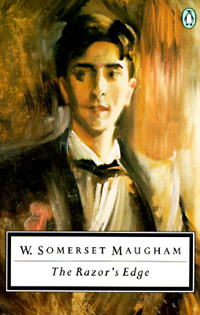
“The Razor’s Edge” by W. Somerset Maugham

the-razors-edge

Somerset Maugham has always been one of my most favorite authors. Growing up in India at a time when the British influence was still very strong, most of the books written in English were by British authors and they seemed very much a part of our culture. We grew up on adventure stories by Enid Blyton, murder mysteries by Agatha Christie, Victorian-era romances by Jane Austen and Charlotte Bronte, classics by Charles Dickens, and turn-of-the-century stories by Somerset Maugham. In fact, I still have my original copies of most of these books, and every once in a while, I go back and re-read them to find out if I still like them as much as I did before. One such book I just finished re-reading is The Razor’s Edge by Somerset Maugham. While this is not his most famous novel, it remains one of my enduring favorites, and re-reading it brought into sharper focus why I had liked it so much in the first place.

The Razor’s Edge is primarily the story of a young man, Larry, and his spiritual quest to find the meaning of life after his friend, a fellow fighter pilot, dies before his eyes during a flight mission they are on that goes awry during World War 1. Unlike his friends, and to the dismay of his socialite fiancée and her family, Larry does not want to settle down and work and lead a normal life after his return from the war. Instead, he wants to “loaf” – which, in his case, really means traveling around the world, working odd jobs, getting varied experiences, and reading extensively, often for over 10 hours at a stretch, all in an effort to understand life and make sense of what had happened to him. What made The Razor’s Edge especially appealing to those of us in India was that Larry’s quest ultimately drew him to India and that he found the answers to what he was looking for in an ashram there under the guidance of a guru. In fact, the name of the book comes from a verse in the Katha Upanishad which says “The sharp edge of a razor is difficult to pass over; thus the wise say the path to Salvation is hard.” For those of us who were not just looking at The Razor’s Edge as a work of fiction, the fact that Larry’s spiritual awakening came from the Vedantic philosophy of Hinduism was both an affirmation of it and gratification that it was being recognized and given voice to by one of the foremost novelists of that time.

Of course, the book is not just the story of Larry. Brilliantly woven in are other characters including Isabel, Larry’s childhood friend and fiancée, who ultimately could not give up her society life and join him in the alternate (simple but “rich in spirit”) life he had to offer: Gray, his best friend who ultimately ends up marrying Isabel; Sophie, another childhood friend, who, after a horrific tragedy of her own, becomes an alcoholic and nymphomaniac and finally cannot even be redeemed by Larry, despite his best efforts; Elliot, Isabel’s rich uncle who is a strong influence in her life; and finally, Maugham himself, Elliot’s friend who unwittingly becomes everyone’s confidant and is the narrator of the story.

What I like most about The Razor’s Edge, and all of Maugham’s books – even today – is how simple the telling of the story is and how it is riveting inspite of it. There are no literary gimmicks here, no examples of “stylistic” writing that critics could pick out and hold it up before us to justify what a great writer Maugham was. Instead, the focus is completely on the story, and the language is used entirely at the service of telling it. In short, the story is so brilliant that the writing is almost invisible!

The characters are also artfully captured, with all the foibles that make us human. In fact, I would say that in retrospect, the only trouble with The Razor’s Edge is that Larry seems to be too good to be true – he is portrayed with a little too much saintliness. (Also, some of the miracles he could perform after his return from India seemed to be playing to the stereotype and could have been avoided.)

Maugham died in 1965, and I really miss his books. They don’t write like this anymore.

The Razor’s Edge
Author: W. Somerset Maugham
Publisher: William Heinemann (Parent company: Penguin Random House)
Publication Date: 1944

Contributor: Lachmi Khemlani runs a technology publication in the San Francisco Bay Area.

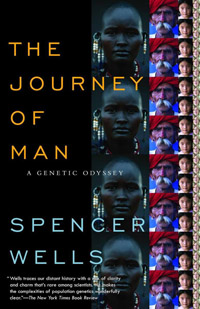
“The Journey of Man: A Genetic Odyssey” by Spencer Wells

the-journey-of-man

You are descended from a man who lived in Africa about 59,000 years ago. Do you find this hard to believe or accept? Well, that’s not all. Every other guy living on Planet Earth today is also descended from the same man! Man, wasn’t he a lucky man! The poor savage wouldn’t have imagined this level of success even in his wildest dreams!

How did the descendants of all the other ancients disappear into thin air? And if all of us have a common male ancestor then why do we all look so different? What accounts for our different colors and characteristics? Does race mean anything at all? How did the descendants of this super grandpa spread all over the planet? Where did they go first? How long did they remain in Africa?

This path-breaking book tries to answer all these questions. Earlier studies had revealed that all of us are descended from a single female ancestor (called Mitochondrial Eve) who lived about 150,000 years ago in Africa. Charles Darwin wrote in 1871, “It is therefore probable that Africa was formerly inhabited by extinct apes closely allied to the gorilla and chimpanzee, and as these two species are now man’s nearest allies, it seems somewhat more probable that our early progenitors lived on the African continent than elsewhere.” How right he was!

Today we know that apes lived in Africa some 23 million years ago. We went searching for the so-called ‘missing link’ and we found Homo Erectus, the first stand-up man. We wondered whether some of us are descended from the Neanderthals. We were puzzled about the Java Man, the Peking Man and so many others. It appears now that the Southern Ape is more likely to be our direct ancestor than any of these guys. The oldest genetic lineages are found in people living in eastern and southern Africa.

The sequencing of the human genome provided several answers and threw up just as many questions. Humans were in Australia 50,000-60,000 years ago. They are the only primates on the continent. This means they must have colonized the continent from elsewhere. The DNA trail leads to Africa. Homo erectus never made it to Australia, though they inhabited the island of Java. The aborigines of Australia have a lot in common with the Bushmen of southern Africa. How did homo sapiens travel to Australia so long ago? Did they make boats? Traces left by modern humans in Europe date back to a mere 40,000 years! And Europeans claim they ‘discovered’ Australia! Obviously 21st century humans need to unlearn much that they had learnt.

There is evidence to show that early moderns arrived in India from the south rather than the north. The Dravidian languages are completely unrelated to the Indo-European languages. And DNA markers seem to indicate that the Aryan invasion theory is not without substance.

As early as 1787, Thomas Jefferson wrote, “The resemblance between the Indians of America and the Eastern inhabitants of Asia would induce us to conjecture that the former are the descendants of the latter, or the latter of the former…” We know now that Jefferson had hit the nail on the head. It was across the Bering Strait that modern man came to the new World – and it took him only a thousand years to reach the southern tip of South America. Spencer Wells adds that, “Three-quarters of the large mammals in the Americas were driven to extinction around this time, among them mammoths and horses – the latter weren’t to reappear in the Americas until the Spaniards introduced them in the fifteenth century.”

Overall Assessment: A fascinating read. Biologists, anthropologists, geneticists, truth-seekers, DO READ!

The Journey of Man: A Genetic Odyssey
Author: Spencer Wells
Publisher: Random House
Date of Publication: 2003

Contributor: Pushpa Kurup lives in Trivandrum, India and works in the IT sector.