“Exit West” by Mohsin Hamid

Exit West

Exit West is the new novel by Mohsin Hamid, who is most well known for his book, The Reluctant Fundamentalist, which was also made into a movie. I have neither read that book nor watched the movie, but Exit West has made quite a splash in literary circles and is currently #9 on The New York Times bestseller list, which is an amazing accomplishment. It’s not that often that we have someone from the Indian subcontinent being interviewed in leading magazines, podcasts, and talk shows, and as someone who is “plugged into” the latest news from the literary world, I was definitely intrigued. In his interviews, Mohsin Hamid came across as very  intelligent and articulate, and he spoke particularly eloquently about his experience as a Muslim in an increasingly Islamaphobic world. I was curious to see how the book had captured his experience and knowledge of the Muslim world, and whether it was a good story. Because, ultimately, that is what really counts — even the most topical novels will fail to have any impact if they’re not well-told stories as well.

Exit West is indeed, set in the Muslim world, in an imaginary Muslim country in which the political situation is rapidly deteriorating. The protagonists of the novel are two citizens of this country, Saeed and Nadia, who meet and fall in love against its violence-ridden backdrop. Things are not so bad when they first meet, but the political crisis escalates rapidly – all around them, people are being killed, the living conditions are unspeakable, the brutality is extreme. Things come to a head when Saeed’s mother is also killed – it makes Saeed and Nadia determined to find a way to escape from their home country. Fortunately for them – and this is where the novel departs from physical reality and enters the territory of magic realism – there are these “magic doors” that function as portals out of the country, and eventually Saeed and Nadia decide to try their luck with one of them. It’s all very clandestine and they have to pay a substantial amount to a middleman for the passage, but one night, furtively in the dark, they finally manage to make their way out of a door. They have no idea where the door leads, but it turns out to be into the Greek island of Mykonos.

At this point, you might think of this as, “Wow! Greece!” and expect a happily-ever-after ending. But we’re only half-way through the book and it turns out that these magic doors exist in many places around the world, allowing lots of people to move from one place to another instantly. However, it’s not that easy to gain access to them. The doors from the “bad” places to the “good” places are heavily guarded, and naturally, no one is interested in the doors going from the “good” to the “bad” places. Needless to say, the mere existence of these doors — the influx through which cannot really be controlled by the country to which they are leading — ends up actually fostering the creation of a slew of migrants all over the world, similar to Saeed and Nadia. These are people escaping from war and poverty in their home countries and attempting to settle in the more stable and affluent countries. The situation is identical to the current refugee crisis in the world, except that in real life, migrants have to travel long distances — often in extremely hazardous conditions­ — to actually get to other countries – there are no magical shortcuts. Apart from this, the situation is similar to what we have now – the migrants are looked down upon by the people of the countries they have escaped to, the governments of those countries want to crack down on them, there is racism, and the migrants are housed in cramped, shanty towns that are not that much better than their living conditions back home.

Exit West was interesting and enjoyable up to this point, but I found myself losing interest in the book after Saeed and Nadia’s first entry to Mykonos and a narration of how life is for them and the other migrants who have also come there from various countries. Not much happens to Saeed and Nadia after that except that they travel to a few more places, including London and San Francisco, and drift apart. There is no other “magic” in the book apart from the doors, which was a little incongruous and somewhat disappointing. After all, if you want to have magic in a story, take it all the way through! Otherwise, just having magic doors to transport you from one place to another without any other change in the world is simply weird. (People in Exit West have smart phones and use social media, so that hasn’t changed.)

Thus, while the premise of the book was very interesting, I thought it simply didn’t live up to the hype. I also had mixed feelings about the writing style, which I found inconsistent — most of the book was written “normally” and was easy to read, when all of a sudden, it occasionally veered off into this bizarre style where there were long paragraphs, often longer than a page, written entirely without a period (i.e., full stop), with only commas to separate out the sentences. I personally find it somewhat pretentious and annoying when writers do this — a good example being Arundhati Roy in The God of Small Things, where several words and phrases are capitalized in the middle of sentences. But at least, this technique was consistently used across The God of Small Things, whereas in Exit West, the no-period paragraph style appears haphazardly, in just some places, and therefore sticks out like a sore thumb. I really wish writers would resort to less gimmicks and focus on creating stories that don’t need literary tricks to prop them up. It would make reading their books so much less onerous.

Exit West
Author: Mohsin Hamid
Publisher: Riverhead Books
Publication Date: March 2017

Contributor: Lachmi Khemlani runs a technology publication in the San Francisco Bay Area.

“Yuganta: The End of an Epoch” by Irawati Karve (translated from Marathi by the author)

Yuganta

I read M T Vasudevan Nair’s “Bhima -Lone Warrior” (Malayalam original ‘Randamoozham’) and Kavita Kane’s “Karna’s Wife: The Outcast’s Queen” before I read Karve’s “Yuganta”. None of these would make sense unless you’ve read the Mahabharata. This great epic which comes to us in simple Sanskrit verse tells the story of a family feud that ends in an 18 day battle at Kurukshetra. It is generally believed that this happened around 1000 B.C.

“Yuganta” reads like a collection of essays rather than a novel and the author brings her own unique perspectives and interpretation to the characters and events. When she speaks of Draupadi, Kunti , Gandhari, Krishna and Karna, she paints different shades of their complex personalities. “The Mahabharata,” she says, “is a record of human beings with human weaknesses.” She attempts to explain the deification of Krishna and points out that the Krishna of the Mahabharata is an ordinary mortal with only rare flashes of divinity (that could be attributed to later additions in the text). Krishna is killed by a hunter’s arrow and the Yadava clan is wiped out in violent internecine quarrels. The author suggests that the few miracles in the Mahabharata could be later additions.

One can learn a lot about the Mahabharata from the Introduction to this book, e.g. the names of the 18 divisions in the critical text together with the number of couplets in each. There are stories within stories and the thread of the main storyline is taken up after several digressions. The author notes that the Arabian Nights follows this model of narration. Karve is highly critical of Bhishma. She points out that he is more of a match-maker than a warrior. He never fought any major battle. However, he abducted the three princesses of Kashi in order to marry them to his half-brother Vichitravirya. Amba committed suicide by self-immolation, while Ambika and Ambalika were forcibly married to Vichitravirya. Later Gandhari was brought from a faraway land to marry the blind Dhritarashtra. Pandu was afflicted by vitiligo (or so I believed) but Karve describes him as an albino.

She goes on to say without mincing words, “Kunti, stout and no longer young, and the lovely Madri were married to the impotent Pandu.” She notes that Bhishma paid an enormous bride price to acquire Madri. Dhritarashta, Pandu, and the Pandavas (Karna included) were all conceived by the ‘niyoga’ method, involving the use of a substitute male stud in order to produce heirs. Pandu retired to the forests of the Himalayas with his two queens in the prime of his youth for no apparent reason. That is how Dhritarashtra became king.

Karve suggests that Pandu’s motive was to hide his impotence and obtain heirs by resorting to ‘niyoga’. Karve says of the Pandavas that they “were more concerned with getting a share of the kingdom and in keeping peace than in revenging the insults to their wife.” She emphasizes their pitiful request for five villages, which was turned down by Duryodhana. She notes that “Draupadi’s wrongs were avenged only by Bhima,” as it was he who killed Keechaka and later Dushasana. Dhritarashtra says to his wife after the war has ended, “We Kuru men have done great injustices to women. And we have paid in full for them too. In Amba’s wrath Bhishma was burned. I am still burning in yours. My children too have been destroyed in it. Kunti was also married to a deficient man…” He continues, “You feel, Gandhari, that you have been cheated and deceived, but think for a moment: in the three generations of our family every person has been cheated and deceived.”

The author triggers many speculations citing ‘circumstantial evidence’. Is Yudhishthira really the son of Vidura? “When they were planning to call gods to father the children, it is very curious that the first god Kunti called was Yamadharma, the god of death,” Karve observes. She also raises some key questions. Did Krishna and Arjuna burn the Khandava forest in order to acquire more land for cultivation? Why was this made out to be a valorous feat? “Did Krishna and Arjuna feel that they had to kill every creature in order to establish unchallenged ownership over the land?” The Nagas were slaughtered in the process. Were they humans? An event that occurred during the Pandavas’ exile would be of interest to environmentalists: The Pandavas were constantly hunting because they had a large retinue to feed. One night, a stag appeared to Dharmaraja in a dream and said, “King, you are killing so many of us that we are on the way to extinction. Go into some other forest; give us respite. When we are multiplied enough you may come back.”

Karve calls attention to some interesting facts that may have eluded the casual reader. For instance, the Mahabharata makes no reference to writing. It appears that the Brahmins and Kshatriyas of the Mahabharata never did any writing, for messages were communicated through live messengers. The author reminds us that Indraprastha and Hastinapura have vanished from history but fails to mention that Kurukshetra and Dwaraka remain to this day.

Overall Assessment: Good read.

Yuganta: The End of an Epoch
AUTHOR: Irawati Karve
PUBLISHER: Orient BlackSwan
YEAR OF PUBLICATION: 1991 (Original version published in 1969)

Contributor: Pushpa Kurup lives in Trivandrum, India and works in the IT sector.

“Sweetbitter” by Stephanie Danler

Sweetbitter

I have often thought that with the advent of Modernism in Literature, readers have grown impatient with the long, lush descriptions of old, instead preferring the clipped sentences of Hemingway and the dryness of Camus. Not that these are not valid and important styles of writing, but there’s something beautifully nostalgic about writing that pays homage to the world around us, that values imagery and description just as much as plot. Stephanie Danler’s willingness to include both in her new novel Sweetbitter is what makes the book stand apart.

The novel follows a young woman who moves away from an unspecified part of America for New York City to work at a famous restaurant. It is clear that this other place does not matter, because the most important character in the novel is New York City. Like so many works of fiction before it, Sweetbitter examines the dreamscape that is New York City for many people. But unlike the trope of, “New York City is gritty and not the dream you believe it to be,” or the Sex and the City trope of, “In New York City all your dreams can come true,” Danler walks a more true-to-life line, revealing the city to be, as the title implies, sweet and bitter at the same time. Our main character revels in a city that shelters so many kinds of people, that changes dramatically from season to season, but she also finds the city to be cold and terribly lonely at times, a city that sometimes needs alcohol and a few hits of cocaine to look beautiful. To read Danler’s prose is to experience the city from your armchair. Danler’s lush descriptions of the restaurant—of oysters and red wines and cheese—of the seasons of the city—the thickness of summer, the freshness of autumn—and of people, are transformative.

It’s a novel in which the characters are undeniably secondary to the description. The characters are thinly drawn, an unfortunate weakness for a writer who writes so beautifully. Other than the protagonist, who becomes familiar only because readers spend so much time in her head, everyone else seems to inhabit some kind of cliché—tortured bartender; knowledgeable, well-traveled older woman; manager who sleeps with his female employees; edgy, cocaine-toting lesbian. When the protagonist eventually gives up on her relationships with these people, I did not have enough emotional investment in them to care much about it.

It is impossible for me to dislike Sweetbitter. As a writer myself, it is often a breath of fresh air to read an author who so unabashedly worships the written word. Reading Sweetbitter is undeniably a literary feast. Occasionally throughout the book, Danler eschews narration and just gives readers lines and lines of dialogue from various people in the restaurant, and the result reads more like poetry than prose.

Certainly with some more attention to character, Danler would be unstoppable.

Sweetbitter
Author: Stephanie Danler
Publisher: Alfred A. Knopf
Publication Date: May 2016

Reviewer: Sarisha Kurup is a senior at The Harker School in San Jose, CA.

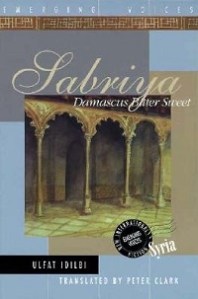
“Sabriya: Damascus Bitter Sweet” by Ulfat Idlibi – Translated from the Arabic by Peter Clark

“She was like a hand grenade with the safety pin removed.” That, in essence, is Ulfat Idlibi for you! Explosive! Born in Damascus in 1912, she grew up amidst the French occupation and the accompanying violence. She went on to become Syria’s most acclaimed woman writer and died in Paris in 2007 at the age of 94.

No one can read this novel and remain unmoved. It describes life in Syria between the World Wars, underlining the pathos of the human condition, outlining the mute longing of young couples who rarely get to meet, describing clandestine love affairs and surreptitious messages passed through unsuspecting conduits, and bemoaning the emptiness clouding the lives of young women caught up in the deadly tentacles of a patriarchal society.

The story begins with a woman’s suicide. Barely forty days after her father’s death, Sabriya hangs herself from a lemon tree in the courtyard of her parental home. She had tended to the old man for ten long years after he had suffered a paralytic stroke. Her mother had died earlier. Her brother Sami and her lover Adil had chosen the path of insurgency and died heroic deaths. Sabriya is unmarried and her two surviving brothers, Raghib and Mahmud, are planning to sell the family home, when her suicide comes as a bolt from the blue. Sabriya’s young niece, Salma, discovers her diary in her room, and she is the narrator of this incredible story.

Idlibi’s language is an exquisite blend of poetry and prose, embellished with liberal doses of simile and metaphor. “She was still hanging from the lemon tree, like a black flag at half-mast, protesting loudly at oppression and injustice.” Who else could have described a gruesome corpse with such literary finesse? Sabriya’s private thoughts and her conversations with the many characters in the novel have unmistakeable feminist and nationalist overtones. Here are some samples:

  • In our country they train a girl, as soon as she is aware of herself, to serve the men, be it brother, husband or son. So when she has grown up she feels that such servitude is part of nature.
  • May Allah pardon you Sami, when you told me that my steadfastness was also part of the struggle and that I should have the courage of those who are fighting. Brother dear, this silent struggle is hard, very hard. It is unsung. It is heroism without the glory.
  • “Sometimes I almost explode with anger at you, Mother. A woman of your age, old enough to be a grandmother, having to seek permission from her husband whenever she wants to leave the house!”
  • “What cowards we are,” I observed to Mahmud. “Our county is being burnt and destroyed and we are like rats who have slunk into their holes.”
  • Why is it that the people of my country demand freedom and at the same time cannot grant it to each other? Half the nation was shackled in chains created by men. That is a wrong we refuse to acknowledge.
  • “Did you read in the papers about the battle raging between those for the removal of the veil and those who want to retain it?”
  • If the French left we would have Hitler or Mussolini here.

Umm Abdu, one of the stoic women in the story, utters some prophetic words, “What does the revolt, what do politics mean to us? It will be all the same to us whether it is the French or a national government that rules us. Or whether we are ruled by blue monkeys.” Adil’s words to Sabriya echo the same sentiment: “When we have achieved our independence we shall embark on battle among ourselves fiercer than the one we are waging with the imperialists.”

When we behold Syria’s tragedy today we can’t help but wonder whether the author had an eerie premonition.

Overall Assessment: Must read – especially if you are a woman.

SABRIYA: DAMASCUS BITTER SWEET
AUTHOR: ULFAT IDLIBI TRANSLATOR: PETER CLARK
PUBLISHER: INTERLINK BOOKS
YEAR OF PUBLICATION: 2003 (FIRST PUBLISHED IN 1980 IN ARABIC)

Contributor: Pushpa Kurup lives in Trivandrum, India and works in the IT sector.

“Defending Jacob” by William Landay

Defending Jacob

Of late, it has been difficult for me to find books that hold my interest. I regularly listen to the New York Times Book Review podcast and also subscribe to Bookmarks magazine, so I am up to date with which are the hottest books being published – what critics are saying about them, as well as their authors in the course of the many interviews they do as part of their book promotion tours. I borrow these books from the library with great enthusiasm, but very often, I just don’t find them interesting enough to stick with them beyond the first few chapters – they don’t hold my attention or make me care enough about the characters to make reading them a pleasure rather than a chore.

Therefore, I decided to take a break from “heavy-duty” reading and go back to that genre which, when well done, is impossible for me to put down – a good old-fashioned murder mystery. I grew up on hundreds of Enid Blyton mystery books as a kid in India and I subsequently graduated to Agatha Christie – my all-time favorite mystery writer — whose books I can still read again and again and enjoy them even when I know whodunit (“Who [has] done it?”). Along the way, I also discovered that I like courtroom dramas, a great example of which are books by Jodi Picoult (see my review of Small Great Things). This is why when I came across Defending Jacob, it seemed to me like a no-brainer to give it a try and end my long dry run of finding something to read that I could actually finish. I’m happy to say that it worked. I was riveted by the book and finished it in the course of a day.

Defending Jacob tells the story of a regular family that is suddenly thrown in turmoil when the son, Jacob, is charged with the murder of a boy, Ben, from the same school, who is found stabbed to death in the neighborhood park. Jacob is the only son of Andy, who is actually the Assistant DA (District Attorney) of the small town near Boston where the murder happens and is given charge of the case. It is a real shock to the community, which has been crime-free until now — all the kids go to the local school and most of the parents have known each other since their kids started school in kindergarten. Andy and his wife, Laurie, are well liked and highly respected members of this community, and they remain so even after the murdered boy is found until it turns out that their son, Jacob, may have done it. They are then, of course, immediately ostracized. To his parents, Jacob seems just like any other high school adolescent boy – sullen, introverted, and uncommunicative — and it’s impossible for them to tell if these are normal or the signs of a killer. Complicating the fact is that Andy is descended from a family with a history of violence, with at least three generations of men prior to him convicted of murder and his father still in prison because of it. Andy has successfully disassociated himself from this aspect of his family’s history – even Laurie does not know about it – but now the issue comes up when the case goes to court. Is there such a thing as a “murder gene,” and if so, has Jacob inherited it?

Andy is removed from the case as soon as Jacob comes under suspicion and the book tells the harrowing story of the family’s long ordeal in the days leading up to the trial and the trial itself. The story is extremely well told without resorting to melodrama or clichés, making it extremely believable. And of course, it is a mystery that leaves you guessing – did Jacob do it, or someone else, such as the convicted pedophile who was often in the park where Ben was murdered? The fact that Ben bullied Jacob and that Jacob owned a knife that he had bought earlier naturally throws suspicion on him, along with the discovery of a single fingerprint found on Ben’s jacket that matches Jacob. Then there is the whole online world that Jacob inhabits — all the Facebooks posts among the school kids some of which openly accuse him of the murder, and the “cutter porn” chat rooms (focused on violence and torture) that he frequents and occasionally even contributes to. All of these are pretty incriminating, but are they sufficient for the jury to pronounce Jacob guilty without a reasonable doubt?

There is the proverbial twist at the end of this book, as with many books of this genre, but it is not something related to this crime itself – in fact, it is so believable that you do not feel for a minute that you have been cheated or that some information was withheld from you deliberately to throw you off the track. It ends on a solid conclusion rather than a shaky one, unexpected for sure, but not at all contrived. All in all, it was a very good read.

Defending Jacob
Author: William Landay
Publisher: Bantam
Publication Date: September 2013

Contributor: Lachmi Khemlani runs a technology publication in the San Francisco Bay Area.

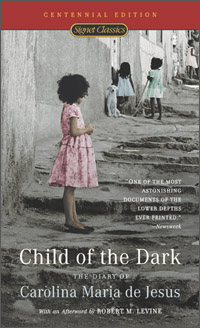
“Child of the Dark: The Diary Of Carolina Maria De Jesus” by Carolina Maria de Jesus – Translated from the Portuguese by David St. Claire

Child of the Dark

A spectacular diary penned by a virtually unlettered woman in a Brazilian slum. The language is raw and unrefined – and so are the emotions. Carolina was black, an unwed mother of three, a garbage-picker and ultimately a dreamer, who desperately wanted to write. And write she did. “The book is man’s best invention so far,” she says. (It needed a woman of the slums to say this.)

Carolina salvaged scraps of paper from garbage dumps and fashioned her diary. One day in 1958 a Sao Paulo reporter visiting the favela (slum) was astonished to hear a feisty black woman screaming at a group of men, “If you continue mistreating these children, I’m going to mention all your names in my book!” He got talking with Carolina. Later he convinced his editor to serialize the diary. The book emerged soon thereafter.

“Never had a book such an impact on Brazil,” says the translator. “In three days the first printing of 10,000 copies was sold out in Sao Paulo alone. In less than six months 90,000 copies were sold in Brazil…”

Carolina left no subject untouched. Religion, politics, philosophy, economics, sociology, racism, gender, human rights, man-woman relationships, parenting, animals, and even reincarnation are intricately women into the narrative. Here are some excerpts:

  • I am so used to garbage cans that I don’t know how to pass one without having to see what is inside.
  • I bore the weight of the sack on my head and the weight of Vera Eunice in my arms. Sometimes it makes me angry. Then I get ahold of myself. She’s not guilty because she’s in the world. I reflected: I’ve got to be tolerant with my children. They don’t have anyone in the world but me. How sad is the condition of a woman alone without a man at home.
  • Father’s Day. What a ridiculous day!
  • Brazil needs to be led by a person who has known hunger. Hunger is also a teacher. Who has gone hungry learns to think of the future and of the children.
  • I wonder if the poor of other countries suffer like the poor of Brazil.
  • I wonder if God knows the favelas exist and that the favelados are hungry?
  • The daze of hunger is worse than that of alcohol. The daze of alcohol makes us sing but the one of hunger makes us shake. I know how horrible it is to have only air in the stomach.
  • What they (favela children) can find in the streets they eat. Banana peels, melon rind, and even pineapple husks. Anything that is too tough to chew, they grind.
  • The white man says he is superior. But what superiority does he show? If the Negro drinks pinga, the white drinks. The sickness that hits the black hits the white. If the white feels hunger so does the Negro. Nature hasn’t picked any favourites.
  • If reincarnation exists, I want to come back black.
  • The cat is a wise one. She doesn’t have any deep loves and doesn’t let anyone make a slave of her. And when she goes away she never comes back, proving that she has a mind of her own.
  • The publishers in Brazil don’t print what I write because I’m poor and haven’t got any money to pay them. That’s why I’m going to send my novels to the United States.

Oscar Wilde once wrote, “We are all in the gutter but some of us are looking at the stars.” Carolina was among the star-gazers – penniless, but with oodles of enthusiasm. She was not bogged down by poverty but battled the odds and clung to her dreams. She was illegitimate and so was her mother. She left home in search of work and ended up in the favela when she was pregnant. Her three children were fathered by white men of three different nationalities. The luxury of sentiment was not for her. When her daughter says, “Mama, sell me to Dona Julita because she has delicious food,” what could Carolina do but record it in her diary?

The book’s success enabled Carolina to buy a brick house and move out of the favela that had been her home for 12 long years. But her children were ostracized by the new neighbours and life continued to be difficult. Carolina wrote four more books but they did not sell. She had to sell her house and revert to her familiar life on the streets. When she died in 1977, a favela neighbour paid for her casket. She left behind 40 notebooks.

Carolina was the only Brazilian woman of colour to leave a written testimony of her struggles. That she could write at all was nothing short of a miracle.

Overall Assessment: Like a diamond solitaire emerging from a garbage dump, this book surely stands out.

Child of the Dark: The Diary Of Carolina Maria De Jesus
AUTHOR: Carolina Maria de Jesus TRANSLATOR: David St. Claire
PUBLISHER: Penguin
YEAR OF PUBLICATION: 1962 (First published in Portuguese in 1960)

Contributor: Pushpa Kurup lives in Trivandrum, India and works in the IT sector.

“Return of the King: LeBron James, the Cleveland Cavaliers and the Greatest Comeback in NBA History” by Brian Windhorst and Dave McMenamin

Return of the King

This history of the greatest comeback in NBA history starts and ends with LeBron James, who rallied the Cleveland Cavaliers back from a 3-1 deficit in the NBA Finals against the Golden State Warriors. The Return of the King, written by Brian Windhorst, an ESPN analyst who has been covering LeBron since his high school days, and Dave McMenamin, another ESPN analyst who covers the Lakers and the Cavs, takes you all the way back to 2014, when LeBron made his decision to come back to his hometown Cleveland. It goes in depth into Cavaliers owner Dan Gilbert’s process of finding a new general manager to make the Cavs a playoff team in 2014. David Griffin then had to find a new coach, as the former coach, Mike Brown, was not helping the team win games, going into the fourth straight season of not making the playoffs. They then hired Russia’s national team coach David Blatt, who won a lot of titles in the Euroleague. Gilbert, Griffin, and Blatt, after many talks with LeBron’s agent Rich Paul about his contract, eventually lured LeBron back to Cleveland. Return of the King takes you deep into this process, showing you the players they got to entice LeBron, the talks between LeBron and Griffin, as well as the writing of the Coming Home letter written by James, which was published in Sports Illustrated to inform everyone of his final decision to return to Cleveland.

The book also explains how the Cavaliers ended up getting Kevin Love from Minnesota as a trade for their number one draft pick that year, Andrew Wiggins. Love made the decision after talking with LeBron on the phone, and having a sitdown with Gilbert and Griffin at Vegas. LeBron also is a free agent magnet, and he attracted many veterans like Mike Miller, James Jones, and Shawn Marion. McMenamin and Windhorst then explain the many frustrations during the first season for LeBron James. First, there were the growing issues with Dion Waiters, who was eventually traded for JR Smith and Iman Shumpert, and then there was David Blatt. Return of the King goes in depth into David Blatt’s problem, which were that he had trouble calling plays during timeouts, and he didn’t show authority well. This led to a frustrating season for the team, who ended up losing to the Warriors in the Finals after Kevin Love and Kyrie Irving got injured. LeBron James posted unbelievable numbers, but ran out of gas, as he was the only one doing much on the team.

Onto the next season, and a fresh start. Blatt was still coaching, but despite the good words LeBron said to the media about the coach, there was still unrest between the players about Blatt. The book goes in depth into the season, talking about almost every regular season game. They also bring in interesting facts, such as how LeBron James loved watching other NBA teams on offnights, and was a huge fan of the NBA app, when he once even complained to the league about its functionailty. Return of the King dives into the firing of David Blatt in the middle of the season, and the hiring of the assistant coach Tyronn Lue. The book takes us through all the playoff games, where the Cavaliers got to an amazing 10-0 start. It goes in depth into the celebration after the Eastern Conference Final win, and the preparation for a rematch with the Warriors. It recaps every game, and talks about the most memorable moments from Game 7:  “The Block. The Shot. The Stop.” The book tells us what happened after, during the celebrations in the locker room in Oracle Arena.

I absolutely recommend this book, as it is extremely indepth and told me things I did not know about the Cavaliers, even after watching almost every game. If you are a Cavs fan, this is a must-buy. This book will also tell you what an NBA front office is like, and all the things that goes on behind the scenes of an NBA championship team. Return of the King is an extremely interesting book, one that you can read over and over again to relive the Cleveland Cavaliers 2016 title run.

Return of the King: LeBron James, the Cleveland Cavaliers and the Greatest Comeback in NBA History
Authors: Brian Windhorst and Dave McMenamin
Publisher: Grand Central Publishing
Publication Date: April 2017

Reviewer: Sahil Kurup is a freshman at St. Francis High School in Mountain View, CA.

“Factory Girls: From Village to City in a Changing China” by Leslie T. Chang

Factory Girls

This book is partly about factory girls in China and partly about the author’s own family history. The two parts don’t blend together and the reader often feels the lack of cohesion, although the book is well-researched and well-written. It reveals the inner workings of China’s economic miracle of recent decades – and for this reason alone it’s worth reading.

I really relished the parts where the author carefully tracks the lives of several young girls who leave their homes in rural China in search of a better future and find their way to the factories in large towns and cities. Their dreams and aspirations, successes and disappointments, factory-hopping and dating games make interesting reading.

From Wu Chunming’s diary, the author shares many entries. An entry made on May 24, 1994 reads: “We start work at seven in the evening and get off work at nine at night. Afterward we shower and wash our clothes. At around ten, those with money go out for midnight snacks and those without money go to sleep. We sleep until 6.30 in the morning. No one wants to get out of bed, but we must work at seven.” Another undated entry reads: “RIGHT NOW I HAVE NOTHING. MY ONLY CAPITAL IS THAT I AM STILL YOUNG.” Chunming had migrated to Dongguan from a village in Hunan province two years ago when she was seventeen. The author met her when she was nearly thirty.

The author’s grandfather travelled to the US to study and subsequently returned home only to be killed in Manchuria in 1946. Later he is turned into a martyr, but again the tide turns and his grave is desecrated. The grandmother stoically brings up her five children, moving them to Taiwan in 1948, and sending them to the US one by one. The author herself is born in America and works in Beijing as a WSJ correspondent for several years. She begins a serious investigation that culminates in this book.

Are there any revelations? Well, here are some insights and observations:

  • In traditional Chinese genealogies, a family traces its lineage back to the “first migrating ancestor” who settled in a new location.
  • Widows who remarried after their husbands’ deaths were often omitted from a genealogy, as were childless concubines and sons who became monks.
  • Chinese history museums have grey areas. Ancient civilization is glorified but we are reminded that it was also feudal and backward. Modern China was ravaged by foreigners. China triumphed in 1949 when the communists came to power. But dark events such as the Cultural Revolution and the Tiananmen massacre of 1989 were blacked out.
  • Chiang Kai-shek breached the dikes of the Yellow River and unleashed a flood to stem the Japanese invasion. But the flood killed several hundred thousand Chinese farmers as well.
  • Though the government promoted cremation and charged each family a hefty fine for a burial, many villagers simply paid up and proceeded to bury their dead.
  • A fake degree from a vocational college cost around $7.50 while one from a vocational high school could be obtained for half that price.
  • “The mobile phone was the first big purchase of most migrants. Without a phone, it was virtually impossible to keep up with friends or find a new job…….. In a universe of perpetual motion, the mobile phone was magnetic north, the thing that fixed a person in place.”
  • “People referred to themselves in the terminology of mobile phones. I need to recharge. I am upgrading myself.”

The human suffering that triggers migration and the inevitable emotional cost is clearly spelt out. In the author’s own words, “My grandmother pushed her children to leave. She felt that Taiwan was too small; America was the only place for further education. But the journey by ship across the Pacific Ocean was too costly to be taken more than once. Every time she said goodbye to a child, she knew it was for the last time.”

There is pathos, there is humour, and there is some measure of confusion. Three chapters stick out of the book like a sore thumb: “The stele with no name”, “The historian in my family” and “The tomb of the emperor”. They have nothing to do with factory girls.

Overall Assessment: Worth reading despite the complexity.

Factory Girls: From Village to City in a Changing China
AUTHOR: Leslie T Chang
PUBLISHER: Spiegel & Grau, an imprint of the Random House Publishing Group
YEAR OF PUBLICATION: 2008

Contributor: Pushpa Kurup lives in Trivandrum, India and works in the IT sector.

“The Refugees” by Viet Thanh Nguyen

The Refugees

I really wanted to like this book. I had heard a lot about it in literary circles, as it was the new book by Viet Thanh Nguyen, a Vietnamese American novelist who had won the esteemed Pulitzer Prize for Fiction last year for his debut novel, The Sympathizer. The author was a recent visitor to a talk show that I happened to watch (Late Night with Seth Meyers), and I was very impressed—I found him intelligent, articulate, and extremely down-to-earth. Also, the subject of the book—refugees—seems particularly relevant these days, and even though the ones in this book are those who fled Vietnam after the Vietnam War in the 70s and 80s, they are refugees nevertheless. And while this book is a collection of short stories as opposed to a novel which I usually prefer, I have occasionally come across other collections of short stories that I have really enjoyed— the best example being Jhumpa Lahiri’s Interpreter of Maladies (which coincidentally also won the Pulitzer Prize for Fiction when it was published). I hadn’t read any book by a Vietnamese author before, so I was really open and receptive to this one. Thus, I had so many reasons to be predisposed towards liking this book—how could I not?

However, liking the book did not turn out to be as straightforward as I had anticipated. While I really appreciated Nguyen’s writing style—sparse, unpretentious, and eminently accessible—I did not find this collection of stories—there are eight of them—all that interesting, or even particularly insightful in better understanding the psyche of Vietnamese Americans who had fled their country and settled in the US. The horrors of that long-drawn out brutal war are not really captured except in one story, where a sister is visited by her brother’s ghost who died while trying to save her from soldiers on the boat their family was fleeing in. An oblique reference to the many land-mines that are still all over the country appears in another story in which an American military man, who was part of the air force that fought in the Vietnam War, visits it many years later with his wife to visit his daughter and her Vietnamese boyfriend. However, the focus of that story is really about the father-daughter relationship rather than Vietnam as such.

I also found that many of the stories ended very abruptly. For example, in a story called “The Other Man,” a young Vietnamese refugee, Liem, comes to live with a gay couple in San Francisco, is attracted to one of them, and ends up sleeping with him when the other unsuspecting partner has to go out of town for a few days. And the story pretty much just ends there, with Liem reading a letter from his family that he has just received and exchanging a glance with a stranger he sees with another man from his window. In another story, “The Transplant,” an American man, Arthur, gets fooled into storing fake merchandise in his garage for a Vietnamese American man, Louis Vu, who pretends to be the son of an unknown donor of the life-saving liver transplant that Arthur has recently received. The story just ends with Arthur finding out that Louis Vu had lied to him, and that’s it. The merchandise is still in Arthur’s garage, and we don’t know what happens to it or to Arthur. Several of the other stories had similarly inconclusive endings. It seemed as though the story could have well gone on, but the author just decided to pull the plug on it and move on. While I certainly wasn’t expecting a resolution to every story—that would be extremely unrealistic, given how messy life usually is—it would be nice to at least have some semblance of an ending. Otherwise, what’s the point? Why bother telling a story? Why bother reading one?

Of course, I am aware that very often, having a “non-ending” is often a stylistic choice by the author, which may be greatly appreciated by other readers, similar to how movies such as Terrence Malick’s The Tree of Life can be vilified by some and widely acclaimed by others at the same time. (I must admit to being one of the former.) However, even if I were to accept that I am one of those who just didn’t “get” the stories in The Refugees, I was disappointed to find that I was not able to really relate to them either, in the manner in which someone of Vietnamese descent might be able to identify with the characters and situations. I find this a real pity as it goes against our notion of universality — commonality of thought and feeling — as human beings. I do not know if the fact that I could not identify with much of the book is a problem with me or a failing of the book.

What I do know, however, is that I would like to give Viet Thanh Nguyen another try as an author, as I really respect him and like his writing style. I will go ahead and put his Pulitzer Prize-winning novel, The Sympathizer, on my reading list. Maybe I’ll have better luck with it.

The Refugees
Author: Viet Thanh Nguyen
Publisher: Grove Press
Publication Date: February 2017

Contributor: Lachmi Khemlani runs a technology publication in the San Francisco Bay Area.
“Karna’s Wife: The Outcast’s Queen” by Kavita Kane

Karna's Wife

If you haven’t read the Mahabharata, there’s no point in reading this one. Kavita Kane tells the story of the Mahabharata from a unique vantage point, that of Princess Uruvi, the only child of the King of Pokeya, who falls in love with Karna, the eldest Pandava, and marries him in the face of stiff opposition. With Karna’s birth being kept a secret by his mother, Kunti, the glorious son of the sun god, born with the golden kavach (armour) and kundals (ear-pieces) is condemned to be called a ‘sutaputra’ as he was raised by a humble charioteer.

The book has elements of a Mills & Boon romance with long conversations, imaginary sequences, and not-so-subtle appeals to the readers’ sentiments. Those who are sentimentally inclined will find the tears flowing. If you know your epics well, there is nothing that shocks, no new revelations, just another perspective. The book does not elevate Karna to another level, it merely evokes sympathy for his losses. The language is exquisite but delightfully Indian.

Many of the famous taunts that add spice to the Mahabharata have been repeated in this book. Draupadi insults Karna, Karna insults Draupadi, Karna insults Dronacharya and so on. However, the book has many original insights that are the unique inputs of the author herself. Here’s an example: ‘I almost feel sorry for Duryodhana,’ rued Uruvi as she sat with her husband in a rare moment of peace. ‘No one seems to be unconditionally on his side; he seems to be surrounded by half-hearted, disinclined warriors. Guru Dronacharya has already said he will only capture, not kill the Pandavas, while King Salya is the maternal uncle of Nakul and Sahadeva and an ardent Pandava supporter who has reluctantly joined the Kaurava side. Bhishma Pitamaha declares that he shall not kill the Pandavas!’

You have Kunti speaking about the practice of ‘niyoga’ wherein a woman conceives a child from another man with her husband’s consent. You are reminded that Satyavati (the Queen Mother) persuaded her illegitimate son Vyasa to perform niyoga on her daughters in law Ambika and Ambalika in order to produce Dhritrashtra, Pandu and Vidura for the continuance of the Kuru dynasty when her son Vichitravirya died without leaving an heir.

The book highlights many of the injustices perpetrated against women in the interest of the ruling classes of the day. In an imaginary conversation between Uruvi and Bhishma, the former says, ‘….you kidnapped the three Kashi princesses, Amba, Ambika and Ambalika, for your brother King Vichitravirya. They were forced to marry him. Were you not responsible for the suicide of Amba, who eventually killed herself because they man she was in love with refused to marry her, fearing the wrath of the great Bhishma? Kings were so petrified of you that you easily bought over their princesses and forced them to marry Kuru princes. You did it with Madri for King Pandu and with Gandhari for King Dhritrashtra.’

Karan’s first wife Vrushali, the mother of his many sons, comes across as a drab and stoic character. One can’t help feeling sorry for the devoted consort who loses her husband’s affections to the charming princess who abruptly comes in the way.

The chapters could have been given more interesting titles. ‘Indraprastha’, ‘Draupadi’, ‘Krishna and Karna, ‘Bhishma and Karna’, ‘Kunti and Uruvi’, ‘Uruvi and Bhanumati’ are hardly inspiring. On the whole the book has the characteristics of a Hindi television serial – it is slow moving, with several dramatic scenes, unnecessary repetitive dialogues, tear-jerkers, and strong emotional content. The shocks are minimal because we already know the story.

Overall Assessment: Not very enlightening.

Karna’s Wife: The Outcast’s Queen
AUTHOR: Kavita Kane
PUBLISHER: Rupa Publications
YEAR OF PUBLICATION: 2013

Contributor: Pushpa Kurup lives in Trivandrum, India and works in the IT sector.

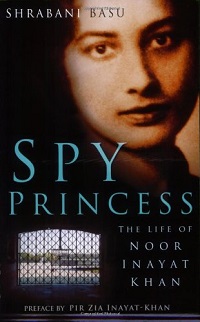
“Spy Princess: The Life of Noor Inayat Khan” by Shrabani Basu

Spy Princess

I’d read “Victoria and Abdul” by Shrabani Basu and I’d been really, really impressed. It was about Queen Victoria striking up a great friendship with a young man, Abdul Karim, who had been brought from India to work in the palace. The stupendous amount of research that formed the basis for that book and the author’s way with words had made it a most enjoyable read. So I picked up the “Spy Princess” with a basket of great expectations. Noor is a fascinating subject, firstly because she was a spy, and secondly because she was a direct descendant of Tipu Sultan, the Lion of Mysore who died fighting the British in 1799. The book, however, disappoints as it enlightens. Too many characters, too many details, too many sub-plots make it a tiring read.

Born in Moscow to Hazrat Inayat Khan, an Indian prince who was a Sufi singer, and an American woman, Ora Ray Baker, Noor-un-nisa was the eldest of four siblings, and lived mostly in Paris and London. Neither her genteel upbringing in the Sufi tradition nor her sensitive, refined temperament had prepared her for the stupendous role she was to play during the crucial years of World War II. Noor was executed by the Nazis at the Dachau concentration camp on 13th September 1944. It was only two years after the war ended that this fact became known. On 16th June 1943 she had been airdropped in France along with three others, none of whom survived the war.

Noor’s story is a saga of personal tragedies. At twelve she fell in love with a Dutch boy but her parents didn’t approve. Her father wanted her to marry Alladatt Khan, a man from Baroda, but that was not to be. Noor lost her father when she was thirteen, and took upon herself the burden of looking after her mother and younger siblings. In a short story titled ‘Echo’ she wrote: “Amongst the nymphs who lived on a high mountain slope was a little one who talked and talked and jabbered and chattered, even more than the crickets in the grass, and more than the sparrows in the trees. Her name was Echo.” She soon began contributing poems and children’s stories in magazines and radio.

Noor had learnt the basic Indian ragas from her father and played the harp and the piano. While studying music at the Ecole Normale de Musique, she was involved with a Turkish Jew. The relationship lasted six years and left her emotionally drained.

Noor graduated in child psychology from the Sorbonne in 1938. Her English translation of the Jataka Tales was published in England in 1939. In 1940, she broke off her engagement and decided to move to England with her family. Hours after the fall of Paris they set sail on the last boat to leave France. In November Noor joined the WAAF (Women’s Auxiliary Air Force). Later she was chosen as an SOE (Special Operations Executive) agent and became the first woman radio operator to be infiltrated into occupied France to aid the Resistance. The average survival span for a radio operator was estimated by the SOE to be six weeks, and Noor was briefed about this. Her acceptance of the fatal assignment was whole-hearted.

Before leaving England, Noor told her family she was engaged to a British officer and they would marry when the war ended. The mystery man was never identified. In Paris, Noor was linked to Antelme (who was later executed by the Germans) but the nature of their relationship is uncertain. It was wartime after all – and Noor was an unfailing romantic.

For four months after landing in France Noor evaded capture, changing locations frequently, changing her appearance occasionally, and relying on her network of friends who provided cover. She was eventually betrayed and fell into the hands of the Gestapo. When Ernest Vogt at the Gestapo headquarters in Paris told Noor her sacrifice had been in vain, she replied calmly, “I have served my country. That is my recompense.” After making two daring escape attempts, Noor was labelled “highly dangerous” and transported to a prison where she was kept shackled for the next ten months. Despite interrogation, abuse and torture she revealed nothing and remained defiant until her last breath. She was only thirty when she died.

Had the SOE deliberately sent innocent girls to their deaths, knowing they would never return? The compulsions of a country at war cannot be viewed through a peace-time lens, and obviously one cannot expect simple answers.

In 1949, the George Cross, Britain’s highest civilian honour was bestowed upon Noor. France had awarded her their highest civilian honour in January 1946. Every year on Bastille Day (14th July) a band plays outside her childhood home, Fazal Manzil, on the rue de la Tuilerie. A square in Suresnes is named Cours Madeleine (The French know her by her code name ‘Madeleine’). There is a plaque in her honour at Dachau in Germany, and another at Grignon in France where she made her first transmission. In 2012 a bronze bust of the ‘spy princess’ was unveiled in Gordon Square Gardens, London.

Overall Assessment: Despite its shortcomings, this is a book that begs to be read.

Spy Princess: The Life of Noor Inayat Khan
AUTHOR: Shrabani Basu
PUBLISHER: Sutton Publishing, UK
YEAR OF PUBLICATION: 2006

Contributor: Pushpa Kurup lives in Trivandrum, India and works in the IT sector.

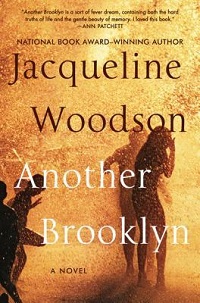
“Another Brooklyn” by Jacqueline Woodson

Another Brooklyn

There were several reasons that prompted me to pick up Another Brooklyn in the New Books section of my local library. To start with, its author, Jacqueline Woodson, had won the National Book Award in 2014 for her critically acclaimed memoir, Brown Girl Dreaming. Also, the title of the book reminded me of the classic 1943 novel, A Tree Grows in Brooklyn, which I had read several years ago, and which is still often quoted whenever Brooklyn is being discussed. Then there is also the fact that I recently visited Brooklyn—and walked on the famous Brooklyn Bridge—so I feel a visceral connection to the place.

And finally, Brooklyn is now one of the main cities in the U.S. going through a rapid gentrification process with enormous increases in the housing prices and apartment rentals, pricing out the traditional African-Americans who have lived there for generations. Another Brooklyn captures a time before all this happened, when Brooklyn was still very much a place dominated by black people, and it provides a fascinating glimpse into what it was like. In fact, the book is primarily set in the 1970s, when white people were fleeing from Brooklyn because of the influx of black people. The irony would be funny if it weren’t so tragic.

Anyway, getting back to the book, Another Brooklyn is the coming-of-age story of four girls growing up in Brooklyn, how they become inseparable friends, how they grow up from being kids to adolescents, and how they eventually drift apart and go their own separate ways as adults. August, the protagonist, is one of the four girls—she has recently moved to Brooklyn from Tennessee with her father and brother, following the tragic death of her mother (which she refuses to acknowledge for several years until she goes to meet a therapist at the insistence of her father). As she is adjusting to her new surroundings, Angela sees the clique of the other three—Sylvia, Angela, and Gigi—and desperately wants to be a part of it. This happens quite soon, without much fanfare, and the story then goes on to explore different issues through the interactions of the four friends with each other, their families, and the others around them.

What really impressed me about this book was that the issues that are explored through the lens of the four friends are issues that are common to any race and culture—the changes that adolescence brings in girls and in how others react to them, the growing interest in and from boys, going out on dates, the pressure from boyfriends to “go all the way,” the repercussions of resistance, the betrayals by close friends, teen pregnancies, parental expectations and failing to meet them, and the large part that luck plays in becoming successful even if you are very talented. There are no “black” issues as such, and from that perspective, the book is not at all stereotypical. About the only time race comes into play is when the parents of one of the girls, who is half-Chinese and half-black, disapprove of her friends and think that she can do better. (Not that this stops her.)

There are also none of the usual story lines you would expect. Soon after their arrival in Brooklyn, August’s father gets inducted into the Nation of Islam and eventually her brother also starts following Islam. Yet, there is nothing that shows the religion as being harmful or hurtful in any way. The father is not abusive, neither is the brother. They were poor, but always had enough to eat and were able to help those worse off than them. August is an academically good student, focuses on AP exams and SATs in high school, eventually goes to an Ivy League school, and becomes an anthropologist as an adult, travelling the world to study about death and dying in different cultures. (She returns to Brooklyn when her father dies and a chance glimpse of one of her friends on the subway brings back memories of her childhood to her.)

In addition to not being about race or racism at all, what also distinguishes Another Brooklyn is its lack of drama. This are no big defining moments when things change, no life-changing events, no plot twists and turns. This makes it more true to how life is for most people. The writing is also every poetic, making the term “understated eloquence” a very apt description of the book. I really liked it—not only was it beautifully written and different from other books I have read, it gave me a first-person glimpse into a life and culture I didn’t know much about.

Another Brooklyn
Author: Jacqueline Woodson
Publisher: Amistad (HarperCollins)
Publication Date: August 2016

Contributor: Lachmi Khemlani runs a technology publication in the San Francisco Bay Area.

“The Silk Roads: A New History of the World” by Peter Frankopan

The Silk Roads

Penned by an Oxford scholar, this 600 page chronicle has the potential to cause a paradigm shift in your world view. The narrative is embellished with nuggets of information about the ancient and modern worlds. It deftly removes the mask of ‘civilization’ from the face of Europe and reveals the true motivation behind many historically significant moves.

ON ISLAM AND CHRISTIANITY
• The Prophet Mohammed’s last words: “Let there not be two religions in Arabia.”
• The faithful (Muslims) had initially been told to face Jerusalem when they prayed. It was only in 628 (six years after his flight to Medina) that Mohammed decided on Mecca.
• When Mohammed came to Yathrib (Medina) the Jews in the town concluded a mutual defence agreement that offered protection for their faith and property. However, one rabbi opined that Mohammed was a false prophet, ‘for prophets do not come armed with a sword’.
• Muslims were tolerant towards other religions during the early decades of Islam. They rebuilt the church at Edessa (Turkey) when it was damaged by an earthquake in 679. The mosque of the Dome of the Rock, constructed at the start of the 690s, had mosaic inscriptions mentioning not only Mohammed but also Jesus and Mary. Muslim attitudes towards ‘kafirs’ hardened towards the end of the seventh century as a result of the antagonism between rival factions for the control of Islam. (Of the first four caliphs, three were murdered.)
• The Arab conquest of Sindh (Pakistan) in 711 yielded 60 million dirhams in immediate gains (not accounting for future taxes).
• “Islamic societies generally distributed wealth more evenly than their Christian counterparts, largely thanks to very detailed instructions set out in the Quran about legacies.”

THE SLAVE TRADE
• The customary greeting in Italy, ‘Ciao’ does not mean ‘hello’ – it means ‘I am your slave.’
• Venetian merchants became involved in the slave trade in the mid 8th century.
• From the 8th to the 10th centuries, slaves were the currency used for trade between Europe and the East. Money was a later addition.
• A ninth century prayer from France: “Save us, O Lord, from the Savage Norsemen who destroy our country; they take away….our young, virgin boys.”
• The Roman empire at its height required 250,000 to 400,000 new slaves annually to maintain its slave population, but the size of the market was substantially larger in the Arab world (centuries later).
• One writer opined, “There is no equal to the Turkish slaves among all the slaves of the earth.” Another account mentions a Caliph and his wife owning a thousand slave girls each.
• There were guide-books for slave-purchase. Wrote one 11th century author, “Of all the black (slaves), the Nubian women are the most agreeable, tender and polite.”
• Jewish merchants played a key role in trafficking boys and girls from Europe and castrating the males on arrival. Eunuchs were highly valued. “If you took Slavic twins, wrote one Arabic author in this period, and castrated one, he would certainly become more skilful and ‘more lively in intelligence and conversation’ than this brother – who would remain ignorant, foolish and exhibit the innate simple-mindedness of the Slavs.”
• The Arabic word for eunuch comes from the ethnic label referring to Slavs.

POT POURI
• Rustichello of Pisa and Marco Polo of Venice struck up a friendship in a Genoese prison. Genoa had been victorious in separate naval battles against Pisa and Venice – and the poor men had been captured. Rustichello had spent a decade in prison before the world traveller came along. It was he who carefully recorded “The Travels of Marco Polo”.
• The Mongols were “far removed from our common perceptions of them.” They combined military dominance and selective brutality with religious tolerance, political savvy and liberal taxation.
• The Incas had meticulously recorded births and deaths.
• Elihu Yale was Governor of Madras for 5 years. He returned from India with priceless loot that included five tons of spices, diamonds and precious objects. Before his death (in Wales) he donated generously to a college in Connecticut that now bears his name. (Wikipedia describes Yale as merchant, philanthropist and slave trader.)
• European powers often resolved their disputes by exchanging their colonies. Madras changed hands between the French and the British. When Portugal ceded Bombay to Britain as part of the dowry of Catharine of Braganza in the 1660s, the Portuguese Governor of Bombay predicted that this move would spell the end of Portugal’s empire in India. It did.
• After Robert Clive defeated the Nawab of Bengal in 1757, over two million pounds flowed into the pockets of East India Company employees. Clive became the richest man in the world. The Bengal Famine of 1770 followed soon thereafter.

Everything about this book is interesting. The fonts are reader-friendly but you need both hands to hold the book.

An unforgiveable faux pas: The Guru Granth Saheb is described as “the great scared text of Sikhism.”

Overall assessment: It would make Oxford proud.

The Silk Roads: A New History of the World
AUTHOR: Peter Frankopan
PUBLISHER: Bloomsbury
YEAR OF PUBLICATION: 2015

Contributor: Pushpa Kurup lives in Trivandrum, India and works in the IT sector.

“The Sense of an Ending” by Julian Barnes

The Sense of an Ending

This book by Julian Barnes won the Man Booker Prize in 2011. However, I hadn’t heard of this book or this author before, up until a few weeks ago when I read, following a recommendation, another book by Barnes, Levels of Life, in which he writes poignantly about grief following the sudden death of his wife of 30 years. Not only did I find it deeply moving, it was also extremely well written, with a grace and fluency that pointed to years of experience with writing. I did some research on Barnes and found that he is indeed an established writer with a career spanning over three decades with over 25 books. While three of his earlier novels had been shortlisted for the Booker prize, he finally won it in 2011 for The Sense of an Ending. Even more intriguingly, I found that this book has now been made into a movie—which has just been released—and that it is directed by an Indian director, Ritesh Batra, who made his directorial debut with the highly acclaimed movie, The Lunchbox. That moved The Sense of an Ending immediately to the top of my reading list, as I wanted to read it well before I saw—if I decided to—the movie.

The Sense of an Ending tells the story of a middle-aged man, Anthony, who has been living a relatively uneventful life so far—he is divorced but still has an amicable relationship with his ex-wife, he has a grown-up daughter who is married, he is retired but keeps himself occupied with some volunteer activities—when suddenly, his world is shaken up by “ghosts from the past.” Not literally—this is not a ghost story—but figuratively. It happens in the form of a mysterious legacy; the mother of his ex-girlfriend, Veronica, leaves him a small amount of money, but more importantly, the diary of his close childhood friend, Adrian, who committed suicide as a young man. Throughout his youth, Anthony always looked up to Adrian as someone who was a lot more intelligent, sophisticated, erudite, and well-read than him and his other two friends in their group of four, and Adrian’s suicide seemed to be, on the surface, a calculated high-minded move inspired by Albert Camus who famously said that suicide was the only true philosophical question. Adrian’s diary would give Anthony a better insight into his friend’s state of mind and possible shed some light on his decision to kill himself, and Anthony would really like to have it—it was left to him, after all.

But Adrian’s diary has fallen into the possession of Veronica, who was not only his ex-girlfriend, but who subsequently started going out with Adrian, and who, as far as Anthony knows, was still with Adrian when he killed himself. Anthony’s relationship with Veronica, when they were together, was complicated, and the fact that she took up with Adrian soon after they had broken up had upset Anthony so much that he had sent them an acrimonious letter, full of vitriol, at that time. Therefore, it is not altogether surprising that Veronica refuses to give him Adrian’s diary, despite the fact that Anthony is very ashamed of having written and send that letter all those years ago, and apologizes for it repeatedly when they now meet.

So how does it end? Is there a resolution, the “sense of an ending” as the title implies? Of course, I cannot give it away except to say that there was an ending, although it was extremely unexpected. From that perspective, the book is suspenseful and builds up the drama, making it hard to put down until you know what happens. It is also a relatively short book, and therefore you don’t have to wait too long to find out how it ends. The writing is masterful—concise and precise but without feeling rushed, taking the time to dwell on the main events in the story but not wasting time and words on things that don’t contribute to it.

That said, I did find the ending of the book too abrupt and a little too mysterious, to the extent that I actually had to do some online research to clarify what exactly had happened. There is eventually a revelation which provides the “sense of an ending,” but it leads to several unanswered questions and was therefore not very satisfying. Thus, while Julian Barnes’ talent as a writer is beyond question and I found The Sense of an Ending a good read, I would hesitate to give it my whole-hearted seal of approval.

The Sense of an Ending
Author: Julian Barnes
Publisher: Alfred A. Knopf
Publication Date: October 2011

Contributor: Lachmi Khemlani runs a technology publication in the San Francisco Bay Area.
 

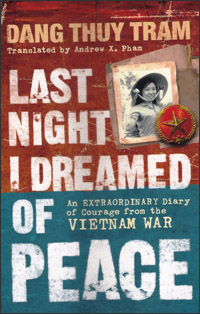
“Last Night I Dreamed of Peace: The Diary of Dang Thuy Tram” by Dang Thuy Tram

Last Night I Dreamed of Peace

At the War Remnants Museum in Ho Chi Ming City, Vietnam, I paid the princely sum of fifteen US dollars for the diary of a dead woman I had never heard of. As I began to read, the realization dawned on me that hers was a true rendering of history – and every word was dynamite. This was no ordinary woman, no white-collared doctor, no run-of- the-mill revolutionary. She had the heart of a humanist, the soul of a poet, and the grit of a guerrilla fighter. “For the first time I dig a grave to bury a comrade. The shovel hits a rock, and sparks fly like the flame of hatred in my heart.”

On 22nd June 1970, Dr. Dang Thuy Tram, barely aged 28, was shot dead by American soldiers as she walked along a remote trail in Duc Pho with three others. Her diary made its way to the United States and remained for decades in the possession of Fred Whitehurst who worked for the FBI, turned whistleblower, and finally tracked down Thuy’s aged mother in Hanoi to hand over the precious memoir. Published in 2005, the diary was an instantaneous hit. The English translation emerged in 2007. Thuy’s last words express her deep anguish and sense of hopelessness in the face of a powerful destiny: “I am no longer a child. I have grown up. I have passed trials of peril but somehow, at this moment, I yearn deeply for Mom’s caring hand. Even the hand of a dear one or that of an acquaintance would be enough. Come to me, squeeze my hand, know my loneliness, and give me the love, the strength to prevail on the perilous road before me.”

Born in a cultured, ‘bourgeois’ family, Thuy learnt to play the guitar and the violin. She qualified as a doctor and was accepted for higher studies in surgical ophthalmology. Yet she chose to move south and join the resistance in December 1966. Her beloved country was at war and America was no mean foe. Part of her motivation was her desire to re-unite with the love of her life, a man she simply calls ‘M’. Thuy had loved him from an early age but he had joined the North Vietnamese army four years earlier. The truth about their break-up remains shrouded in mystery. Thuy’s diary is actually the second volume, the first having been lost in the war zone during a miraculous escape on 31st December 1969. Did she write about her heartbreak in the first volume? We may never know.

The pocket sized diary was often scribbled in dark, humid, underground shelters or narrow caves in the mountainside. US President Richard Nixon is a “mad dog.” American soldiers are “devils” or “bandits”. Thuy speaks of revenge but never kills a fly. She only saves lives. Thuy speaks of young men dying in her arms, of performing amputations without anaesthesia, of a great many medical challenges. In mid 1969, she wrote, “I will not be there when they sing the victory song.”

Of her broken relationship she says little, but her words are powerful. “The trust stemming from ten years of waiting and longing does not erode easily, but when it cracks it’s hard to repair.” And, “I know the roots of my love still lie deep within my heart, dormant but not dead. It can sprout, it can grow if spring returns. A part of me is still that young girl you know, the one who loves to feel cool raindrops on her face.”

Her writing is embellished with simile and metaphor, and the play of emotions mingles with practical descriptions of life’s harshest realities. There is poetry in every sentence. One marvels at the ebullient romanticism of the young woman in an environment shrouded by the horrors of war. Bravery and optimism, pathos and idealism – a plethora of intense feelings gives the diary a powerful voice that reaches out to even the most disinterested reader. Some excerpts:

  • My soul is as full, as tumultuous, as a river after days of torrential rain.
  • My youth has been soaked with the sweat, tears, blood, and bones of the living and the dead.
  • The hand-basket is heavy, but my worries are much heavier.
  • Hatred is bruising my liver, blackening my gut.
  • This war has robbed me of all my dreams of love.
  • Oh! Cruel American bandits, your crimes are piling up like a mountain. As long as I live I vow to fight until my last drop of blood in this thousand-year vendetta.

The diary begins on 8th April 1968, when Thuy had already spent two years among the fighters. The words she used to pay tribute to a fallen comrade are entirely appropriate and applicable in her own case: “Your heart has stopped so that the heart of the nation can beat forever.”

Overall Assessment: Must read.

Last Night I Dreamed of Peace: The Diary of Dang Thuy Tram
AUTHOR: Dang Thuy Tram (translated from the Vietnamese by Andrew X Pham)
PUBLISHER: Rider
Date of Publication: 2007

Contributor: Pushpa Kurup lives in Trivandrum, India and works in the IT sector.