“A Place to Stand” by Jimmy Santiago Baca

a-place-to-stand

A brutally honest memoir by a person born to deprivation and abandonment. Born in the southern state of New Mexico to parents of Mexican and Apache Indian descent, Baca’s early life is the very antithesis of the American dream. This book enables you to see the indifferent face of America, the very existence of which many in the developing world are unaware. Poverty in America? Don’t tell me! Here is a man lucky enough to be born in America and yet living a most horrendous and nightmarish existence from early childhood to adulthood. “I’d begun to feel early on that the state and society at large considered me a stain on their illusion of a perfect America. In the American dream there weren’t supposed to be children going hungry or sleeping under bridges.”

Baca and his two siblings were abandoned in childhood by both parents – their father drifting through life in an alcoholic haze and their mother eloping to California with a lover in her quest for a more settled lifestyle. Brought up by their grandparents for a while, the children keep yearning for their parents’ return. When their grandfather passes way, the boys are sent to an orphanage. Baca runs away again and again – and ends up in a detention center at the age of thirteen. From there, he moves on to street life marked by vagrancy, aimlessness, petty crimes, intermittent jail terms, violence and substance abuse, for a while reuniting with his brother and then losing him again. “And somewhere along the line, I started fighting just for the sake of fighting, because I was good at it and it felt good to beat other people up.”

Baca is sentenced for drug peddling and ends up in jail. During his five-year incarceration at a maximum security prison, he learns to read and write. He attained real literacy only when he was in his early twenties – and it turned out to be his path to salvation. While he speaks of the sub-human conditions that prevail in prison, something that the vast majority of us cannot even imagine, his language espouses a dark beauty and is more poetry than prose. “The rage that came out of him was the kind of rage that transcends friendship. It’s the kind of rage that can be created only in prison. The seeds of that rage are nourished by prison brutality and fertilized by fear and the law of survival of the fittest. It grows and grows, hidden deep in souls that have died from too many beatings, too many jail cells, and bottomless despair, contained like a ticking bomb.”

Of life in jail, he has this to say, “Three meals a day and a warm cot with a roof over my head was a vacation. It was often better in jail than on the streets; I didn’t have to worry for a while about surviving.” And “Handcuffs had become as normal to me as a wristwatch is to a free man.”

Baca draws plausible portraits of everything that is wrong with a system that recognizes human beings only when there is a perceived need to punish and restrain them. “You could see the narrowing of life’s possibilities in the cold, challenging eyes of the homeboys in the detention center; you could see the numbing of their hearts in their swaggering postures. All of them had been wounded, hurt, abused, ignored; already aggression was in their talk, in the way they let off steam over their disappointments, in the way the expressed themselves. It was all they allowed themselves to express, for each of them knew they could be hurt again if they tried anything different.”

The emotional content of the book is stupendous. It doesn’t come as surprise that Baca soon became an acclaimed writer. He had endured so much and he had so much to say. And most significant of all, he had overcome. Through the world of letters, the human spirit had broken out of the vicious circle of drugs, crime and depravity and settled down to the peaceful pursuit of true happiness. This memoir has the potential to awaken hope in the hearts of people who are going through similar travails and plumbing the depths of despair, not only in America but elsewhere. In the author’s own words, “I was a witness, not a victim. I was a witness for those who for one reason or another would never have a place of their own, would never have the opportunity to make their lives stable enough because resources weren’t available or because they just could not get it together.”

Overall Assessment: Definitely worth reading.

A Place to Stand
AUTHOR: JIMMY SANTIAGO BACA
PUBLISHER: GROVE PRESS, NEW YORK
DATE OF PUBLICATION: 2001

Contributor: Pushpa Kurup lives in Trivandrum, India and works in the IT sector.
“Eligible: A Modern Retelling of Pride and Prejudice” by Curtis Sittenfeld

eligible

I absolutely loved Jane Austen’s Pride and Prejudice when I first read it as a teenager, and even now as an adult, having re-read it multiple times, I still rate it as the best—not “one of the best” but unequivocally “the best”—book I have read. This is why when I heard of the new book, Eligible, described as a contemporary take on the beloved Jane Austen classic, I was intrigued. The author, Curtis Sittenfeld, was a young, upcoming novelist who had already written a few books, was well respected, and generally considered as one of the promising literary stars of the new generation. While it is always difficult to appease die-hard fans of any book—I found the BBC mini-series of Pride and Prejudice a decent attempt but the recent Keira Knightley movie quite bad, even though it got good reviews—the promise of reliving my favorite Pride and Prejudice characters seemed too good to pass up on.

So I went ahead with reading Eligible. For the most part, I found it a fun and entertaining read. There is still the Bennet family with five unmarried sisters, who their mother, Mrs. Bennet, is desperately trying to find matches for. They live in Cincinnati, and while the three younger sisters still live at home, the older two, Jane and Elizabeth, live in New York where they have their own lives and careers. A sudden heart attack suffered by their father brings them back home for a visit, and this is how they get a chance to meet Mr. Bingley and Mr. Darcy, the eventual love interests of Jane and Elizabeth respectively. Both are doctors, so deemed as great “catches” by Mrs. Bennet, although Darcy soon falls out of favor by seeming to be snooty and obnoxious, as in the original. Bingley, on the other hand, is, in addition to being a doctor, a reality TV star, just coming off the sets of a Bachelor-type show called Eligible (which is where the name of the book comes from). Jane, meanwhile, is almost 40 and is trying to have a baby using artificial insemination through an anonymous sperm donor. Elizabeth, or Liz as she is called, is a fairly successful magazine writer who has been having an affair with a married man for many years and is not terribly happy with that relationship. Darcy, as in the original, is fabulously wealthy, exceptionally smart, and extremely handsome—he is a neurosurgeon, went to Stanford, has a Ph.D., and has a sprawling estate called “Pemberly” in Atherton, the priciest location in the already pricey Bay Area. In short, apart from his perceived arrogance and pride, he is perfection personified!

Rounding off the main characters from the original are Liz’s closest friend Charlotte, who gets paired off with Liz’s cousin Willie, a highly successful Silicon Valley entrepreneur, who was first interested in Liz and gets together with Charlotte only on the rebound; Lydia, the youngest Bennet sister, who elopes and gets married to a transgender man, Ham (short for Hamilton), who Mrs. Bennet does not accept at first but eventually comes around to thanks to some “neurological” talk from Darcy; Kitty, the second-youngest Bennet sister, who eventually joins a beauty school (thanks to Liz’s encouragement), and starts going out with a black man, which is another nail in the coffin for the biased Mrs. Bennet; Mary, the middle sister, who is as scholarly and uninteresting as in the original; Kathy de Bourgh, who is now a famous feminist celebrity that Liz interviews, rather than Darcy’s obnoxious aunt who want to stop him getting together with Liz; and finally, Bingley’s sister, Caroline Bingley, who continues to be the thorn on Liz’s side and wants Darcy for herself.

Admittedly, the plot line does sound ludicrous and die-hard fans of the book like me would likely cringe at this mutilation of their beloved characters. But surprisingly, Curtis Sittenfeld is able to pull it off for the most part, keeping in mind that Eligible is not meant to be a serious book but instead a fun and light-hearted take of the storyline of Pride and Prejudice set in current times. It is a fast-paced, easy read, with short chapters, some of which are no longer than a page or even a few paragraphs. The story moves on briskly, and some of the contemporary touches are quite witty, such as Kitty and Lydia being into CrossFit workouts and Paleo diets, the fumigation of the Bennet home because of an infestation of spiders, the over-shopping and hoarding tendency of Mrs. Bennet which requires Liz to eventually move all her stuff into a portable storage truck in order to sell the house, Jane’s artificial insemination through an anonymous sperm donor which actually results in her getting pregnant and having a baby, and the introduction of not just gay but also transgender characters into the storyline.

At the same time, some parts of the story just don’t work. For example, the whole reality TV aspect of the book is hard to take seriously—and it’s not just that Bingley recently came off from acting in a Bachelor-like show, he also returns for a sequel, and his eventual wedding to Jane, with family and friends, is included in the TV show, broadcast live on television! Then there is Mr. Darcy. While he was a terrific “catch” in Pride and Prejudice with his large estate and income, it was not at all unbelievable—it was quite common in the Victorian days for wealthy families to have large estates and for the scions of those families to be highly sought after for marriage. However, in Eligible, not only is Darcy impossibly wealthy (an estate in Atherton), but he is also the smartest person in the noblest profession (Stanford educated neurosurgeon), he is single (he has no time for girlfriends as he is so busy doing surgery on people’s brains), and of course, he is extremely good-looking! It’s hard to take a book seriously in which the “hero” is so perfect—in every possible way. Then there is the manner in which Liz and Darcy first get together—they have “hate sex” initiated by Liz. Whatever happened to good old-fashioned romance? Are people now so driven by hormones that the first thing they do at even the slightest hint of interest or attraction is sleep together, and are our contemporary books and movies simply capturing that?

For those of us who love our classics, we need to be prepared for the influx of modern retellings like Eligible as they are getting more common. (While Pride and Prejudice is a favorite, popular classics that are being “retold” in current or upcoming books are Romeo and Juliet, Wuthering Heights, The Taming of the Shrew, and Hamlet.) It would help to have the original books handy so they can “wash off” the experiences of these retellings, if required.  I have to go back and re-read Pride and Prejudice to let it works its magic and charm on me again.

Eligible: A Modern Retelling of Pride and Prejudice
Author: Curtis Sittenfeld
Publisher: Random House
Publication Date: April 2016

Contributor: Lachmi Khemlani runs a technology publication in the San Francisco Bay Area.

“The Last Lecture” by Randy Pausch with Jeffrey Zaslow

the-last-lecture

I read ‘The Last lecture’ on a flight from Dubai to New York. The book was published in 2008, the year Randy Pausch died of pancreatic cancer. The fatal diagnosis had come in 2006 and the following year Pausch delivered “The Last Lecture” at Carnegie Mellon on the topic “Really Achieving Your Childhood Dreams.” Ironically, the speech was part of a series Carnegie Mellon called “The Last Lecture,” where speakers were asked to think about what mattered to them most and give a hypothetical last lecture. Pausch’s speech soon became a sensation on Youtube and the book (supposedly dictated over cellphone to WSJ journalist Jeffrey Zaslow) later turned out to be a New York Times bestseller.

Pausch, a computer scientist and university professor, recognized as a pioneer of virtual reality research, married with three little infants, finds out he has very little time left. This book is his last and final legacy. It is both touching and thought-provoking, leaving the reader sad and elated at the same time. Though it is about death and man’s helplessness in the face of the inevitable, it maintains a humorous vein throughout. Here are a few samples:

  • I quote my father to people almost every day. Part of that is because if you dispense your own wisdom, others often dismiss it; if you offer wisdom from a third party, it seems less arrogant and more acceptable
  • After I got my PhD, my mother took great relish in introducing me by saying: “This is my son. He’s a doctor but not the kind who helps people.
  • Throughout my academic career, I’d given some pretty good talks. But being considered the best speaker in a computer science department is like being known as the tallest of the Seven Dwarfs
  • While I went through treatment, those running the lecture series kept sending me emails. “What will you be talking about?” they asked. “Please provide an abstract.” There’s a formality in academia that can’t be ignored, even if a man is busy with other things, like trying not to die.

The book encompasses many quotable quotes, sound business advice and much wisdom. A few examples:

  • There is more than one way to measure profits and losses.
  • On every level, institutions can and should have a heart.
  • A good apology is like an antibiotic, a bad apology is like rubbing salt in the wound.

Overall Assessment: Definitely worth reading.

The Last Lecture
AUTHOR: Randy Pausch with Jeffrey Zaslow
YEAR OF PUBLICATION: 2008
PUBLISHER: Hodder & Stoughton

Contributor: Pushpa Kurup lives in Trivandrum, India and works in the IT sector.

“Small Great Things” by Jodi Picoult

small-great-things

Jodi Picoult is a prolific novelist. She has written over 25 novels in a span of 24 years, many of which I have read. Her writing is not high literature by any means, the kind that would win prestigious awards, but her books are very entertaining, absorbing, and well-written, making her a highly successful writer whose books are extremely popular. She also typically touches upon some weighty issues in each of her novels, such as organ transplant (Change of Heart), a school shooting (Nineteen Minutes), religious belief (Keeping Faith), autism (House Rules), genetic engineering (My Sister’s Keeper, a riveting book that was also made into a movie), and many others.

In her new novel, Small Great Things, she takes on the hot-button issue of racism, which has emerged to the forefront in the U.S. in the last couple of years, with the shootings of black men, the Black Lives Matter movement, and of course, the 2016 Presidential election (which, at the time of writing this, is still 11 days away). The title of the novel comes from this quote by Dr. Martin Luther King, Jr.: “If I cannot do great things, I can do small things in a great way.” Almost all of Picoult’s novels revolve around a lengthy court case, where the issue at the heart of the novel is taken to court and ultimately settled—usually favorably—after the requisite back and forth between the prosecution and the defense, and Small Great Things is no different in this regard.

The story revolves around Ruth, a black woman (albeit lighter-skinned than the average African-American), who is a nurse in a the maternity ward of a hospital and has been doing this devotedly for 20 years—she is very good at her job and is widely respected as being the best there is. Her world turns upside down when a hate-filled white supremacist couple comes in to have a baby, and then after the baby is born, specifically ask that Ruth be taken off her nursing duties for their baby because she is black. The baby dies after a complication and Ruth was present in the room when the death happened, and before she knows it, she is slapped with a lawsuit by the parents accusing her of murdering their baby. If it seems preposterous, it really is, and I thought the weakest aspect of this book was in its premise—a white couple suing a black nurse for killing their baby. Really?

Once you get past this issue, however, the book is as well-crafted as any of Picoult’s other books. She has mastered the art of writing books with a certain style, and Great Small Things is no different. It is substantial, and comprises equally of internal dialog and external action. The story is told from the points of views of three different narrators—another quintessential Picoult approach. And as with her other books, a large part of this one takes place in court with witnesses, testimonies, cross-examinations, opening and closing statements, and other legal paraphernalia. There is also a twist at the end, which again usually happens in all Picoult’s novels. Thus, Small Great Things is quite formulaic, coming unmistakably from Picoult’s oeuvre. I would have known she had written it even if was published anonymously!

Where this book is different is that it does not just highlight racism—similar to how her other novels highlight different issues—but that it also digs a lot deeper and exposes the difference between overt racism—of the kind blatantly exhibited by white supremacists­—and implicit bias—which most white people have but are not aware of it. They take their place in the world for granted, the opportunities that they have, how they fit right into society, the common courtesies they receive, the professionalism they encounter in most places, and so on, without even being aware that it is different for black people, even if they are just like them in all other respects. The public defender who takes on Ruth’s case is a white woman, who would never think she was racist in any way; however, it is in the very act of not wanting to be racist, or not seeming to be racist, where the implicit bias comes in—the fact that you are conscious that the person is different so you need to behave in a certain way, be extra nice, or be extra polite. You would never feel like this if the person has the same skin color as you.

Picoult explains in an Afterword that she realized she had the same experience being a white woman and wanted to write about racism and bring this issue to the forefront. I think she has accomplished this very well. While the plot of the story in Small Great Things is far-fetched, the exploration of racism, both explicit and implicit, is very well done. In particular, the implicit bias will hit everyone hard because it applies to most people. To a certain extent, it is human nature to take your own privilege for granted, especially if it does not seem like one and most people around you are just like you. But it’s important to be reminded of it, as usually it is so subtle that we’re not even conscious about it. If not for anything else, Small Great Things should be read just for this.

Small Great Things
Author: Jodi Picoult
Publisher: Ballantine Books
Publication Date: October 2016

Contributor: Lachmi Khemlani runs a technology publication in the San Francisco Bay Area.

“The Millionaire Next Door: The Surprising Secrets of America’s Wealthy” by Thomas J. Stanley and William D. Danko

the-millionaire-next-door

It’s evident that extensive research has gone into the making of this masterpiece. Thomas J. Stanley studied wealthy individuals for decades before he co-authored this book along with William D. Danko. There are quite a few ‘get rich’ books on the market. This one is undoubtedly special.

The good news is that anyone with a decent job can accumulate a fortune over time. The bad news is that high income does not automatically translate into great wealth. What do the wealthy folks in America have in common? Have they merely inherited a fortune? Not so, say the authors. One thing they all have in common is frugality. We all know of Warren Buffet, but hey, there are dozens of others! And the rich are not who we think they are.

The authors state that affluent persons tend to answer ‘yes’ to three questions they were asked in routine surveys:

  1. Were your parents very frugal?
  2. Are you frugal?
  3. Is your spouse more frugal than you are?

“Most people will never become wealthy in one generation if they are married to people who are wasteful. A couple cannot accumulate wealth if one of its members is a hyper-consumer. This is especially true when one or both are trying to build a successful business. Few people can sustain profligate spending habits and simultaneously build wealth.” So high living is just not cool.

Tighten your belt folks! Take a deep breath. Do you really need that new Lamborghini?

You can also learn new ways of calculating what your net worth ought to be. “Multiply your age times your realized pre-tax annual household income from all sources except inheritances. Divide by ten. This, less any inherited wealth is what your net worth should be.” Check it out. Do you pass the test? No? Then buy another copy of the book and give it to your spouse.

Overall assessment: Wanna become rich? Try this one!

The Millionaire Next Door: The Surprising Secrets of America’s Wealthy
AUTHORS: THOMAS J STANLEY & WILLIAM D DANKO
PUBLISHER: TAYLOR TRADE PUBLISHING
DATE OF PUBLICATION: 2010

Contributor: Pushpa Kurup lives in Trivandrum, India and works in the IT sector.
“Temporary Answers” by Jai Nimbkar

temporary-answers

I came upon this book at a second-hand bookstore when I growing up in India, at a time when I pretty much devoured any kind of book that seemed remotely interesting. While most of the books I read during that phase were eminently forgettable, I really liked Temporary Answers and have held on to my copy of it all these years. Given that the book was originally priced at Rs. 4 and I bought it second-hand for Rs. 2, and that I have held on it all these years, and the fact that it is no longer even available—it seems like an unprecedented bargain! Family members and friends who read the book on my recommendation also really liked it, and I recently read it again to re-discover what was it about this unknown book by a relatively unknown author that had made me hold on to it and actually bring it with me to the US when I moved here from India.

Temporary Answers is very much an Indian story with Indian sensibilities written by an Indian author. It tells the story of Vineeta, a woman in her late twenties, who comes back to live with her parents after the sudden death of her husband, as per the custom at that time—the story is set in the 1960s, when women were not as financially and emotionally independent as they are now. Yet, Vineeta is far from a docile widow and soon breaks free from the claustrophobic confines of her childhood home to get her own place and start on a career as a pediatrician, for which she was trained but never practiced while she was married. The book charts her gradual independence as she navigates her way through tricky situations and complicated relationships. Her mother is a non-nonsense, working woman, but she tends to be somewhat autocratic and also very traditional in the sense that she cares deeply about what society thinks; her father is non-confrontational but also quite spineless; her younger sister is not just uncommunicative, but seems to actively dislike her; her U.S.-returned childhood male friend, who had a crush on her when they were kids, would now like to marry her, giving her an easy way out; and she is strongly attracted to an older man, a professor and playwright, and gets involved with him, but he has his own demons to deal with. Along the way, there are also lots of issues stemming from her fledgling pediatric practice and her work in a non-profit for poor kids.

None of these problems really go away or are neatly resolved; what changes is Vineeta’s gradual realization that there are no permanent answers to her existential crisis—she first has to come to terms with her own feelings of insecurity and “find herself” before she can find comfort and support through others.

What I really liked about Temporary Answers is how authentic it is. All the characters, including the protagonist, are flawed human beings, like we all are, so we can readily identify with them. Vineeta herself is far from a conventional heroine—she often says or does the wrong things and is propelled by her baser instincts, by feelings that are far from elevated. At the same time, she is very introspective and we get a chance to step inside her mind and witness the conflicting feelings she has about so many things, her ruminations on marriage and love, the difficulties of being a doctor including not just the helplessness but also the guilt for not always feeling the sympathy and empathy people expect doctors to have. Not only is this internal dialogue in the protagonist’s head so fascinating, Temporary Answers also has a lot of philosophical discussions between its characters about the meaning of life and death, which is something you don’t find that often in books. In essence, this is really a cerebral book, focused more on what the protagonist feels rather than on what she does.

Given that the book is set in India—in the city of Pune, or Poona as it was called then—in the 60s, I found it surprisingly contemporary, with Vineeta eventually living by herself and being visited often by the man she is in a relationship with, who often spends the night. And while she does not flaunt the relationship, she makes no attempt to hide it either, which would not have been easy in those conservative times. Also, while Temporary Answers is, by and large, a serious book, I did appreciate some occasional bits of tongue-in-cheek humor, usually as part of a conversation between characters. For instance, when Vineeta asks her mother—who all but manages the family and holds the reins of the household—if her husband (Vineeta’s father) had ever beat or mistreated her, her mother replied, “He wouldn’t have had the nerve.” In the book, Vineeta burst out laughing, and when I read that, so did I.

Temporary Answers
Author: Jai Nimbkar
Publisher: Sangam Books (A Division of Orient Longman Ltd)
Publication Date: 1974

Contributor: Lachmi Khemlani runs a technology publication in the San Francisco Bay Area.

“So Long a Letter” by Mariama Bâ

so-long-a-letter

This book by a Senegalese woman writer in French was widely acclaimed and translated into several languages. The English translation was published in 1981, the same year the author died following a tragic illness.

“To warp a soul is as much a sacrilege as murder.” The status of women in polygamous social structures is gracefully outlined in this teeny weeny semi-autobiographical novel that appears in the form of a long letter from a woman to her friend. Sensitive, without being sentimental, it recounts the tragic story of a woman’s life in the simplest of ways. As a woman born into a patriarchal conservative Islamic society with all its inherent contradictions, Ramatoulaye remains stoic through multiple childbirths, watches helplessly as her husband takes a younger second wife, and later battles the emotional storms of widowhood.

“My voice has known thirty years of silence, thirty years of harassment,” the epistle states in a matter-of-fact tone. “It bursts out, violent, sometimes sarcastic, sometimes contemptuous.” When her husband’s much-married brother proposes to wed her in accordance with the prevailing custom, Ramtoulaye reacts, “Did you ever have any affection for your brother? Already you want to build a new home for yourself, over a body that is still warm. While we are praying for Modou, you are thinking of future wedding festivities.” Not content with this admonition she goes on to question the social order with its unfair tradition of unearned male privilege: “What of your wives, Tamsir? Your income can meet neither their needs nor those of your numerous children. To help you out with your financial obligations, one of your wives dyes, another sells fruit, the third untiringly turns the handle of your sewing machine.”

When Daouda, a former suitor, now a distinguished member of the National Assembly, turns up at the funeral, Ramatoulaye brings up the subject of women’s representation in the august house. “Four women, Daouda, four out of a hundred deputies! What a ridiculous ratio! Not even one for each province.” Daouda’s response is as meaningful as it is amusing. “But you women, you are like mortar shells. You demolish. You destroy. Imagine a large number of women in the Assembly. Why, everything would explode, go up in flames.”

The oppressed woman’s yearning for freedom is subtly and powerfully expressed in crystal clear language: “Daouda Dieng was savouring the warmth of the inner dream he was spinning around me. As for me, I was bolting like a horse that has long been tethered and is now free and reveling in space.” Ramatoulaye’s letter delivered by a messenger to Daouda and his reply are both heart-breaking.

The novel is entertaining, thought-provoking and soul-stirring. It undoubtedly has feminist overtones as it highlights the imbalance between the sexes and the helplessness of women. Every woman will love it.

The translator, Modupe Bode-Thomas, deserves commendation for the professional touch that makes the book so very special.

Overall Assessment: Well worth a read –especially if you are a Muslim woman.

So Long a Letter
AUTHOR: Mariama Bâ
DATE OF PUBLICATION: French original in 1979, English translation in 1981.
PUBLISHER: Waveland Press

Contributor: Pushpa Kurup lives in Trivandrum, India and works in the IT sector.

“The Razor’s Edge” by W. Somerset Maugham

the-razors-edge

Somerset Maugham has always been one of my most favorite authors. Growing up in India at a time when the British influence was still very strong, most of the books written in English were by British authors and they seemed very much a part of our culture. We grew up on adventure stories by Enid Blyton, murder mysteries by Agatha Christie, Victorian-era romances by Jane Austen and Charlotte Bronte, classics by Charles Dickens, and turn-of-the-century stories by Somerset Maugham. In fact, I still have my original copies of most of these books, and every once in a while, I go back and re-read them to find out if I still like them as much as I did before. One such book I just finished re-reading is The Razor’s Edge by Somerset Maugham. While this is not his most famous novel, it remains one of my enduring favorites, and re-reading it brought into sharper focus why I had liked it so much in the first place.

The Razor’s Edge is primarily the story of a young man, Larry, and his spiritual quest to find the meaning of life after his friend, a fellow fighter pilot, dies before his eyes during a flight mission they are on that goes awry during World War 1. Unlike his friends, and to the dismay of his socialite fiancée and her family, Larry does not want to settle down and work and lead a normal life after his return from the war. Instead, he wants to “loaf” – which, in his case, really means traveling around the world, working odd jobs, getting varied experiences, and reading extensively, often for over 10 hours at a stretch, all in an effort to understand life and make sense of what had happened to him. What made The Razor’s Edge especially appealing to those of us in India was that Larry’s quest ultimately drew him to India and that he found the answers to what he was looking for in an ashram there under the guidance of a guru. In fact, the name of the book comes from a verse in the Katha Upanishad which says “The sharp edge of a razor is difficult to pass over; thus the wise say the path to Salvation is hard.” For those of us who were not just looking at The Razor’s Edge as a work of fiction, the fact that Larry’s spiritual awakening came from the Vedantic philosophy of Hinduism was both an affirmation of it and gratification that it was being recognized and given voice to by one of the foremost novelists of that time.

Of course, the book is not just the story of Larry. Brilliantly woven in are other characters including Isabel, Larry’s childhood friend and fiancée, who ultimately could not give up her society life and join him in the alternate (simple but “rich in spirit”) life he had to offer: Gray, his best friend who ultimately ends up marrying Isabel; Sophie, another childhood friend, who, after a horrific tragedy of her own, becomes an alcoholic and nymphomaniac and finally cannot even be redeemed by Larry, despite his best efforts; Elliot, Isabel’s rich uncle who is a strong influence in her life; and finally, Maugham himself, Elliot’s friend who unwittingly becomes everyone’s confidant and is the narrator of the story.

What I like most about The Razor’s Edge, and all of Maugham’s books – even today – is how simple the telling of the story is and how it is riveting inspite of it. There are no literary gimmicks here, no examples of “stylistic” writing that critics could pick out and hold it up before us to justify what a great writer Maugham was. Instead, the focus is completely on the story, and the language is used entirely at the service of telling it. In short, the story is so brilliant that the writing is almost invisible!

The characters are also artfully captured, with all the foibles that make us human. In fact, I would say that in retrospect, the only trouble with The Razor’s Edge is that Larry seems to be too good to be true – he is portrayed with a little too much saintliness. (Also, some of the miracles he could perform after his return from India seemed to be playing to the stereotype and could have been avoided.)

Maugham died in 1965, and I really miss his books. They don’t write like this anymore.

The Razor’s Edge
Author: W. Somerset Maugham
Publisher: William Heinemann (Parent company: Penguin Random House)
Publication Date: 1944

Contributor: Lachmi Khemlani runs a technology publication in the San Francisco Bay Area.

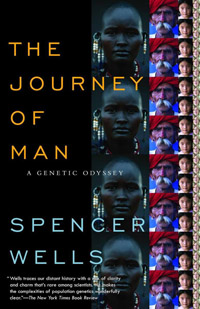
“The Journey of Man: A Genetic Odyssey” by Spencer Wells

the-journey-of-man

You are descended from a man who lived in Africa about 59,000 years ago. Do you find this hard to believe or accept? Well, that’s not all. Every other guy living on Planet Earth today is also descended from the same man! Man, wasn’t he a lucky man! The poor savage wouldn’t have imagined this level of success even in his wildest dreams!

How did the descendants of all the other ancients disappear into thin air? And if all of us have a common male ancestor then why do we all look so different? What accounts for our different colors and characteristics? Does race mean anything at all? How did the descendants of this super grandpa spread all over the planet? Where did they go first? How long did they remain in Africa?

This path-breaking book tries to answer all these questions. Earlier studies had revealed that all of us are descended from a single female ancestor (called Mitochondrial Eve) who lived about 150,000 years ago in Africa. Charles Darwin wrote in 1871, “It is therefore probable that Africa was formerly inhabited by extinct apes closely allied to the gorilla and chimpanzee, and as these two species are now man’s nearest allies, it seems somewhat more probable that our early progenitors lived on the African continent than elsewhere.” How right he was!

Today we know that apes lived in Africa some 23 million years ago. We went searching for the so-called ‘missing link’ and we found Homo Erectus, the first stand-up man. We wondered whether some of us are descended from the Neanderthals. We were puzzled about the Java Man, the Peking Man and so many others. It appears now that the Southern Ape is more likely to be our direct ancestor than any of these guys. The oldest genetic lineages are found in people living in eastern and southern Africa.

The sequencing of the human genome provided several answers and threw up just as many questions. Humans were in Australia 50,000-60,000 years ago. They are the only primates on the continent. This means they must have colonized the continent from elsewhere. The DNA trail leads to Africa. Homo erectus never made it to Australia, though they inhabited the island of Java. The aborigines of Australia have a lot in common with the Bushmen of southern Africa. How did homo sapiens travel to Australia so long ago? Did they make boats? Traces left by modern humans in Europe date back to a mere 40,000 years! And Europeans claim they ‘discovered’ Australia! Obviously 21st century humans need to unlearn much that they had learnt.

There is evidence to show that early moderns arrived in India from the south rather than the north. The Dravidian languages are completely unrelated to the Indo-European languages. And DNA markers seem to indicate that the Aryan invasion theory is not without substance.

As early as 1787, Thomas Jefferson wrote, “The resemblance between the Indians of America and the Eastern inhabitants of Asia would induce us to conjecture that the former are the descendants of the latter, or the latter of the former…” We know now that Jefferson had hit the nail on the head. It was across the Bering Strait that modern man came to the new World – and it took him only a thousand years to reach the southern tip of South America. Spencer Wells adds that, “Three-quarters of the large mammals in the Americas were driven to extinction around this time, among them mammoths and horses – the latter weren’t to reappear in the Americas until the Spaniards introduced them in the fifteenth century.”

Overall Assessment: A fascinating read. Biologists, anthropologists, geneticists, truth-seekers, DO READ!

The Journey of Man: A Genetic Odyssey
Author: Spencer Wells
Publisher: Random House
Date of Publication: 2003

Contributor: Pushpa Kurup lives in Trivandrum, India and works in the IT sector.
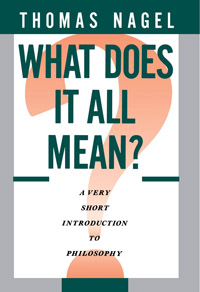
“What Does It all Mean?” by Thomas Nagel

what-does-it-all-mean

This brief book, which intends to provide a very short introduction to philosophy, ends with a chapter on The Meaning of Life and concludes with the sentence, “Life may be not only meaningless but absurd.” This will surely be off-putting to most people, who just cannot imagine the possibility that life as a whole, and their lives in particular, might not have a meaning. If so, why bother to live? What’s the point? A possible answer to this, according to Nagel, is, “There’s no point. It wouldn’t matter if I didn’t exist at all, or if I didn’t care about anything at all. But I do. That’s all there is to it.”

At the outset, I must say that this book is not for anyone who is religious and believes that all philosophical questions are answered by God, that God provides meaning to our lives, that we have souls that are immortal, that there is a heaven to which souls go to after they leave their physical bodies, that we are just instruments in God’s hands, that he is looking out for us, and that our lives have a higher purpose which comes from God. This kind of faith can provide an enormous amount of emotional support throughout life’s trials and tribulations, and people who have this faith are to be envied, but sadly, you cannot force yourself to believe in God any more than you can force yourself to like something you don’t.

Having recently lost someone very dear to me, I skipped to the chapter on Death. So much of what Nagel captures in this chapter resonated with me, especially the idea that there really is no reason to be afraid of death since we did not exist before we were born and will similarly cease to exist after we are dead. So why is non-existence scary? I had prided myself on having this brilliant insight long before I read this book, and while my “delusions of grandeur” have been deflated, I am gratified to see that this idea has also been recognized by others, as was evidenced in this book. Nagel, in particular, captures it very eloquently. Of course, he is talking about how people feel about their own death rather than how people feel about the death of their loved ones. Grief is a part of human make-up, and it would have been helpful to understand what philosophy has to say about it.

I did not find all the chapters as brilliant and compelling as Death and The Meaning of Life. For instance, there is a chapter on Free Will which sort of drags on, is very abstract, does not have any specific conclusion, and on the whole was not particularly insightful. Others in the same vein were the earlier chapters in the book on subjects such as knowledge and knowing, what words mean, and the connection between the body and the mind. On the other hand, the chapter on Free Will provides a good segway into discussing moral questions of Right and Wrong and Justice. If there’s so much in our lives that we cannot control (and some would argue that our sense of controlling anything whatsoever is a complete illusion), does it make sense to talk about morality and punish those who are “immoral”? It’s an ethical dilemma society as a whole has to deal with. There are no easy answers to any of these questions.

What Does It All Mean? is definitely a book that makes us think, and if we are open, to make us question the many assumptions we have about life in general, and our lives in particular.

What Does It All Mean? A Very Short Introduction to Philosophy
Author: Thomas Nagel
Publisher: Oxford University Press
Publication Date: 1987

Contributor: Lachmi Khemlani runs a technology publication in the San Francisco Bay Area.

“Empires of the Indus: The Story of a River” by Alice Albinia

empires-of-the-indus

This first book by a young author made me feel thoroughly ashamed of my ignorance of history. A splendid piece of meticulous research, it ought to be read by every Indian and Pakistani, not to mentions Afghans, Tibetans, and others. The author traces the path and history of the mighty Indus River in an altogether novel narrative, and portrays the lives and aspirations of the peoples who inhabited the lands surrounding it. The book is at once a delightful travelogue, and a superb historical narrative spanning thousands of years. It is serious, yet entertaining, cerebral but not incomprehensible.

Consider these snippets of information:

  1. Islam had a complex relationship with slavery. As in the Bible, slaves were an important part of the Quran’s social system. Mohammed himself sold the Jewish women of Medina into slavery – and the Quran, which has a rule for everything, scripted a strict code regarding their treatment. Slaves were not objects but human beings and they were to be considered a part of the family.
  2. The 10th century Baghdad Caliph had 7000 black eunuchs (and 4000 white ones).
  3. As Islam’s reach into Africa deepened, and the number of black slaves being exported to Arabia increased, so did Arab racism about Africans. Some historians trace this to the revolt by black slaves working in the mines and plantations of Mesopotamia in 883CE.
  4. Arabs imported/exported 2 million sub-Saharan slaves between 900 and 1100.
  5. When the first Muslim-Arab army arrived on the shores of Sind in 711CE, it arrived with plenty of African slaves.
  6. In 1240 Razia Sultan was deposed for having an affair with her Abyssinian (Ethiopian) slave minister Jamaluddin Yaqut, though Razia herself belonged to the ‘Slave Dynasty’ which was of Turkish origin.

All this has to do with slavery but that’s not what the book is about. There’s lots of information about many things, people and events. There are profound sentiments and an overall sense of pathos. The unstated is as powerful as the stated. Babur hunted rhinoceros in the jungles of northern Punjab. (Now the region has no more rhinos.) Ashoka’s edict at Kandahar was scripted in Aramaic and Greek. The land where the Golden Temple of Amritsar stands was donated by Emperor Akbar to the fourth Sikh Guru. (This is fiercely contested.)

Overall Assessment: If you have any intellectual pretensions, do read the book. If you have an interest in history, sociology and the environment, it’s a must-read. Flippant readers, keep away – this book is not for you!

Empires of the Indus: The Story of a River
Author: Alice Albinia
Publisher: John Murray (An Hatchette UK Company)
Date of Publication: 2008

Contributor: Pushpa Kurup lives in Trivandrum, India and works in the IT sector.

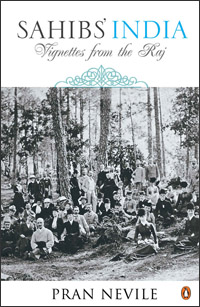
“Sahibs’ India: Vignettes from the Raj” by Pran Nevile

sahibs-india

This is a meticulously researched work, yet the author eschews boring details and tells us only what informs and entertains. “In the royal household of the Viceroy, Lord Lytton, there were 300 indoor servants, of whom a third were cooks.” My heart stops, my head spins, my hair stands on end! While we do know that the British in India lived in opulent splendor, the actual details and descriptions are revealing if not shocking. We are left wondering whether the kings and queens of England enjoyed such luxuries as the sahibs did.

The chapters have interesting titles, indicating the shape of things to come: Sex and the Sahib, Memsahibs and the Indian Marriage Bazar, When Sahib was Hooked to Hookah, Nautch Parties, Fun and Frolic in Simla, Shikar and Pig-Sticking, Sadhus, Sufis and Sanyasis, Banning of an Indian Erotic Epic, and so on. “David Ochterlony, the British resident in Delhi (1803) popularly known as ‘Loony Ahktar’, lived like a royal prince and used to take the air in the evening accompanied by his thirteen Indian bibis riding elephants.” Similarly, William Frazer who was the British commissioner in the 1830s maintained seven Indian wives and had several children, who were either Hindu or Muslim depending on the faith of their mothers.

We learn that “The cost of landing a European wife in Calcutta worked out to Rs.5000 – far beyond the means of ordinary company officials. On the other hand, according to Captain Williamson’s Guide book published in 1810, the expenses that had to be incurred on an Indian mistress worked out to Rs.40 per month.” We also learn than white-skinned girls from Eastern Europe and Japan were procured to staff the brothels of Bombay and Calcutta. Robert Clive in the 18th century described Calcutta as “one of the most wicked places in the Universe.” In 1828 there was a general strike by palanquin bearers in Calcutta. Interestingly, all of them were natives of Orissa. The rickshaw was introduced from Japan in the 1880s. The Kumbh Mela at Haridwar attracted pilgrims from China, Persia and Bokhara.

“All accounts emphasize the fact that Muslims celebrated their festivals just like the Hindus, with the same earnestness and ostentation and amused themselves with dance and song and other entertainments, including feast and sports,” the book informs us. Persian songs were as popular in India as Hindi songs until the end of the 19th century. “Tazah ba tazah, nu ba nu”, a ghazal by Hafiz (Shirazi) dominated the nautch scene for over a century. By the early 20th century, thanks to the fervor of the missionaries and the campaigns of the vigilantes, the nautch had fallen out of favour and the nautch girls had faded into oblivion.

The book has several amusing anecdotes. Here’s a sample: As the story goes, Nobel laureate C.V. Raman was once performing religious rituals with offerings of food to his ancestors in Gaya when someone said to him, ‘Sir, you are such a great scientist – how can you believe this food would reach your ancestors? Sir Raman smiled and replied, ‘I cannot prove that it will not reach them.’

The author, Pran Nevile, was born and educated in Lahore and served in the Indian Foreign Service and the United Nations. He has written several books on the British Raj, including Beyond the Veil: Indian Women in the Raj, Rare Glimpses of the Raj, and Nautch Girls of the Raj.

Overall Assessment: Worth reading

Sahibs’ India: Vignettes from the Raj
Author: Pran Nevile
Publisher: Penguin
Publication Date: November 2010

Contributor: Pushpa Kurup lives in Trivandrum, India and works in the IT sector.
“The Travels of Ibn Battuta” by Ibn Batuta (Abridged and Edited by Tim Mackintosh-Smith)

Travels of Ibn Battutah

“They told me that one of the Hindu infidels had died, that a fire had been kindled to burn him, and his wife would burn herself along with him.” Describing the practice of sati in 14th century Hindustan, Ibn Battuta observes that, “The burning of the wife after her husband’s death is regarded by them as a commendable act, but is not compulsory; but when a widow burns herself her family acquire a certain prestige by it…”

Abu Abdallah Ibn Battuta is undoubtedly the greatest traveller in world history. Born in Tangier, Morocco in 1304, he set out for Mecca and Medina at the age of 22 and returned home a quarter of a century later, having visited much of the old world from Hangzhou in China to Timbuktu in Mali, and traversed an estimated 75,000 miles between 1325 and 1354. On his return he wrote his epic travelogue wherein he mentioned more than 1500 persons by name. Ibn Battuta (that’s his family name) was a Sunni Muslim and a scholar of Islamic jurisprudence.

He described Al Iskandariya (Alexandria) in Egypt as one of the most beautiful places he has ever seen. “Among all the ports in the world I have seen none to equal it except the ports of Kawlam (Quilon) and Qalicut (Calicut) in India……..and the port of Zaitun (Quanzhou) in China.” [Alexandria is still beautiful, but Kollam and Calicut are ports no longer.] Ibn Battuta observed the famed lighthouse of Alexandria (Pharos), one of the wonders of the ancient world, on his outward journey and also on his return. When he saw it for the first time, only one face had been ruined but when he returned in 1349, it had virtually become inaccessible.

At Delhi, Sultan Muhammad bin Tugluq appointed him as Maliki Qadi and he spent six years there, referring to his benefactor as king of Al-Sind and Al-Hind. His description of the Qutub Minar and the metal pillar are revealing. There are some descriptions that would make painful reading for devout Hindus. “At the eastern gate of the mosque there are two enormous idols of brass, prostrate on the ground and held by stones, and everyone entering or leaving the mosque treads on them. The site was formerly occupied by a budkhanah, that is an idol temple, and was converted to a mosque on the conquest of the city.” (Delhi was sacked by Muhammad Ghori in 1192, Prithviraj Chauhan was defeated, and a few years later Qutbuddin Aibak established the Slave Dynasty.)

Of the holy man Shaikh Ala al-Din he wrote, “He preaches to the people every Friday and multitudes of them repent before him and shave their heads and fall into ecstasies of lamentation, and some of them faint.” Sounds familiar? These practices persist even today, but not necessarily in the Islamic world.

“No person eats with another out of the same dish,” Ibn Battuta noted. He also spoke of the Indian habit of eating betel leaves with areca nuts, sprinkling rose water and eating samosas. He recounted the common scenes in the capital, telling us a great deal about life in Delhi in the 14th century. “Every day there are brought to the audience hall hundreds of people chained, pinioned and fettered, and those who are for execution are executed, those for torture tortured, and those for beating beaten.” The shifting of the capital from Delhi to Daulatabd in the Deccan is recounted, probably with a little exaggeration.

Of the Syrian city of Aleppo he said, “The spirit feels in the environs of the city of Halab (Aleppo) an exhilaration, gladness and sprightliness which are not experienced elsewhere, and it is one of the cities which is worthy to be the seat of the Caliphate.” Well, if Ibn Battuta were to see the state of Aleppo today he would just sit down amidst the rubble and weep.

These teeny-weeny tales are just the tip of the iceberg. There’s lots more! Overall Assessment: Very, very interesting.

The Travels of Ibn Battuta
Author : Ibn Battuta (Abridged and Edited by Tim Mackintosh-Smith from the translation by Sir Hamilton Gibb and C F Beckingham)
Publisher: Picador
Date of Publication: December 2002

Contributor: Pushpa Kurup lives in Trivandrum, India and works in the IT sector.
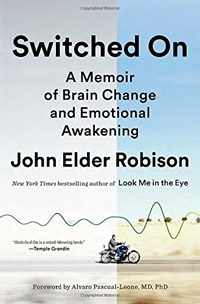
“Switched On: A Memoir of Brain Change and Emotional Awakening” by John Elder Robison

Switched On

How much of what we are, what we think and feel, and what we do is determined by the “wiring” of our brains? This question is at the heart of Switched On, a fascinating memoir of one man who was a participant in a TMS (transcranial magnetic stimulation) research study conducted at the Neurology Department of the Beth Israel Center, which is a teaching hospital of Harvard Medical School. TMS is a magnetic method used to stimulate small regions of the brain, allowing doctors to change brain activity without surgery or medication. It has been in research and development for over twenty years, which seems like a long time, but is actually quite short in the medical research field, which is why most of us have never even heard of it. I learnt of TMS during a Fresh Air broadcast featuring John Elder Robison, the author of Switched On, and the neurologist, Alvaro Pascual-Leone, who led the TMS study at Beth Israel and worked closely with Robison throughout the time he was receiving TMS. The main reason behind inviting Robison to be a participant in the study was that he has autism, and the researchers wanted to investigate whether a non-invasive technique like TMS could help in any way.

Much of the book is a methodically detailed log of the author’s day-to-day experience with the study, including how he met the researchers, how he was invited to participate, why he agreed, what he was hoping for, the buildup to every session, what happened at every session, and what were the effects that he experienced afterwards. He also shares details about his family, his work, his autism, and the impact that TMS had on different aspects of his life. These details, in and of themselves, are not especially riveting—after all, who wants to know about the mundane details of the day-to-day events in our lives?

What we do want to know, however, is—does it work? Does TMS change our brains and consequently, our emotions and our actions? And if so, are the effects temporary or long-term? And since Switched On is a first-person account of someone who has actually received TMS, we actually get to know the answers to some of these questions. Robison does a terrific job of describing both the short-term and long-terms effects that he experienced after each TMS session, including being much more open to people and experiences, the ability to “read” people a lot better and understand nuances which had earlier escaped him thanks to autism, and even the ability to be moved to tears by a sad story, even if it was just in the newspaper or told to him by someone he had just met. Fortunately, being so overcome with emotion that life becomes difficult was not a long-term effect of TMS. At the same time, having had the experience of empathy and connectedness—however short-lived—provided him with a “knowledge” of these emotions that is helping him to better understand “normal” (non-autistic) people on an ongoing basis.

Of course, Switched On is one person’s account of the effect of TMS, and it’s possible that other participants in the study experienced somewhat different reactions and effects. It would be good to know more, and I hope the TMS researchers can compile their findings not just into research papers for the academic community but also articles and books for the rest of us. It is fascinating to think that everything we think and do—including this thinking!—comes from our brain chemistry. Does this mean that at some point, we will be able to manipulate brains to create “designer thinkers,” similar to how we could potentially manipulate genes to create “designer babies?” Another interesting question, brought to the forefront by Switched On.

Switched On: A Memoir of Brain Change and Emotional Awakening
Author: John Elder Robison
Publisher: Spiegel & Grau
Publication Date: March 2016

Contributor: Lachmi Khemlani runs a technology publication in the San Francisco Bay Area.

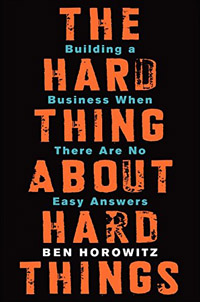
“The Hard Thing about Hard Things: Building a Business When There are No Easy Answers” by Ben Horowitz

The Hard Thing about Hard Things

This is a must-read book for entrepreneurs, especially those who have wandered the streets looking for venture capital, struggling to manage all aspects of a company while barely being able to make ends meet. The book talks about hiring, management cultures, and styles, lay-offs, selling the company, partnerships, and every possible aspect involving startups.

Most entrepreneurs, especially those who have struggled, should be able to relate to every line in this book. It is very much a “guy’s book written for guys.” The direct in-your-face style makes this book hilarious in parts.

This is the only book that I have ever purchased thrice – first on my Kindle and two hard copies – the second hard copy was intended as a gift for a friend/entrepreneur.

The author, Ben Horowitz, founded Opsware and is now a leading investor based in Silicon Valley.

The Hard Thing about Hard Thing: Building a Business When There are No Easy Answers
Author: Ben Horowitz
Publisher: Harper Business
Publication Date: March 2014

Contributor: Pran Kurup is an author and entrepreneur based in the San Francisco Bay Area.