“Small Great Things” by Jodi Picoult

small-great-things

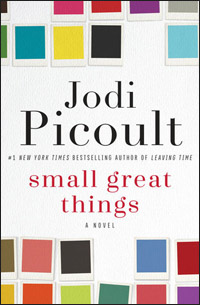
Jodi Picoult is a prolific novelist. She has written over 25 novels in a span of 24 years, many of which I have read. Her writing is not high literature by any means, the kind that would win prestigious awards, but her books are very entertaining, absorbing, and well-written, making her a highly successful writer whose books are extremely popular. She also typically touches upon some weighty issues in each of her novels, such as organ transplant (Change of Heart), a school shooting (Nineteen Minutes), religious belief (Keeping Faith), autism (House Rules), genetic engineering (My Sister’s Keeper, a riveting book that was also made into a movie), and many others.

In her new novel, Small Great Things, she takes on the hot-button issue of racism, which has emerged to the forefront in the U.S. in the last couple of years, with the shootings of black men, the Black Lives Matter movement, and of course, the 2016 Presidential election (which, at the time of writing this, is still 11 days away). The title of the novel comes from this quote by Dr. Martin Luther King, Jr.: “If I cannot do great things, I can do small things in a great way.” Almost all of Picoult’s novels revolve around a lengthy court case, where the issue at the heart of the novel is taken to court and ultimately settled—usually favorably—after the requisite back and forth between the prosecution and the defense, and Small Great Things is no different in this regard.

The story revolves around Ruth, a black woman (albeit lighter-skinned than the average African-American), who is a nurse in a the maternity ward of a hospital and has been doing this devotedly for 20 years—she is very good at her job and is widely respected as being the best there is. Her world turns upside down when a hate-filled white supremacist couple comes in to have a baby, and then after the baby is born, specifically ask that Ruth be taken off her nursing duties for their baby because she is black. The baby dies after a complication and Ruth was present in the room when the death happened, and before she knows it, she is slapped with a lawsuit by the parents accusing her of murdering their baby. If it seems preposterous, it really is, and I thought the weakest aspect of this book was in its premise—a white couple suing a black nurse for killing their baby. Really?

Once you get past this issue, however, the book is as well-crafted as any of Picoult’s other books. She has mastered the art of writing books with a certain style, and Great Small Things is no different. It is substantial, and comprises equally of internal dialog and external action. The story is told from the points of views of three different narrators—another quintessential Picoult approach. And as with her other books, a large part of this one takes place in court with witnesses, testimonies, cross-examinations, opening and closing statements, and other legal paraphernalia. There is also a twist at the end, which again usually happens in all Picoult’s novels. Thus, Small Great Things is quite formulaic, coming unmistakably from Picoult’s oeuvre. I would have known she had written it even if was published anonymously!

Where this book is different is that it does not just highlight racism—similar to how her other novels highlight different issues—but that it also digs a lot deeper and exposes the difference between overt racism—of the kind blatantly exhibited by white supremacists­—and implicit bias—which most white people have but are not aware of it. They take their place in the world for granted, the opportunities that they have, how they fit right into society, the common courtesies they receive, the professionalism they encounter in most places, and so on, without even being aware that it is different for black people, even if they are just like them in all other respects. The public defender who takes on Ruth’s case is a white woman, who would never think she was racist in any way; however, it is in the very act of not wanting to be racist, or not seeming to be racist, where the implicit bias comes in—the fact that you are conscious that the person is different so you need to behave in a certain way, be extra nice, or be extra polite. You would never feel like this if the person has the same skin color as you.

Picoult explains in an Afterword that she realized she had the same experience being a white woman and wanted to write about racism and bring this issue to the forefront. I think she has accomplished this very well. While the plot of the story in Small Great Things is far-fetched, the exploration of racism, both explicit and implicit, is very well done. In particular, the implicit bias will hit everyone hard because it applies to most people. To a certain extent, it is human nature to take your own privilege for granted, especially if it does not seem like one and most people around you are just like you. But it’s important to be reminded of it, as usually it is so subtle that we’re not even conscious about it. If not for anything else, Small Great Things should be read just for this.

Small Great Things
Author: Jodi Picoult
Publisher: Ballantine Books
Publication Date: October 2016

Contributor: Lachmi Khemlani runs a technology publication in the San Francisco Bay Area.
“Temporary Answers” by Jai Nimbkar

temporary-answers

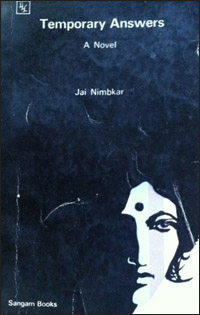
I came upon this book at a second-hand bookstore when I growing up in India, at a time when I pretty much devoured any kind of book that seemed remotely interesting. While most of the books I read during that phase were eminently forgettable, I really liked Temporary Answers and have held on to my copy of it all these years. Given that the book was originally priced at Rs. 4 and I bought it second-hand for Rs. 2, and that I have held on it all these years, and the fact that it is no longer even available—it seems like an unprecedented bargain! Family members and friends who read the book on my recommendation also really liked it, and I recently read it again to re-discover what was it about this unknown book by a relatively unknown author that had made me hold on to it and actually bring it with me to the US when I moved here from India.

Temporary Answers is very much an Indian story with Indian sensibilities written by an Indian author. It tells the story of Vineeta, a woman in her late twenties, who comes back to live with her parents after the sudden death of her husband, as per the custom at that time—the story is set in the 1960s, when women were not as financially and emotionally independent as they are now. Yet, Vineeta is far from a docile widow and soon breaks free from the claustrophobic confines of her childhood home to get her own place and start on a career as a pediatrician, for which she was trained but never practiced while she was married. The book charts her gradual independence as she navigates her way through tricky situations and complicated relationships. Her mother is a non-nonsense, working woman, but she tends to be somewhat autocratic and also very traditional in the sense that she cares deeply about what society thinks; her father is non-confrontational but also quite spineless; her younger sister is not just uncommunicative, but seems to actively dislike her; her U.S.-returned childhood male friend, who had a crush on her when they were kids, would now like to marry her, giving her an easy way out; and she is strongly attracted to an older man, a professor and playwright, and gets involved with him, but he has his own demons to deal with. Along the way, there are also lots of issues stemming from her fledgling pediatric practice and her work in a non-profit for poor kids.

None of these problems really go away or are neatly resolved; what changes is Vineeta’s gradual realization that there are no permanent answers to her existential crisis—she first has to come to terms with her own feelings of insecurity and “find herself” before she can find comfort and support through others.

What I really liked about Temporary Answers is how authentic it is. All the characters, including the protagonist, are flawed human beings, like we all are, so we can readily identify with them. Vineeta herself is far from a conventional heroine—she often says or does the wrong things and is propelled by her baser instincts, by feelings that are far from elevated. At the same time, she is very introspective and we get a chance to step inside her mind and witness the conflicting feelings she has about so many things, her ruminations on marriage and love, the difficulties of being a doctor including not just the helplessness but also the guilt for not always feeling the sympathy and empathy people expect doctors to have. Not only is this internal dialogue in the protagonist’s head so fascinating, Temporary Answers also has a lot of philosophical discussions between its characters about the meaning of life and death, which is something you don’t find that often in books. In essence, this is really a cerebral book, focused more on what the protagonist feels rather than on what she does.

Given that the book is set in India—in the city of Pune, or Poona as it was called then—in the 60s, I found it surprisingly contemporary, with Vineeta eventually living by herself and being visited often by the man she is in a relationship with, who often spends the night. And while she does not flaunt the relationship, she makes no attempt to hide it either, which would not have been easy in those conservative times. Also, while Temporary Answers is, by and large, a serious book, I did appreciate some occasional bits of tongue-in-cheek humor, usually as part of a conversation between characters. For instance, when Vineeta asks her mother—who all but manages the family and holds the reins of the household—if her husband (Vineeta’s father) had ever beat or mistreated her, her mother replied, “He wouldn’t have had the nerve.” In the book, Vineeta burst out laughing, and when I read that, so did I.

Temporary Answers
Author: Jai Nimbkar
Publisher: Sangam Books (A Division of Orient Longman Ltd)
Publication Date: 1974

Contributor: Lachmi Khemlani runs a technology publication in the San Francisco Bay Area.

“So Long a Letter” by Mariama Bâ

so-long-a-letter

This book by a Senegalese woman writer in French was widely acclaimed and translated into several languages. The English translation was published in 1981, the same year the author died following a tragic illness.

“To warp a soul is as much a sacrilege as murder.” The status of women in polygamous social structures is gracefully outlined in this teeny weeny semi-autobiographical novel that appears in the form of a long letter from a woman to her friend. Sensitive, without being sentimental, it recounts the tragic story of a woman’s life in the simplest of ways. As a woman born into a patriarchal conservative Islamic society with all its inherent contradictions, Ramatoulaye remains stoic through multiple childbirths, watches helplessly as her husband takes a younger second wife, and later battles the emotional storms of widowhood.

“My voice has known thirty years of silence, thirty years of harassment,” the epistle states in a matter-of-fact tone. “It bursts out, violent, sometimes sarcastic, sometimes contemptuous.” When her husband’s much-married brother proposes to wed her in accordance with the prevailing custom, Ramtoulaye reacts, “Did you ever have any affection for your brother? Already you want to build a new home for yourself, over a body that is still warm. While we are praying for Modou, you are thinking of future wedding festivities.” Not content with this admonition she goes on to question the social order with its unfair tradition of unearned male privilege: “What of your wives, Tamsir? Your income can meet neither their needs nor those of your numerous children. To help you out with your financial obligations, one of your wives dyes, another sells fruit, the third untiringly turns the handle of your sewing machine.”

When Daouda, a former suitor, now a distinguished member of the National Assembly, turns up at the funeral, Ramatoulaye brings up the subject of women’s representation in the august house. “Four women, Daouda, four out of a hundred deputies! What a ridiculous ratio! Not even one for each province.” Daouda’s response is as meaningful as it is amusing. “But you women, you are like mortar shells. You demolish. You destroy. Imagine a large number of women in the Assembly. Why, everything would explode, go up in flames.”

The oppressed woman’s yearning for freedom is subtly and powerfully expressed in crystal clear language: “Daouda Dieng was savouring the warmth of the inner dream he was spinning around me. As for me, I was bolting like a horse that has long been tethered and is now free and reveling in space.” Ramatoulaye’s letter delivered by a messenger to Daouda and his reply are both heart-breaking.

The novel is entertaining, thought-provoking and soul-stirring. It undoubtedly has feminist overtones as it highlights the imbalance between the sexes and the helplessness of women. Every woman will love it.

The translator, Modupe Bode-Thomas, deserves commendation for the professional touch that makes the book so very special.

Overall Assessment: Well worth a read –especially if you are a Muslim woman.

So Long a Letter
AUTHOR: Mariama Bâ
DATE OF PUBLICATION: French original in 1979, English translation in 1981.
PUBLISHER: Waveland Press

Contributor: Pushpa Kurup lives in Trivandrum, India and works in the IT sector.

“The Razor’s Edge” by W. Somerset Maugham

the-razors-edge

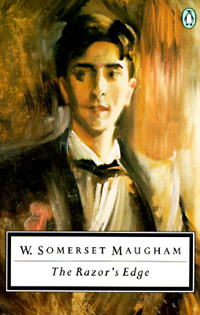
Somerset Maugham has always been one of my most favorite authors. Growing up in India at a time when the British influence was still very strong, most of the books written in English were by British authors and they seemed very much a part of our culture. We grew up on adventure stories by Enid Blyton, murder mysteries by Agatha Christie, Victorian-era romances by Jane Austen and Charlotte Bronte, classics by Charles Dickens, and turn-of-the-century stories by Somerset Maugham. In fact, I still have my original copies of most of these books, and every once in a while, I go back and re-read them to find out if I still like them as much as I did before. One such book I just finished re-reading is The Razor’s Edge by Somerset Maugham. While this is not his most famous novel, it remains one of my enduring favorites, and re-reading it brought into sharper focus why I had liked it so much in the first place.

The Razor’s Edge is primarily the story of a young man, Larry, and his spiritual quest to find the meaning of life after his friend, a fellow fighter pilot, dies before his eyes during a flight mission they are on that goes awry during World War 1. Unlike his friends, and to the dismay of his socialite fiancée and her family, Larry does not want to settle down and work and lead a normal life after his return from the war. Instead, he wants to “loaf” – which, in his case, really means traveling around the world, working odd jobs, getting varied experiences, and reading extensively, often for over 10 hours at a stretch, all in an effort to understand life and make sense of what had happened to him. What made The Razor’s Edge especially appealing to those of us in India was that Larry’s quest ultimately drew him to India and that he found the answers to what he was looking for in an ashram there under the guidance of a guru. In fact, the name of the book comes from a verse in the Katha Upanishad which says “The sharp edge of a razor is difficult to pass over; thus the wise say the path to Salvation is hard.” For those of us who were not just looking at The Razor’s Edge as a work of fiction, the fact that Larry’s spiritual awakening came from the Vedantic philosophy of Hinduism was both an affirmation of it and gratification that it was being recognized and given voice to by one of the foremost novelists of that time.

Of course, the book is not just the story of Larry. Brilliantly woven in are other characters including Isabel, Larry’s childhood friend and fiancée, who ultimately could not give up her society life and join him in the alternate (simple but “rich in spirit”) life he had to offer: Gray, his best friend who ultimately ends up marrying Isabel; Sophie, another childhood friend, who, after a horrific tragedy of her own, becomes an alcoholic and nymphomaniac and finally cannot even be redeemed by Larry, despite his best efforts; Elliot, Isabel’s rich uncle who is a strong influence in her life; and finally, Maugham himself, Elliot’s friend who unwittingly becomes everyone’s confidant and is the narrator of the story.

What I like most about The Razor’s Edge, and all of Maugham’s books – even today – is how simple the telling of the story is and how it is riveting inspite of it. There are no literary gimmicks here, no examples of “stylistic” writing that critics could pick out and hold it up before us to justify what a great writer Maugham was. Instead, the focus is completely on the story, and the language is used entirely at the service of telling it. In short, the story is so brilliant that the writing is almost invisible!

The characters are also artfully captured, with all the foibles that make us human. In fact, I would say that in retrospect, the only trouble with The Razor’s Edge is that Larry seems to be too good to be true – he is portrayed with a little too much saintliness. (Also, some of the miracles he could perform after his return from India seemed to be playing to the stereotype and could have been avoided.)

Maugham died in 1965, and I really miss his books. They don’t write like this anymore.

The Razor’s Edge
Author: W. Somerset Maugham
Publisher: William Heinemann (Parent company: Penguin Random House)
Publication Date: 1944

Contributor: Lachmi Khemlani runs a technology publication in the San Francisco Bay Area.
“Harry Potter and the Cursed Child” — Play by J. K. Rowling, Jack Thorne, and John Tiffany

Harry Potter and the Cursed Child

I love the Harry Potter books and have them all—each of the seven books in the series. I discovered them in 2000 after the first three had already been published and was so hooked that I recall pre-ordering each of the subsequent books prior to its release and devouring it right away after it was delivered—which was typically the day before it was officially released. And while I was thrilled when my kids also started to read and love the books as they grew older, I made it clear that the books were mine. In time, after frequent re-reading by my kids, whenever one of my Harry Potter books started to wear down, I would order another copy— hardcover, of course—so I would still have the complete set in near-pristine condition. In fact, I was so possessive about the books that I used to discourage my kids from lending my cherished copies to their friends, and even bought extra (paperback) copies just for this purpose!

Given my love for the books and the magical world that J.K. Rowling has so brilliantly created—so rich, so vivid, so detailed, and so much fun—I was really disappointed when the series concluded in 2007 with the publication of the seventh book, Harry Potter and the Deathly Hallows. But I could appreciate why. After all, J.K. Rowling could not continue the series endlessly—not only was she so rich and famous that she didn’t need to write any more, but to what extent can you drag a story on and on? Also, one of the charms of the Harry Potter books was that you knew they would come to an end after Harry defeats Voldemort and is finished with school. It was a good, satisfying conclusion to the saga of “the boy who lived.”

Thus, when I heard of Harry Potter and the Cursed Child, it seemed intriguing, even though it was in the form of a script for a play and was not actually written by J.K. Rowling herself, but rather by a playwright based on a story by her, supposedly the eighth in the series. While the play itself debuted last month in London and seems to be doing very well, the book itself has received mixed reviews from Harry Potter fans. Thus, I bought it with some trepidation, not wanting to cast a shadow on my experience of the original series and ruin my love for it.

It turned out that I needn’t have worried. I really enjoyed the book and finished it in one sitting. Even though the plot is set several years after the first seven books—Harry is now middle aged with three kids, all of whom are in the same Hogwarts School that he attended—the book keeps transporting you to many of the same events that happened in those years through the clever use of a time traveling device, the Time Turner, that plays such a key role in the third book, Harry Potter and the Prisoner of Azkaban. While the protagonist of the book is now Harry’s middle son, Albus, who could be the “cursed child” of the book title, the book brings back all the characters who had key roles in the earlier books, including Hermoine, Ron, Malfoy, Snape, and even Dumbledore. In an unexpected but heart-warming twist, Albus’s best friend at Hogwarts is now Scorpius, the son of Draco Malfoy, who was Harry’s archenemy throughout his own time as a student at Hogwarts. And there are many hilarious situations caused by the ripple effects of going back in time and changing certain events, including one where Ron is married to Padma (a Hogwarts student who made a very brief appearance in the earlier books) and has a son called “Panju.” As an Indian, I’m still laughing at that one!

That said, I wish the story was in the more conventional form of a book than a script for a play, which, by its very nature, is forced to be somewhat choppy. I really liked the plot of this eighth story in the series and felt it would have been so much more substantial and enjoyable as a book. I have no interest in seeing the play just as I had little interest in the movies­—although, admittedly, they did a good job of capturing the “magic” of Harry Potter’s world. Of course, the books have spawned a huge and very successful franchise with the movies, theme parks, and merchandise, and it’s a wonder to me that J.K. Rowling is even motivated to continue the series at all. I’m thankful, however, that the creative genius in her continues to create, bringing joy to the millions of Harry Potter aficionados that are out there, including adults like me who may otherwise be somewhat jaded by the “realities” of life.

Such is the power of the world of Harry Potter created by J.K. Rowling that I was fighting with my daughter about who got to read Harry Potter and the Cursed Child first. I prevailed, of course, but only because of my childish and rather pathetic excuse that I had paid for the book and so I should get to read it first. When does this ever happen?

Harry Potter and the Cursed Child
Play written by Jack Thorne, based on an original new story by J.K. Rowling, Jack Thorne and John Tiffany.
Publisher: Little Brown UK
Publication Date: July 2016

Contributor: Lachmi Khemlani runs a technology publication in the San Francisco Bay Area.

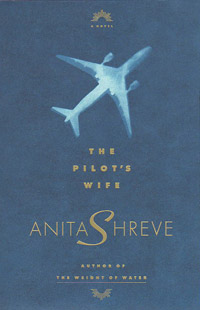
“The Pilot’s Wife” by Anita Shreve

The Pilot's Wife

I first read Anita Shreve’s popular novel, The Pilot’s Wife, shortly after it was published in 1998. While the book was no means a literary sensation or even highly acclaimed by critics, it did gain wide readership by virtue of being chosen as an “Oprah’s Book Club” selection for March 1999. (While this club does not exist anymore, it was quite an honor to be selected, in addition to dramatically boosting sales.) At the time I read The Pilot’s Wife, I also read quite a few other books by Anita Shreve that I recall enjoying, especially her most well-known book, The Weight of Water.  That said, I would not have sought out Anita Shreve to read again, except for a recent first visit to Maine, where its unique geography of multiple islands dotting the coastline reminded me of a fascinating historical fiction set in these islands that I had read a long time ago, and which I wanted to re-read now that I had actually been there. While I couldn’t remember exactly what that book was, I thought it might be an Anita Shreve novel, given that many of her books were set in Maine and along the coast.

Well, as it turned out, it wasn’t – I borrowed several possible Anita Shreve books from the library and needed only a quick perusal to determine that none of them was the one I was looking for. I did not even find myself wanting to re-read them now, even though it had been over 15 years since I had first read them — except for The Pilot’s Wife. I started reading it, and found the plot even more compelling now than when I read it all those years ago. Kathryn, whose husband, Jack, is a pilot for a commercial airliner has just been informed that her husband has died in a plane crash. As the book unfolds, the details begin to emerge – that the crash was caused by an explosion, which in turn was caused by a bomb, and that it may have been Jack himself who took the bomb on board, making him responsible not only for his own death but that of the other crew members and over a hundred passengers that were on board. This notion of “suicide-bombing” is one that we are, unfortunately, all too familiar with now, which makes the book seem eerily timely, even though it was written over 15 years ago. As always, there is some political unrest underlying these tragedies, and while the one in The Pilot’s Wife had to do with Ireland and the IRA, it is not all that different from the political turmoil and terrorism threats we constantly live with today.

Apart from this analogy that makes the book even more relatable now, The Pilot’s Wife primarily revolves around Kathryn and how she copes with not only the death of her husband and the revelation that he may be a suicide-bomber, but also with the fact that there was a side to him about which she knew nothing– that he had a whole other family, including wife and kids, in another country and that he was able to do this without giving her the faintest hint or suspicion that something might be wrong. The suspense is well built up, and the book is a compelling page-turner, keeping you hooked right up the end. Along the way, there are some touching moments highlighting the relationship Kathryn has with her teenage daughter, who is at the height of her turbulent and rebellious years. There is also the customary romance — but with just an inkling of it given the story-line — of Kathryn with the man from the pilot’s union, Robert, who brings her the news of Jack’s plane crash and guides her through its aftermath, including the frenzied publicity, media coverage, and crash investigation.

While I found The Pilot’s Wife a good read even the second time around – and an easy one – the ending was so abrupt that I was sure that there were some pages missing in the library copy of the book that I had. I spent a lot of time searching online for a free electronic copy of the book, but I couldn’t find one (which, by the way, is a testament to how popular the book is even now – its pricing is still the same, even after so many years of being published). Finally, I went to the local library of the place I was on vacation at and found a copy of the book – and discovered, much to my chagrin, that the ending of the book was exactly the same as the one in the copy that I had.

In conclusion, The Pilot’s Wife was a nice, easy, and interesting read, but with an ending that didn’t seem like an ending at all!

The Pilot’s Wife
Author: Anita Shreve
Publisher: Little, Brown
Publication date: May 1998

Contributor: Lachmi Khemlani runs a technology publication in the San Francisco Bay Area.
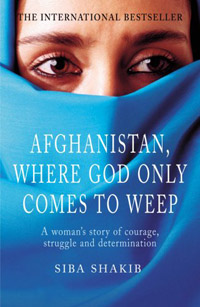
“Afghanistan, Where God Only Comes to Weep” by Siba Shakib

Afghanistan, Where God Only Comes to Weep

This book by an Iran-born author and documentary film-maker paints a grim picture of life in Afghanistan. The Russian invasion. The haphazard resistance. The growth of the Taliban. Violence, oppression, opium addiction and human helplessness are woven into the fine threads of this fascinating story. The characters are powerful and convincing. It is a sordid tale of suffering and endurance, hope and determination.

Shirin-Gol, the lead female character, is a woman of substance. Though unleterred, she taught herself to read ‘three and a half books.’ The plight of women in this war-ravaged country is deeply disturbing. Where girls cannot study, where women cannot work, where the veil is all-pervading, an Afghanistan that god and the world forgot. The reader feels a numbing pain that is beyond tears. Shock, disbelief, sorrow, and a train of inexplicable emotions.

The author has an uncanny knack of saying so much using so few words. “In all likelihood Shirin-Gol’s mother, like all mothers in the world, suffered terrible pains at the birth of her fourth daughter, her ninth child, and in all likelihood she wondered at that moment how she would feed another child with her already weakened body and her empty breasts. And she was probably glad when she pulled the child from her body and saw that it was only a girl, because if Shirin-Gol had been a boy, that boy would have needed even more milk, even more attention. His mother would have had to carry him more often in her arms, they would have had to give a party to celebrate his birth and slaughter a sheep, rustle up some money for his circumcision and send him to the mullah to learn the Koran.”

The cycle of poverty, repression and hopelessness is self-perpetuating — it moves across generations with a cold tenacity. Shirin-Gol goes through multiple deprivations in childhood, is married at a young age, has several children, and lives life at a sub-human subsistence level, yet her spirit soars high above the mundane level. She stands out without being spectacular, and her never-say-die attitude inspires respect.

The book informs, educates, enlightens. It also entertains and tugs at your heart-strings. Amidst the pathos, there is a dark humour. Don’t miss any page, not even the acknowledgments, gracefully titled, ‘Thanks’. There are gems even there. “I thank Malalai and her brother who saved my life. I thank Rahmat, who protected me from stepping on a mine.”

Overall Assessment: Mind-blowing. Siba Shakib is undoubtedly a writer of substance. BTW, ‘Samira and Samir’ is another interesting book.

Afghanistan, Where God Only Comes to Weep
AUTHOR: Siba Shakib
PUBLISHER: CENTURY
Date of Publication: 2002

Contributor: Pushpa Kurup lives in Trivandrum, India and works in the IT sector.

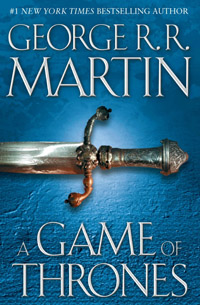
“A Game of Thrones (A Song of Ice and Fire, Book 1)” by George R. R. Martin

A Game of Thrones

As time progresses, and the literary cannon grows and grows, every new writer born in some ways gets the short end of the stick. Why? Because so many ideas have been taken, some so worn out that they get labeled as “tropes” or “clichés.” Thus, modern writers often have the burden of having to find something original in a world in which so many things have been done before. Some make entire careers out of finding ways of subverting tropes, being antithetical, and therefore exciting. This is certainly the case with George R. R. Martin’s epic fantasy series, A Song of Ice and Fire. Martin takes the well-worn genre that grew out of the Middle Ages and peaked with Tolkien, and turns it on its head, making for a thrilling read.

One of the unwritten rules of fantasy, at last before Martin came along, was that the hero prevails. He beats the odds. It can be tough, but he makes it out alright in the end. Perhaps he experiences loss, the death of a sidekick or a horse or a friend, but he does not perish. This is not so in A Game of Thrones. Here, much like in real life, no one is safe. In that sense, this high fantasy novel reads a lot more like the turbulence of reality than many other, less inventive books. The novel ends with the beheading of a character who is set up, in every preceding page, as the hero. Martin impresses upon his reader that everyone has flaws, even the hero, and he does not get any special treatment in the randomness of fate.

A Game of Thrones further subverts the fantasy genre with its treatment of characters. The book refuses to vilify or venerate any one character. Instead, Martin allows you to understand the motivations of each character in turn, so that even if you don’t agree with their actions, you cannot blatantly hate them. By the end of the novel, the reader is left sympathizing with a man who closes the first chapter by pushing a seven-year-old boy out of a window. Only someone as adept as Martin can paint two sides of a person that well.

Finally, the novel’s female characters serve as a potent way to subvert traditional fantasy tropes. In most high fantasy, the women do not have their own agendas. They are tools, playthings, and trophies for the men who ride horses and fight wars and move them conveniently around the chess board of their own lives. This is not so in Martin’s book. While the novel is set in medieval times and thus realistically portrays appropriate historical subjugation of women, Martin balances this with determined female characters who not only have goals, but also the ruthless will to make those goals a reality. Like all his male characters, these women are nuanced, not just good or bad. One of the most popular characters in the sprawling cast is the young Daenerys Targaryan, who, sold into marriage by the brother, becomes empowered to gather an army in preparation to reconquer the Seven Kingdoms, which she views as her birthright. Another, incredibly three-dimensional character is Cersei Lannister, who, as wife of the king, is unhappy with her secondary status in the kingdom, and whose thirst for power and militant protection of her children often paint her hands red with blood. We are horrified by her, but we reluctantly admire her, and in hard times, we sympathize with her.

The book is split into differing perspectives, mostly of the main, clashing families of Stark and Lannister. It is also long, perhaps longer than it needs to be, but the world it builds is so colorful and riveting that you probably won’t find yourself complaining. Martin will not coddle his reader, which makes the book somewhat of a rollercoaster, with nail-biting climaxes and brutal deaths, but in the end, entirely worth it. Make sure the sequel is close at hand!

A Game of Thrones (A Song of Ice and Fire, Book 1)
Author: George R. R. Martin
Publisher: Bantam Books
Publication Date: August 1996

Reviewer: Sarisha Kurup is a senior at The Harker School in San Jose, CA.


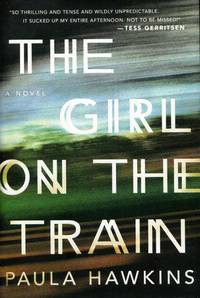
“The Girl on the Train” by Paula Hawkins

The Girl on the Train

The Girl on the Train has had one of longest runs as a New York Times bestseller. Released last year, it topped the list for 16 weeks in 2015, has been on it for 78 weeks so far, and is still on the list at #6. That is a remarkable achievement for any book, let alone a debut novel. It literally came out of nowhere and became an instant success, drawing comparisons with the 2014 crime thriller, Gone Girl, which was also a runaway hit. However, unlike Gone Girl, whose author, Gillian Flynn had published books before which you could read to get a better idea of her earlier work and her path to literary success, the author, Paula Hawkins, of The Girl on the Train was a totally unknown entity in the publishing world, so you can’t go back to read any of her other books, as most of us would do for authors whose books we love. And while I don’t always find New York Times bestsellers terrific reads (such as the book, The Girls, that I wrote about recently), The Girl on the Train was one book that I unequivocally loved.

Set in London in contemporary times, The Girl on the Train is a psychological thriller and murder mystery rolled in one. The mystery at its core is the disappearance of a woman, and the story is told entirely in the form of the narrations of three different characters: Rachel, the main protagonist, who is “the girl on the train” who sees something suspicious related to the missing woman from the train one morning, and whose life, by the way, is falling apart, making her a very unreliable witness; Anna, Rachel’s ex-husband’s current wife, thanks to whom Rachel’s psychological problems and drunkenness are compounded; and finally, Megan, the woman who goes missing. We learn how their lives intersect early on in the book, but not the whole truth. Unlike books like Gone Girl in which a large part of the narration was deliberately misleading to throw readers off the track, the “twist” in The Girl on the Train comes not from an unreliable narration, but from holding something back instead and not divulging the whole truth. The book keeps you on tenterhooks throughout and rather than feeling cheated at the end, it has a very satisfying conclusion that does not make you feel stupid for not having “guessed” the mystery.

Crime thrillers are generally not known for their writing quality, but I found The Girl on the Train not only very clever but also extremely well written. Not only was it thrilling and entertaining the first time I read it last year, I re-read it again recently and I found it just as engaging as the first time—impossible to put down, and having finished it, needing to read it again right away to better understand the clues leading to the resolution of the mystery. For me, the impetus to read it again came from hearing that it was being made into a movie. While I think that The Girl on the Train has an excellent plot and would make for a terrific movie, there is a certain enjoyment of a good book that comes from your own images of the characters before they are overwritten by the images of the actors playing those parts in a movie, and I wanted to experience this again before the movie comes out.

In conclusion, I would say that The Girl on the Train is a terrific book that deserves every bit of its success, and I find it very gratifying that books like this even find a place in—let alone rule—the New York Times bestseller list, where you typically find more “serious” literary fare. The only question now is whether Paula Hawkins will be a one-book wonder, or we will continue to see more from this prodigiously talented author? While it would be hard to match the success of The Girl on the Train, I, for one, am eagerly awaiting her next book.

The Girl on the Train
Author: Paula Hawkins
Publisher: Penguin Group
Publication Date: January 2015

Reviewer: Lachmi Khemlani runs a technology publication in the San Francisco Bay Area.
“Seating Arrangements” by Maggie Shipstead

Seating Arrangements

In a country where the wealth gap becomes more and more apparent every day, where the American Dream seems more and more a thing of the past, Maggie Shipstead invites her readers to take a look at the crumbling aristocracy of New England. Her characters seem like Fitzgerald-era castaways, with their biggest concerns being about premiere colleges and entry into exclusive social clubs and maintaining rather antiquated notions of propriety. And in some ways, Shipstead has written the Gatsby for the modern day, a novel that draws the reader in with its sense of escapism, allowing them to inhabit the life of the ridiculously wealthy for a time, but ultimately closes with a powerful refutation to the idealism with which we treat the life of the rich. No one ends up floating dead in a pool with a bullet in their side, but Shipstead infuses in her story an understated permutation of gloom that is equally powerful.

The story has a simply premise—two families descends on a coastal New England island to witness the marriage of Daphne Van Meter to Greyson Duff. The Van Meters make up most of the main characters, with the focus on Winn, the patriarch, and his younger daughter Livia. The strength of Shipstead’s work has always come from her ability to understand and bring to life on the page so many different kinds of people, and this talent is expertly displayed as she allows her readers into the minds of her diverse cast of characters. She breaks this novel into sections, with each section inhabiting the mind of a different person than the last, although Winn and Livia are the most represented. She jumps expertly from the self-absorbed Winn, who is livid about not getting into a local club while also thirsting after one of his daughter’s bridesmaid’s, to Livia, who is struggling with a breakup and recent abortion while attempting to support her pregnant sister through her wedding weekend, to Biddy, Winn’s dejected and lonesome wife, to Mopsy, the aging Duff grandmother, to Sam Snead, the hyper-active wedding planner.

The reader gets to see the difference between generations—Winn seems more obsessed with the way he is perceived than his daughters, more obsessed with his own wealth and legacy—providing for a fascinating meditation on the way that the changing social dynamic in America has affected the people raised here. Furthermore, the most gratifying part of the novel is that Shipstead does not attempt to make any one character particularly likable. Instead she lays them all bare, their flaws apparent, and asks the reader to begrudgingly love them due to their humanity, their inescapable flaws. This forces the reader to understand that there is no good way to have wealth in America, no way to wear it well without being selfish or obsessed. In creating no apparent hero or winner, Shipstead provides a grippingly real portrayal of a dying aristocracy.

All of this is filled in with beautiful details and thoughtful symbolism. The world of Seating Arrangements is a vivid one, down to the colors of the character’s coats and flavors of their wine. It’s not hard to get lost in a story this rich.

Seating Arrangements
Author: Maggie Shipstead
Publisher: Knopf
Publication Date: June 2012

Reviewer: Sarisha Kurup is a senior at The Harker School in San Jose, CA.

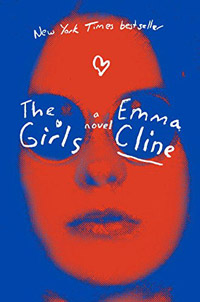
“The Girls” by Emma Cline

The Girls

This debut novel by Emma Cline is the latest “kid” on the bestseller “block.” In what seems to be a phenomenally short span of time, it seems to be everywhere—on the radio and in magazines—and has even made it to the New York Times Bestseller list, where it is currently ranked as #3 in the “Hardcover Fiction” category and #5 in the “Combined Print & E-Book Fiction” category. Does the actual book live up to this sudden fame and hype? Fortunately, I got a chance to find out without having to wait too long and without having to buy the book—a copy was on display in the “New Books” section at my local library and I snatched it up right away to check out.

The Girls tells the story of a teenage girl, Evie Boyd, in the late 60s and how she gets into a cult led by a man, Russell, whose hippie-like, counter-culture, “let’s be free” philosophy seems like a magnet, attracting followers—mostly young and female—who will do anything for him. It is very much like the infamous cult that Charles Manson had in California in the 60s which ended in a series of murders committed by him and his followers, as a result of which he is now serving life in prison. Russell’s cult in The Girls also ends just as badly, with his followers committing four ghastly murders and eventually meeting the same fate. Evie herself was not part of the group that carried out the murders (but only by chance), so she emerges from her experience with the cult physically unscathed but mentally scarred for life. Also, in her case, it was not Russell’s magnetism that drew her to the cult but that of one of Russell’s key female followers, Suzanne, whom she is strongly attracted to.

Despite the lesbian undertone, The Girls however, is far from being a love story, gay or otherwise. Instead, it is an exploration of the mental make-up of someone who can be seduced into giving up everything—home, family, friends, ambitions, creature comforts, in short, a normal life—to go live in a commune where everything is shared, including space (mostly cramped), clothes (mostly bedraggled), food (always scarce, and frequently needing to be scavenged or stolen), chores (cooking, cleaning, farming, etc.), parenting (with no birth control, free sex, and so many girls, there are naturally many pregnancies), and pretty much any other aspect of life. If it sounds awful, it really is, and Cline does a good job of illuminating how someone can be lured to such a life, particularly someone as young and impressionable as Evie. Of course, the fact that she comes from a dysfunctional family with her parents getting divorced seems almost a given—would anyone from a normal, happy family be so susceptible to being brainwashed and exploited?

While I greatly admired the book—it was very well written and especially remarkable coming from someone so young (as the photo of Emma Cline on the jacket cover and her brief bio seem to suggest)—I have to say that I did not find it particularly enjoyable or entertaining. It wasn’t a book I “couldn’t put down,” and it was my curiosity about why it was such a hit that compelled me to stick with it till the end rather than give up on it sooner. Of course, books that are entertaining often do not have a highly evolved writing style and are universally panned by critics, and The Girls seemed more of the reverse kind of book—one which would greatly appeal to critics but not that much to readers.

Books that are beautifully written and impossible to put down are a rarity, but they do exist—unfortunately, I did not find The Girls to be one of them.

The Girls
Author: Emma Cline
Publisher: Random House
Publication Date: June 2016

Reviewer: Lachmi Khemlani runs a technology publication in the San Francisco Bay Area.
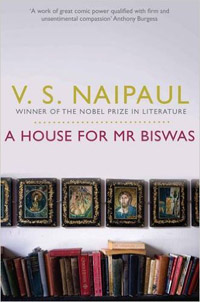
“A House for Mr. Biswas” by V S Naipaul

A House for Mr Biswas

This is a rather ancient book by 21st century standards, penned in the late fifties and published in 1961, by Trinidad born, Indian origin, Oxford educated, UK citizen, Vidiadhar Surajprasad Naipaul. Then why read it at all? Well, for one thing, this guy is no ordinary writer. All his life he did nothing but write, write and write. Many of his books are extraordinary. He won the Booker prize in 1971 and the Nobel Prize for Literature in 2001. He was knighted in 1990.

This book is a magnum opus spanning over 600 pages. The master storyteller brings to life each of the characters and locations in such explicit detail that everything becomes familiar to the reader as if the persons and places were all in his own backyard. Those who love fast paced action thrillers, murders and mysteries may not be fascinated by this one. It is a down to earth account of the daily lives of down to earth people, sons and daughters of a little British colony where many mixed races live together in harsh if not pathetic circumstances. The author manages to paint a perfect portrait without exaggeration or unnecessary recourse to sentiment. The reader is often left wondering whether to feel sorry for the central character or laugh at him.

The humour is typical of an English gentleman – subtle, tongue-in-cheek and greatly amusing. Take this for instance: “The house was alive but subdued when he got back. He found four children on his bed. They were not his. Thereafter he occupied his room early in the evening, bolted the door and refused to answer knocks, calls, scratches and cries.”

Naipaul offers some friendly advice for aspiring journalists: “Even people with outstanding writing ability say they cannot find subjects. But in reality nothing is easier. You are sitting at your desk. You look through your window. But wait. There is an article in that window. The various types of window, the history of the window, windows famous in history, houses without windows. And the story of glass itself can be fascinating. Already, then, you have subjects for two articles.”

Every now and then Naipaul makes a dig at Hindu rituals but the implied criticism is not unfounded. Nearly one fourth of the population of this tiny nation is Hindu (even half a century after Naipaul wrote the book.) They went to the colony as indentured labourers in the mid 19th century and their descendants have remained there ever since. Having little or no contact with India, they are left to practice Hinduism in their own unique ways. The author notes every religious ritual with amusement. Consider this: “In his thin voice, Hari whined out the prayers. Whining, he sprinkled water into the hole with a mango leaf and dropped a penny and some other things wrapped in another mango leaf.”

Naipaul does not hesitate to make cheeky remarks about well-know personalities, particularly Indians. And of course, he makes his characters do all the talking. Here’s an example: “Scathing was one of his favourite words and the person he had handled most scathingly was Krishna Menon.” Naipaul must have had a well-developed sixth sense or perhaps he bumped into Menon in London. This was before China invaded India and inflicted a humiliating defeat and Menon as Defence Minister drew a lot of flak.

How Trinidad-born Indians perceive India-born Indians is interesting too. “Owad disliked all Indians from India,” the author observes. “They were a disgrace to Trinidad Indians; they were arrogant, sly and lecherous; they pronounced English in a peculiar way…..” He goes on and on, making the reader double up with laughter (or red with indignation if his national pride is invoked). Incidentally the book is replete with umpteen examples of Trinidadian English which could give Indian English a run for its money. It is also peppered with politically incorrect words like ‘negro’ but we need to concede that in those days nobody called the blacks ‘blacks’ – and Naipaul was perhaps using common parlance.

If you have an interest in the Indian diaspora, do read this book. It takes patience, but it’s worth the effort.

A HOUSE FOR MR. BISWAS
AUTHOR: V S NAIPAUL
PUBLISHER: PICADOR
PUBLICATION DATE: 1961

Reviewer: Pushpa Kurup lives in Trivandrum, India and works in the IT sector.

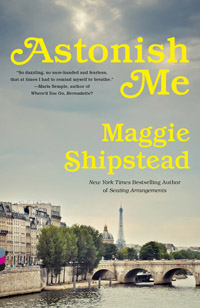
“Astonish Me” by Maggie Shipstead

astonish me- small

There’s something so enchanting about the world of the ballet. Perhaps it’s all the grit that lies beneath the pink tulle, the way that something that looks so graceful can require so much pain. And for those of us who do not have the physical fortitude to dance our way into that world, Maggie Shipstead’s novel Astonish Me is as good a substitute as any. Upon completing the novel, I felt as though I were resurfacing from a world in which I actually knew how a ballet company works and what a pas de deux might be. It’s almost a disappointment to come back to reality, where dashing male ballet dancers are not daringly defecting from the Soviet Union.

And perhaps it’s that part of the plot that will captivate you at first, but Shipstead introduces subplots in the novel that leave the reader pondering some of the uneasy complications of life. For one, the protagonist, Joan, gave up her life for ballet only to find out that she would never be good enough for the real spotlight. Finding out that even at what we might do best, our passions, we do not measure up is a bitter pill to swallow and often many people’s biggest fears. To see it manifest itself here is fascinating, as Joan gives up her life and her one-sided love affair with a man who really does command the spotlight for a suburban life that doesn’t seem to quite fit her. This, too, touches on the common fear of “settling” that plagues many people. Furthermore, Joan’s husband seems increasingly uncertain about his position in her life, offering yet another perspective on human relationships—the uncertainty of a partner’s love. And as Joan’s neighbor watches her wiry body glide about as she performs her routine ballet stretches in the backyard of her suburban, Southern Californian home, we get a glimpse of the very-human envy of a middle aged woman feeling unattractive and insecure as she compares herself to a female peer. This is what gives Shipstead’s novel its unique charm, its extra layer that allows it to linger in the memory of its readers long after the books has been safely deposited back on the shelf. Because many of us may know nothing of the world of ballet, but the human emotions and relationships in the novel are universal.

Shipstead is an Iowa Writers’ Workshop graduate who wields her pen with obvious skill. She does not embellish where unnecessary but her writing is not sparse either. It is rich enough to hold a reader’s attention and sustain their delight. In that respect, she is reminiscent of the minimalist darling, Raymond Carver. By the time the last page is turned, you feel as though you have been taken on an exhausting emotional journey, one that has given you a distinct understanding of the characters she has created. Rarely do pen-and-ink people come so alive, and sustain emotions so real and so bittersweet as in Astonish Me.

To put this book down is a challenge, unless if only for a moment, to look up tickets to the next ballet.

Astonish Me
Author: Maggie Shipstead
Publisher: Vintage
Publication Date: April 2014

Reviewer: Sarisha Kurup is a senior at The Harker School in San Jose, CA.

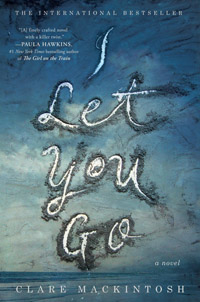
“I Let You Go” by Clare Mackintosh

I let you go-small

I had never heard of this book before seeing it while browsing through the “New” books display at my local library. What prompted me to pick this up and not put it back was a quote on the cover by Paula Hawkins, the author of the best-selling, The Girl on the Train, which was a book that I had loved. I Let You Go seemed to be in the same “crime fiction” genre as The Girl on the Train and Gillian Flynn’s Gone Girl, another book that I had loved (but which was somewhat ruined for me after the movie version), and what seemed to give it instant credibility was the fact that the author had spent twelve years on the police force in England. Also, the book jacket blurb promised a “twist” — another aspect common to both Gone Girl and The Girl on the Train — which is irresistible to die-hard fans of crime thrillers like me and accounts for the enduring popularity of Agatha Christie novels and detectives like Sherlock Homes.

The hallmark of a good crime novel is that it is almost impossible to put down once you start reading it, and from that perspective, I Let You Go definitely makes the cut. The “crime” at the center of the book is a hit-and-run car accident that kills a small boy, and the book focuses primarily on its aftermath, both on the people involved in it as well as the detectives investigating it. It is well written, fast-paced, and keeps you engaged right up to the end. While the promised plot “twist” was a bit too convoluted and the story was eventually resolved a bit too neatly in my opinion, it was still a thrilling and enjoyable read. At times, you just want to be entertained with a good “whodunit” mystery and while Agatha Christie was the master of this genre, she’s not around anymore and it’s great to have books like this coming from other talented writers.

While I found I Let You Go a good thriller that was definitely worth reading, I doubt I would be interested in re-reading it again at some point. It’s the kind of book that captivates you the first time, but once the suspense is over and you know how it ends, it’s done. It’s not the kind of book you re-read to enjoy the way it’s written and how it was cleverly crafted to keep you guessing. So while I bought copies of The Girl on the Train and Gone Girl to have in my collection after reading them (along with Gillian Flynn’s earlier Dark Places — and don’t even get me started on the Cormoran Strike novels by Robert Galbraith, aka J.K. Rowling!), I don’t see myself wanting to re-read I Let You Go. I was glad to have read it, but I have no regrets about returned my borrowed copy back to the library for someone else to enjoy.

I Let You Go
Author: Clare Mackintosh
Publisher: Berkley
Publication Date: May 2016

Reviewer: Lachmi Khemlani runs a technology publication in the San Francisco Bay Area.
“The Expatriates” by Janice Lee

TheExpatriates-small

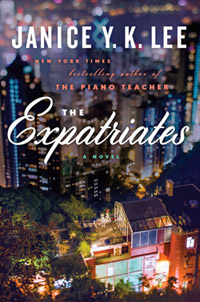
I first heard about this book in a recent NPR Fresh Air interview with the author, Janice lee. The plot of the book – a story about a group of expatriates in Hong Kong – seemed interesting, and the author spoke well. The Expatriates is her second book, the first one being The Piano Teacher, which I had not heard of prior to the Fresh Air interview. I borrowed a copy of The Piano Teacher from the library right away, but when I started reading it, it didn’t grip my attention, and I didn’t persist with it. Thus, when my copy of The Expatriates that I had put on hold in the library finally arrived (it took a bit longer as it was a new book), I didn’t think I would like it very much, based on my experience with Lee’s earlier book.

But I was wrong. I found The Expatriates a very well written and engrossing story about three women, all of whom are expatriates in Hong Kong, and whose lives intersect in ways I did not anticipate at all. There is a major tragic event at the core of the story, and although it doesn’t get resolved – which in itself is extremely unusual for a book – the end of the story is still surprisingly uplifting … and totally unexpected. Along the way, the book does an excellent job of capturing the milieu, the minutiae – the feel – of what it is like to live as an expatriate in Hong Kong and how it is different from life in the US, where all the three main protagonists emigrate from. I imagine much of the authenticity of the book comes from the author’s own experience with both Hong Kong – where she was born and raised – and the US – where she was educated and lived as an adult.

Overall, I found The Expatriates a very well-written book that tells a compelling story about both loss and redemption, but without the sentimentality that often goes with these themes. It wasn’t too highbrow for me to enjoy, but at the same time, it was far from a casual flick.

The Expatriates
Author: Janice Y.K. Lee
Publisher: Viking
Publication Date: January 2016

Reviewer: Lachmi Khemlani runs a technology publication in the San Francisco Bay Area.