“Yuganta: The End of an Epoch” by Irawati Karve (translated from Marathi by the author)

Yuganta

I read M T Vasudevan Nair’s “Bhima -Lone Warrior” (Malayalam original ‘Randamoozham’) and Kavita Kane’s “Karna’s Wife: The Outcast’s Queen” before I read Karve’s “Yuganta”. None of these would make sense unless you’ve read the Mahabharata. This great epic which comes to us in simple Sanskrit verse tells the story of a family feud that ends in an 18 day battle at Kurukshetra. It is generally believed that this happened around 1000 B.C.

“Yuganta” reads like a collection of essays rather than a novel and the author brings her own unique perspectives and interpretation to the characters and events. When she speaks of Draupadi, Kunti , Gandhari, Krishna and Karna, she paints different shades of their complex personalities. “The Mahabharata,” she says, “is a record of human beings with human weaknesses.” She attempts to explain the deification of Krishna and points out that the Krishna of the Mahabharata is an ordinary mortal with only rare flashes of divinity (that could be attributed to later additions in the text). Krishna is killed by a hunter’s arrow and the Yadava clan is wiped out in violent internecine quarrels. The author suggests that the few miracles in the Mahabharata could be later additions.

One can learn a lot about the Mahabharata from the Introduction to this book, e.g. the names of the 18 divisions in the critical text together with the number of couplets in each. There are stories within stories and the thread of the main storyline is taken up after several digressions. The author notes that the Arabian Nights follows this model of narration. Karve is highly critical of Bhishma. She points out that he is more of a match-maker than a warrior. He never fought any major battle. However, he abducted the three princesses of Kashi in order to marry them to his half-brother Vichitravirya. Amba committed suicide by self-immolation, while Ambika and Ambalika were forcibly married to Vichitravirya. Later Gandhari was brought from a faraway land to marry the blind Dhritarashtra. Pandu was afflicted by vitiligo (or so I believed) but Karve describes him as an albino.

She goes on to say without mincing words, “Kunti, stout and no longer young, and the lovely Madri were married to the impotent Pandu.” She notes that Bhishma paid an enormous bride price to acquire Madri. Dhritarashta, Pandu, and the Pandavas (Karna included) were all conceived by the ‘niyoga’ method, involving the use of a substitute male stud in order to produce heirs. Pandu retired to the forests of the Himalayas with his two queens in the prime of his youth for no apparent reason. That is how Dhritarashtra became king.

Karve suggests that Pandu’s motive was to hide his impotence and obtain heirs by resorting to ‘niyoga’. Karve says of the Pandavas that they “were more concerned with getting a share of the kingdom and in keeping peace than in revenging the insults to their wife.” She emphasizes their pitiful request for five villages, which was turned down by Duryodhana. She notes that “Draupadi’s wrongs were avenged only by Bhima,” as it was he who killed Keechaka and later Dushasana. Dhritarashtra says to his wife after the war has ended, “We Kuru men have done great injustices to women. And we have paid in full for them too. In Amba’s wrath Bhishma was burned. I am still burning in yours. My children too have been destroyed in it. Kunti was also married to a deficient man…” He continues, “You feel, Gandhari, that you have been cheated and deceived, but think for a moment: in the three generations of our family every person has been cheated and deceived.”

The author triggers many speculations citing ‘circumstantial evidence’. Is Yudhishthira really the son of Vidura? “When they were planning to call gods to father the children, it is very curious that the first god Kunti called was Yamadharma, the god of death,” Karve observes. She also raises some key questions. Did Krishna and Arjuna burn the Khandava forest in order to acquire more land for cultivation? Why was this made out to be a valorous feat? “Did Krishna and Arjuna feel that they had to kill every creature in order to establish unchallenged ownership over the land?” The Nagas were slaughtered in the process. Were they humans? An event that occurred during the Pandavas’ exile would be of interest to environmentalists: The Pandavas were constantly hunting because they had a large retinue to feed. One night, a stag appeared to Dharmaraja in a dream and said, “King, you are killing so many of us that we are on the way to extinction. Go into some other forest; give us respite. When we are multiplied enough you may come back.”

Karve calls attention to some interesting facts that may have eluded the casual reader. For instance, the Mahabharata makes no reference to writing. It appears that the Brahmins and Kshatriyas of the Mahabharata never did any writing, for messages were communicated through live messengers. The author reminds us that Indraprastha and Hastinapura have vanished from history but fails to mention that Kurukshetra and Dwaraka remain to this day.

Overall Assessment: Good read.

Yuganta: The End of an Epoch
AUTHOR: Irawati Karve
PUBLISHER: Orient BlackSwan
YEAR OF PUBLICATION: 1991 (Original version published in 1969)

Contributor: Pushpa Kurup lives in Trivandrum, India and works in the IT sector.

“Sweetbitter” by Stephanie Danler

Sweetbitter

I have often thought that with the advent of Modernism in Literature, readers have grown impatient with the long, lush descriptions of old, instead preferring the clipped sentences of Hemingway and the dryness of Camus. Not that these are not valid and important styles of writing, but there’s something beautifully nostalgic about writing that pays homage to the world around us, that values imagery and description just as much as plot. Stephanie Danler’s willingness to include both in her new novel Sweetbitter is what makes the book stand apart.

The novel follows a young woman who moves away from an unspecified part of America for New York City to work at a famous restaurant. It is clear that this other place does not matter, because the most important character in the novel is New York City. Like so many works of fiction before it, Sweetbitter examines the dreamscape that is New York City for many people. But unlike the trope of, “New York City is gritty and not the dream you believe it to be,” or the Sex and the City trope of, “In New York City all your dreams can come true,” Danler walks a more true-to-life line, revealing the city to be, as the title implies, sweet and bitter at the same time. Our main character revels in a city that shelters so many kinds of people, that changes dramatically from season to season, but she also finds the city to be cold and terribly lonely at times, a city that sometimes needs alcohol and a few hits of cocaine to look beautiful. To read Danler’s prose is to experience the city from your armchair. Danler’s lush descriptions of the restaurant—of oysters and red wines and cheese—of the seasons of the city—the thickness of summer, the freshness of autumn—and of people, are transformative.

It’s a novel in which the characters are undeniably secondary to the description. The characters are thinly drawn, an unfortunate weakness for a writer who writes so beautifully. Other than the protagonist, who becomes familiar only because readers spend so much time in her head, everyone else seems to inhabit some kind of cliché—tortured bartender; knowledgeable, well-traveled older woman; manager who sleeps with his female employees; edgy, cocaine-toting lesbian. When the protagonist eventually gives up on her relationships with these people, I did not have enough emotional investment in them to care much about it.

It is impossible for me to dislike Sweetbitter. As a writer myself, it is often a breath of fresh air to read an author who so unabashedly worships the written word. Reading Sweetbitter is undeniably a literary feast. Occasionally throughout the book, Danler eschews narration and just gives readers lines and lines of dialogue from various people in the restaurant, and the result reads more like poetry than prose.

Certainly with some more attention to character, Danler would be unstoppable.

Sweetbitter
Author: Stephanie Danler
Publisher: Alfred A. Knopf
Publication Date: May 2016

Reviewer: Sarisha Kurup is a senior at The Harker School in San Jose, CA.

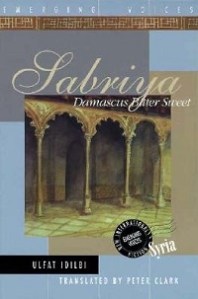
“Sabriya: Damascus Bitter Sweet” by Ulfat Idlibi – Translated from the Arabic by Peter Clark

“She was like a hand grenade with the safety pin removed.” That, in essence, is Ulfat Idlibi for you! Explosive! Born in Damascus in 1912, she grew up amidst the French occupation and the accompanying violence. She went on to become Syria’s most acclaimed woman writer and died in Paris in 2007 at the age of 94.

No one can read this novel and remain unmoved. It describes life in Syria between the World Wars, underlining the pathos of the human condition, outlining the mute longing of young couples who rarely get to meet, describing clandestine love affairs and surreptitious messages passed through unsuspecting conduits, and bemoaning the emptiness clouding the lives of young women caught up in the deadly tentacles of a patriarchal society.

The story begins with a woman’s suicide. Barely forty days after her father’s death, Sabriya hangs herself from a lemon tree in the courtyard of her parental home. She had tended to the old man for ten long years after he had suffered a paralytic stroke. Her mother had died earlier. Her brother Sami and her lover Adil had chosen the path of insurgency and died heroic deaths. Sabriya is unmarried and her two surviving brothers, Raghib and Mahmud, are planning to sell the family home, when her suicide comes as a bolt from the blue. Sabriya’s young niece, Salma, discovers her diary in her room, and she is the narrator of this incredible story.

Idlibi’s language is an exquisite blend of poetry and prose, embellished with liberal doses of simile and metaphor. “She was still hanging from the lemon tree, like a black flag at half-mast, protesting loudly at oppression and injustice.” Who else could have described a gruesome corpse with such literary finesse? Sabriya’s private thoughts and her conversations with the many characters in the novel have unmistakeable feminist and nationalist overtones. Here are some samples:

  • In our country they train a girl, as soon as she is aware of herself, to serve the men, be it brother, husband or son. So when she has grown up she feels that such servitude is part of nature.
  • May Allah pardon you Sami, when you told me that my steadfastness was also part of the struggle and that I should have the courage of those who are fighting. Brother dear, this silent struggle is hard, very hard. It is unsung. It is heroism without the glory.
  • “Sometimes I almost explode with anger at you, Mother. A woman of your age, old enough to be a grandmother, having to seek permission from her husband whenever she wants to leave the house!”
  • “What cowards we are,” I observed to Mahmud. “Our county is being burnt and destroyed and we are like rats who have slunk into their holes.”
  • Why is it that the people of my country demand freedom and at the same time cannot grant it to each other? Half the nation was shackled in chains created by men. That is a wrong we refuse to acknowledge.
  • “Did you read in the papers about the battle raging between those for the removal of the veil and those who want to retain it?”
  • If the French left we would have Hitler or Mussolini here.

Umm Abdu, one of the stoic women in the story, utters some prophetic words, “What does the revolt, what do politics mean to us? It will be all the same to us whether it is the French or a national government that rules us. Or whether we are ruled by blue monkeys.” Adil’s words to Sabriya echo the same sentiment: “When we have achieved our independence we shall embark on battle among ourselves fiercer than the one we are waging with the imperialists.”

When we behold Syria’s tragedy today we can’t help but wonder whether the author had an eerie premonition.

Overall Assessment: Must read – especially if you are a woman.

SABRIYA: DAMASCUS BITTER SWEET
AUTHOR: ULFAT IDLIBI TRANSLATOR: PETER CLARK
PUBLISHER: INTERLINK BOOKS
YEAR OF PUBLICATION: 2003 (FIRST PUBLISHED IN 1980 IN ARABIC)

Contributor: Pushpa Kurup lives in Trivandrum, India and works in the IT sector.
“Defending Jacob” by William Landay

Defending Jacob

Of late, it has been difficult for me to find books that hold my interest. I regularly listen to the New York Times Book Review podcast and also subscribe to Bookmarks magazine, so I am up to date with which are the hottest books being published – what critics are saying about them, as well as their authors in the course of the many interviews they do as part of their book promotion tours. I borrow these books from the library with great enthusiasm, but very often, I just don’t find them interesting enough to stick with them beyond the first few chapters – they don’t hold my attention or make me care enough about the characters to make reading them a pleasure rather than a chore.

Therefore, I decided to take a break from “heavy-duty” reading and go back to that genre which, when well done, is impossible for me to put down – a good old-fashioned murder mystery. I grew up on hundreds of Enid Blyton mystery books as a kid in India and I subsequently graduated to Agatha Christie – my all-time favorite mystery writer — whose books I can still read again and again and enjoy them even when I know whodunit (“Who [has] done it?”). Along the way, I also discovered that I like courtroom dramas, a great example of which are books by Jodi Picoult (see my review of Small Great Things). This is why when I came across Defending Jacob, it seemed to me like a no-brainer to give it a try and end my long dry run of finding something to read that I could actually finish. I’m happy to say that it worked. I was riveted by the book and finished it in the course of a day.

Defending Jacob tells the story of a regular family that is suddenly thrown in turmoil when the son, Jacob, is charged with the murder of a boy, Ben, from the same school, who is found stabbed to death in the neighborhood park. Jacob is the only son of Andy, who is actually the Assistant DA (District Attorney) of the small town near Boston where the murder happens and is given charge of the case. It is a real shock to the community, which has been crime-free until now — all the kids go to the local school and most of the parents have known each other since their kids started school in kindergarten. Andy and his wife, Laurie, are well liked and highly respected members of this community, and they remain so even after the murdered boy is found until it turns out that their son, Jacob, may have done it. They are then, of course, immediately ostracized. To his parents, Jacob seems just like any other high school adolescent boy – sullen, introverted, and uncommunicative — and it’s impossible for them to tell if these are normal or the signs of a killer. Complicating the fact is that Andy is descended from a family with a history of violence, with at least three generations of men prior to him convicted of murder and his father still in prison because of it. Andy has successfully disassociated himself from this aspect of his family’s history – even Laurie does not know about it – but now the issue comes up when the case goes to court. Is there such a thing as a “murder gene,” and if so, has Jacob inherited it?

Andy is removed from the case as soon as Jacob comes under suspicion and the book tells the harrowing story of the family’s long ordeal in the days leading up to the trial and the trial itself. The story is extremely well told without resorting to melodrama or clichés, making it extremely believable. And of course, it is a mystery that leaves you guessing – did Jacob do it, or someone else, such as the convicted pedophile who was often in the park where Ben was murdered? The fact that Ben bullied Jacob and that Jacob owned a knife that he had bought earlier naturally throws suspicion on him, along with the discovery of a single fingerprint found on Ben’s jacket that matches Jacob. Then there is the whole online world that Jacob inhabits — all the Facebooks posts among the school kids some of which openly accuse him of the murder, and the “cutter porn” chat rooms (focused on violence and torture) that he frequents and occasionally even contributes to. All of these are pretty incriminating, but are they sufficient for the jury to pronounce Jacob guilty without a reasonable doubt?

There is the proverbial twist at the end of this book, as with many books of this genre, but it is not something related to this crime itself – in fact, it is so believable that you do not feel for a minute that you have been cheated or that some information was withheld from you deliberately to throw you off the track. It ends on a solid conclusion rather than a shaky one, unexpected for sure, but not at all contrived. All in all, it was a very good read.

Defending Jacob
Author: William Landay
Publisher: Bantam
Publication Date: September 2013

Contributor: Lachmi Khemlani runs a technology publication in the San Francisco Bay Area.

“The Refugees” by Viet Thanh Nguyen

The Refugees

I really wanted to like this book. I had heard a lot about it in literary circles, as it was the new book by Viet Thanh Nguyen, a Vietnamese American novelist who had won the esteemed Pulitzer Prize for Fiction last year for his debut novel, The Sympathizer. The author was a recent visitor to a talk show that I happened to watch (Late Night with Seth Meyers), and I was very impressed—I found him intelligent, articulate, and extremely down-to-earth. Also, the subject of the book—refugees—seems particularly relevant these days, and even though the ones in this book are those who fled Vietnam after the Vietnam War in the 70s and 80s, they are refugees nevertheless. And while this book is a collection of short stories as opposed to a novel which I usually prefer, I have occasionally come across other collections of short stories that I have really enjoyed— the best example being Jhumpa Lahiri’s Interpreter of Maladies (which coincidentally also won the Pulitzer Prize for Fiction when it was published). I hadn’t read any book by a Vietnamese author before, so I was really open and receptive to this one. Thus, I had so many reasons to be predisposed towards liking this book—how could I not?

However, liking the book did not turn out to be as straightforward as I had anticipated. While I really appreciated Nguyen’s writing style—sparse, unpretentious, and eminently accessible—I did not find this collection of stories—there are eight of them—all that interesting, or even particularly insightful in better understanding the psyche of Vietnamese Americans who had fled their country and settled in the US. The horrors of that long-drawn out brutal war are not really captured except in one story, where a sister is visited by her brother’s ghost who died while trying to save her from soldiers on the boat their family was fleeing in. An oblique reference to the many land-mines that are still all over the country appears in another story in which an American military man, who was part of the air force that fought in the Vietnam War, visits it many years later with his wife to visit his daughter and her Vietnamese boyfriend. However, the focus of that story is really about the father-daughter relationship rather than Vietnam as such.

I also found that many of the stories ended very abruptly. For example, in a story called “The Other Man,” a young Vietnamese refugee, Liem, comes to live with a gay couple in San Francisco, is attracted to one of them, and ends up sleeping with him when the other unsuspecting partner has to go out of town for a few days. And the story pretty much just ends there, with Liem reading a letter from his family that he has just received and exchanging a glance with a stranger he sees with another man from his window. In another story, “The Transplant,” an American man, Arthur, gets fooled into storing fake merchandise in his garage for a Vietnamese American man, Louis Vu, who pretends to be the son of an unknown donor of the life-saving liver transplant that Arthur has recently received. The story just ends with Arthur finding out that Louis Vu had lied to him, and that’s it. The merchandise is still in Arthur’s garage, and we don’t know what happens to it or to Arthur. Several of the other stories had similarly inconclusive endings. It seemed as though the story could have well gone on, but the author just decided to pull the plug on it and move on. While I certainly wasn’t expecting a resolution to every story—that would be extremely unrealistic, given how messy life usually is—it would be nice to at least have some semblance of an ending. Otherwise, what’s the point? Why bother telling a story? Why bother reading one?

Of course, I am aware that very often, having a “non-ending” is often a stylistic choice by the author, which may be greatly appreciated by other readers, similar to how movies such as Terrence Malick’s The Tree of Life can be vilified by some and widely acclaimed by others at the same time. (I must admit to being one of the former.) However, even if I were to accept that I am one of those who just didn’t “get” the stories in The Refugees, I was disappointed to find that I was not able to really relate to them either, in the manner in which someone of Vietnamese descent might be able to identify with the characters and situations. I find this a real pity as it goes against our notion of universality — commonality of thought and feeling — as human beings. I do not know if the fact that I could not identify with much of the book is a problem with me or a failing of the book.

What I do know, however, is that I would like to give Viet Thanh Nguyen another try as an author, as I really respect him and like his writing style. I will go ahead and put his Pulitzer Prize-winning novel, The Sympathizer, on my reading list. Maybe I’ll have better luck with it.

The Refugees
Author: Viet Thanh Nguyen
Publisher: Grove Press
Publication Date: February 2017

Contributor: Lachmi Khemlani runs a technology publication in the San Francisco Bay Area.

“Karna’s Wife: The Outcast’s Queen” by Kavita Kane

Karna's Wife

If you haven’t read the Mahabharata, there’s no point in reading this one. Kavita Kane tells the story of the Mahabharata from a unique vantage point, that of Princess Uruvi, the only child of the King of Pokeya, who falls in love with Karna, the eldest Pandava, and marries him in the face of stiff opposition. With Karna’s birth being kept a secret by his mother, Kunti, the glorious son of the sun god, born with the golden kavach (armour) and kundals (ear-pieces) is condemned to be called a ‘sutaputra’ as he was raised by a humble charioteer.

The book has elements of a Mills & Boon romance with long conversations, imaginary sequences, and not-so-subtle appeals to the readers’ sentiments. Those who are sentimentally inclined will find the tears flowing. If you know your epics well, there is nothing that shocks, no new revelations, just another perspective. The book does not elevate Karna to another level, it merely evokes sympathy for his losses. The language is exquisite but delightfully Indian.

Many of the famous taunts that add spice to the Mahabharata have been repeated in this book. Draupadi insults Karna, Karna insults Draupadi, Karna insults Dronacharya and so on. However, the book has many original insights that are the unique inputs of the author herself. Here’s an example: ‘I almost feel sorry for Duryodhana,’ rued Uruvi as she sat with her husband in a rare moment of peace. ‘No one seems to be unconditionally on his side; he seems to be surrounded by half-hearted, disinclined warriors. Guru Dronacharya has already said he will only capture, not kill the Pandavas, while King Salya is the maternal uncle of Nakul and Sahadeva and an ardent Pandava supporter who has reluctantly joined the Kaurava side. Bhishma Pitamaha declares that he shall not kill the Pandavas!’

You have Kunti speaking about the practice of ‘niyoga’ wherein a woman conceives a child from another man with her husband’s consent. You are reminded that Satyavati (the Queen Mother) persuaded her illegitimate son Vyasa to perform niyoga on her daughters in law Ambika and Ambalika in order to produce Dhritrashtra, Pandu and Vidura for the continuance of the Kuru dynasty when her son Vichitravirya died without leaving an heir.

The book highlights many of the injustices perpetrated against women in the interest of the ruling classes of the day. In an imaginary conversation between Uruvi and Bhishma, the former says, ‘….you kidnapped the three Kashi princesses, Amba, Ambika and Ambalika, for your brother King Vichitravirya. They were forced to marry him. Were you not responsible for the suicide of Amba, who eventually killed herself because they man she was in love with refused to marry her, fearing the wrath of the great Bhishma? Kings were so petrified of you that you easily bought over their princesses and forced them to marry Kuru princes. You did it with Madri for King Pandu and with Gandhari for King Dhritrashtra.’

Karan’s first wife Vrushali, the mother of his many sons, comes across as a drab and stoic character. One can’t help feeling sorry for the devoted consort who loses her husband’s affections to the charming princess who abruptly comes in the way.

The chapters could have been given more interesting titles. ‘Indraprastha’, ‘Draupadi’, ‘Krishna and Karna, ‘Bhishma and Karna’, ‘Kunti and Uruvi’, ‘Uruvi and Bhanumati’ are hardly inspiring. On the whole the book has the characteristics of a Hindi television serial – it is slow moving, with several dramatic scenes, unnecessary repetitive dialogues, tear-jerkers, and strong emotional content. The shocks are minimal because we already know the story.

Overall Assessment: Not very enlightening.

Karna’s Wife: The Outcast’s Queen
AUTHOR: Kavita Kane
PUBLISHER: Rupa Publications
YEAR OF PUBLICATION: 2013

Contributor: Pushpa Kurup lives in Trivandrum, India and works in the IT sector.

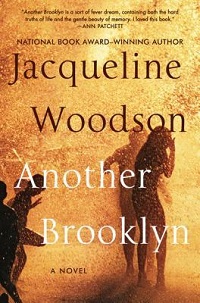
“Another Brooklyn” by Jacqueline Woodson

Another Brooklyn

There were several reasons that prompted me to pick up Another Brooklyn in the New Books section of my local library. To start with, its author, Jacqueline Woodson, had won the National Book Award in 2014 for her critically acclaimed memoir, Brown Girl Dreaming. Also, the title of the book reminded me of the classic 1943 novel, A Tree Grows in Brooklyn, which I had read several years ago, and which is still often quoted whenever Brooklyn is being discussed. Then there is also the fact that I recently visited Brooklyn—and walked on the famous Brooklyn Bridge—so I feel a visceral connection to the place.

And finally, Brooklyn is now one of the main cities in the U.S. going through a rapid gentrification process with enormous increases in the housing prices and apartment rentals, pricing out the traditional African-Americans who have lived there for generations. Another Brooklyn captures a time before all this happened, when Brooklyn was still very much a place dominated by black people, and it provides a fascinating glimpse into what it was like. In fact, the book is primarily set in the 1970s, when white people were fleeing from Brooklyn because of the influx of black people. The irony would be funny if it weren’t so tragic.

Anyway, getting back to the book, Another Brooklyn is the coming-of-age story of four girls growing up in Brooklyn, how they become inseparable friends, how they grow up from being kids to adolescents, and how they eventually drift apart and go their own separate ways as adults. August, the protagonist, is one of the four girls—she has recently moved to Brooklyn from Tennessee with her father and brother, following the tragic death of her mother (which she refuses to acknowledge for several years until she goes to meet a therapist at the insistence of her father). As she is adjusting to her new surroundings, Angela sees the clique of the other three—Sylvia, Angela, and Gigi—and desperately wants to be a part of it. This happens quite soon, without much fanfare, and the story then goes on to explore different issues through the interactions of the four friends with each other, their families, and the others around them.

What really impressed me about this book was that the issues that are explored through the lens of the four friends are issues that are common to any race and culture—the changes that adolescence brings in girls and in how others react to them, the growing interest in and from boys, going out on dates, the pressure from boyfriends to “go all the way,” the repercussions of resistance, the betrayals by close friends, teen pregnancies, parental expectations and failing to meet them, and the large part that luck plays in becoming successful even if you are very talented. There are no “black” issues as such, and from that perspective, the book is not at all stereotypical. About the only time race comes into play is when the parents of one of the girls, who is half-Chinese and half-black, disapprove of her friends and think that she can do better. (Not that this stops her.)

There are also none of the usual story lines you would expect. Soon after their arrival in Brooklyn, August’s father gets inducted into the Nation of Islam and eventually her brother also starts following Islam. Yet, there is nothing that shows the religion as being harmful or hurtful in any way. The father is not abusive, neither is the brother. They were poor, but always had enough to eat and were able to help those worse off than them. August is an academically good student, focuses on AP exams and SATs in high school, eventually goes to an Ivy League school, and becomes an anthropologist as an adult, travelling the world to study about death and dying in different cultures. (She returns to Brooklyn when her father dies and a chance glimpse of one of her friends on the subway brings back memories of her childhood to her.)

In addition to not being about race or racism at all, what also distinguishes Another Brooklyn is its lack of drama. This are no big defining moments when things change, no life-changing events, no plot twists and turns. This makes it more true to how life is for most people. The writing is also every poetic, making the term “understated eloquence” a very apt description of the book. I really liked it—not only was it beautifully written and different from other books I have read, it gave me a first-person glimpse into a life and culture I didn’t know much about.

Another Brooklyn
Author: Jacqueline Woodson
Publisher: Amistad (HarperCollins)
Publication Date: August 2016

Contributor: Lachmi Khemlani runs a technology publication in the San Francisco Bay Area.

“The Sense of an Ending” by Julian Barnes

The Sense of an Ending

This book by Julian Barnes won the Man Booker Prize in 2011. However, I hadn’t heard of this book or this author before, up until a few weeks ago when I read, following a recommendation, another book by Barnes, Levels of Life, in which he writes poignantly about grief following the sudden death of his wife of 30 years. Not only did I find it deeply moving, it was also extremely well written, with a grace and fluency that pointed to years of experience with writing. I did some research on Barnes and found that he is indeed an established writer with a career spanning over three decades with over 25 books. While three of his earlier novels had been shortlisted for the Booker prize, he finally won it in 2011 for The Sense of an Ending. Even more intriguingly, I found that this book has now been made into a movie—which has just been released—and that it is directed by an Indian director, Ritesh Batra, who made his directorial debut with the highly acclaimed movie, The Lunchbox. That moved The Sense of an Ending immediately to the top of my reading list, as I wanted to read it well before I saw—if I decided to—the movie.

The Sense of an Ending tells the story of a middle-aged man, Anthony, who has been living a relatively uneventful life so far—he is divorced but still has an amicable relationship with his ex-wife, he has a grown-up daughter who is married, he is retired but keeps himself occupied with some volunteer activities—when suddenly, his world is shaken up by “ghosts from the past.” Not literally—this is not a ghost story—but figuratively. It happens in the form of a mysterious legacy; the mother of his ex-girlfriend, Veronica, leaves him a small amount of money, but more importantly, the diary of his close childhood friend, Adrian, who committed suicide as a young man. Throughout his youth, Anthony always looked up to Adrian as someone who was a lot more intelligent, sophisticated, erudite, and well-read than him and his other two friends in their group of four, and Adrian’s suicide seemed to be, on the surface, a calculated high-minded move inspired by Albert Camus who famously said that suicide was the only true philosophical question. Adrian’s diary would give Anthony a better insight into his friend’s state of mind and possible shed some light on his decision to kill himself, and Anthony would really like to have it—it was left to him, after all.

But Adrian’s diary has fallen into the possession of Veronica, who was not only his ex-girlfriend, but who subsequently started going out with Adrian, and who, as far as Anthony knows, was still with Adrian when he killed himself. Anthony’s relationship with Veronica, when they were together, was complicated, and the fact that she took up with Adrian soon after they had broken up had upset Anthony so much that he had sent them an acrimonious letter, full of vitriol, at that time. Therefore, it is not altogether surprising that Veronica refuses to give him Adrian’s diary, despite the fact that Anthony is very ashamed of having written and send that letter all those years ago, and apologizes for it repeatedly when they now meet.

So how does it end? Is there a resolution, the “sense of an ending” as the title implies? Of course, I cannot give it away except to say that there was an ending, although it was extremely unexpected. From that perspective, the book is suspenseful and builds up the drama, making it hard to put down until you know what happens. It is also a relatively short book, and therefore you don’t have to wait too long to find out how it ends. The writing is masterful—concise and precise but without feeling rushed, taking the time to dwell on the main events in the story but not wasting time and words on things that don’t contribute to it.

That said, I did find the ending of the book too abrupt and a little too mysterious, to the extent that I actually had to do some online research to clarify what exactly had happened. There is eventually a revelation which provides the “sense of an ending,” but it leads to several unanswered questions and was therefore not very satisfying. Thus, while Julian Barnes’ talent as a writer is beyond question and I found The Sense of an Ending a good read, I would hesitate to give it my whole-hearted seal of approval.

The Sense of an Ending
Author: Julian Barnes
Publisher: Alfred A. Knopf
Publication Date: October 2011

Contributor: Lachmi Khemlani runs a technology publication in the San Francisco Bay Area.


“Selection Day” by Aravind Adiga

selection-day

Selection Day is the new book by Aravind Adiga, who hit a jackpot in 2008 with his debut novel, The White Tiger, which won one of the most prestigious and highly coveted literary awards, the Man Booker Prize, that year. I recall reading The White Tiger when it came out, and while I found it a decent read, I didn’t think it was that spectacular as to win the Booker prize. At the same time, I don’t always find award-winning books as good as they are heralded to be by the critics who are largely responsible for determining which books win awards, and this is something I have come to accept. So it was primarily out of curiosity – and the recommendation of a friend – that I picked up a copy of Selection Day, which has just been published.

Selection Day is unabashedly about cricket, and it tells the story of two brothers who are being groomed by their father to be cricket superstars and make it to the Indian cricket team. The “selection day” of the book’s title refers to that crucial day when tryouts are held among 18-year old cricket aspirants to determine who will make it to the next level – starting with the regional level which is the starting point for anyone aspiring to make it to the state level, and finally, the national level. The protagonist of the story is the younger of the two brothers, Manjunath. For most of their childhood, he was always considered to be second-best to his older brother, Radha Krishna, and it’s something his brother, his father, and he as well take for granted. Things change when he suddenly becomes a better player than his brother, which leads to sibling rivalry, jealousy, and even deep disappointment for his father.

In addition to the cricket obsession that Manju’s father has which has dominated their lives, other aspect of Manju’s personality that gradually become evident, and which the book is focused on, is his possible homosexuality – through his friendship with and growing attraction to Javed, one of his brother’s peers who used to play cricket with them. Javed is like the typical “bad boy” – the rich kid – in contrast to the simple and poor, almost uncouth, Manju. But, of course, this doesn’t eventually work out – that would have been too simplistic. Manju starts going out with girls, but remains a closeted homosexual. While Radha loses his cricketing prowess at about the same time Manju starts shining and makes it through the “selection,” this loss of luster eventually happens to Manju as well and he is replaced in the hearts and minds of the cricketing-obsessed public with a new cricketing “prodigy,” reinforcing the fact that fame and glory are fleeting, ephemeral.

The story in Selection Day, as I have captured it here, seems pretty straightforward, and it could have been the basis for a really good book. But I found Adiga’s telling of this tale so contrived, so difficult to follow, that I have to rate it as one of the worst books I have ever read, or rather, as one of the worst books I have actually finished—most of time, if I don’t find a book engaging after the first few chapters, I don’t bother continuing to read it. In the case of Selection Day, I stuck it out till the end as it had been recommended by a friend and I wanted to give it a shot. I even went back and re-read The White Tiger, hoping it would give me a better perspective on Adiga’s writing. But it didn’t. Adiga’s writing seems to have become much more convoluted since that debut novel, with characters so weird and behaving so strangely that they are hard to relate to, and the liberal use of profanity throughout the book.

That the book is so much about cricket was not a problem for me, as I was as much into the game growing up in India as the rest of that cricket-obsessed nation. It was the entire rest of the book that I couldn’t get.

Selection Day
Author: Aravind Adiga
Publisher: Scribner
Publication Date: January 2017

Contributor: Lachmi Khemlani runs a technology publication in the San Francisco Bay Area.

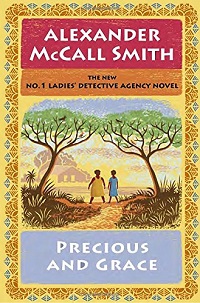
“Precious and Grace” (Book 17 of the No. 1 Ladies Detective Agency Series) by Alexander McCall Smith

precious-and-grace

A new book in the No. 1 Ladies Detective Agency Series is always an unbridled treat for me. I love the books and have all of them, and unlike the Harry Potter series which I also love, these are still coming! Set in Botswana and narrated by a female protagonist—the indomitable Mma Ramotswe, who is the proprietor of the No. 1 Ladies Detective Agency—the books capture the feel of Africa and the skin of the character so completely, that it’s hard to believe that they are written by a Scottish man. Alexander McCall Smith was born in Africa in what is now known as Zimbabwe, so he is certainly familiar with the place, but still, it takes exceptional talent to be able to immerse the reader in the character and the setting so completely.

Each book in the series—the first of which was published in 2003—has one or two main cases and a few side cases. Unlike typical detective stories that are usually fast-paced and action-packed, the focus in these books is more on the people and their lives, their relationships with each other, and the sights and sounds of Botswana. The stories unfold at a very leisurely pace, and in most of them, there is no “mystery” as such to be solved, but instead, “problems” to be resolved.

In Precious and Grace, the main case is that of a young Canadian woman who was born and spent her early childhood in Botswana, and after many years of living in Canada and a failed relationship, has come to Botswana to rediscover and reconnect with her roots. She approaches the agency to help with this, and by the end of the book, Mma Ramotswe does manage to dig out her past, including where she grew up and the nanny who looked after her. However, it turns that rediscovering the past is not as fulfilling as she had hoped. In the course of this main investigation, Mma Ramotswe also helps Mr. Polopetsi, an occasional assistant at the agency, to get out of a pyramid scheme he has unwittingly been tricked into. There’s also a stray dog that Fanwell, a junior mechanic at the garage next door, rescued that has become very attached to him—there’s the issue of what to do with him. This many not be a “case” in a traditional detective book, but it is very much in line with the human issues that Mma Ramotswe concerns herself with.

Precious and Grace has the usual cast of lovable characters who have been there since the first book: Mma (Precious) Ramotswe, who set up the agency—which is the only ladies detective agency in Botswana—and lives by a “how-to” book by an American detective, from which she quotes liberally; Mma (Grace) Makutski, her prickly assistant, who has kept promoting herself until she is now the co-director of the agency; Mr. J.L.B. Matekoni, Mma Ramotswe’s husband and the owner of the garage next door, who knows cars inside out and probably dreams of engines in his sleep; Charlie, a former apprentice in the garage who is now working in the detective agency, and hasn’t gotten very far in life as he is mostly thinking of girls; Fanwell, who, as mentioned earlier, works in the garage under Mr. J.L.B. Matekoni, and is a little more serious about life than Charlie; and Mma Potokwane, a close friend of Mma Ramotswe who runs an orphan farm and who is famous for serving the best fruit cake to which Mma Ramotswe always helps herself liberally whenever she visits her to talk about her cases and life in general.

Although Precious and Grace is the 17th book in the series, the quality has not flagged a bit, and it is every bit as enjoyable and entertaining as the first book. And this is true of all the books in the series. Not only do they capture the essence of Botswana so completely that you feel you are living and breathing it, but they are also among the most delightfully funny books I have read, with so many laugh-out-loud moments which I can’t but help reading out to those around me. And the humor is always intelligent, always good-natured, and never crass. For instance, in response to a government official (whom Mma Ramotswe has approached for some information) who complains about the many injustices of being a junior staff member, Mma Ramotswe sympathizes with him and then thinks that this would never happen to Mma Makutski. “If you were Mma Makutski, you simply promoted yourself regularly until you ended up as junior co-director, of whatever her current position was— Mma Ramotswe had rather lost track of Mma Makutski stellar ascent.”

The book is sprinkled with such witticisms throughout. Another constant source of humor is the fact that Mma Ramotswe is “traditionally built” and sees this as a source of pride rather than shame. She has no compunction about indulging in food—whether it is stew, or fat cakes (similar to our doughnuts), or the delicious fruit cake that Mma Potokwane (who is also traditionally built) always seems to have on hand at the orphan farm. Also, when it comes to hiring a new housemother for the orphan farm, of all the qualified applicants, Mma Potokwane makes the final selection in favor of the woman who is traditionally built, because she feels that “the most traditionally built lady would be the happiest, and would therefore make the children happy—they would love her and she would have the most acreage, so to say, for them to climb on, and her lap would be big enough for many children to sit on at the same time.” That’s the most compelling justification of being plump that I’ve ever heard of!

It’s a testament to how enjoyable all the books in No. 1 Ladies Detective Agency Series are that I’m always sad to reach the end—I wish they would last forever. It’s not a feeling adults have much of anymore, and I am in awe of a writer who can still make us feel this way.

Precious and Grace (Book 17 of the No. 1 Ladies Detective Agency Series
Author: Alexander McCall Smith
Publisher: Pantheon
Publication Date: October 2016

Contributor: Lachmi Khemlani runs a technology publication in the San Francisco Bay Area.


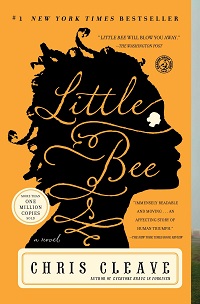
“Little Bee” by Chris Cleave

little-bee

Little Bee is a highly acclaimed novel that was published several years ago in 2008, but which I came upon only recently. Going through a dry spell lately with books that are able to engage and sustain my interest, I started Little Bee without much hope and was pleasantly surprised to find that it held my attention throughout, and was, in fact, difficult to put down, especially towards the end. The story is extremely compelling and is told in a simple clear-cut manner without any literary flourishes or pretensions. This is exactly the kind of book I like – where the focus is entirely on the story and the writing is simply a means to tell it rather than an end in itself.

And oh, the author is British, and perhaps I am biased, having grown up with mostly British authors in India, but I feel an easier and more immediate affinity with British authors than with American ones. Many of the books that I have really liked (and written about here) in recent months have been from British authors such as Paula Hawkins (The Girl on the Train), Clare Mackintosh (I Let You Go), and Fiona Barton (The Widow), not to mention long-standing favorites such as J.K. Rowling and Agatha Christie. I was not surprised to learn that the author of Little Bee, Chris Cleave, had won the Somerset Maugham book award in 2006, given that Somerset Maugham is one of my favorite authors and I love all his books (including The Razor’s Edge, which I recently re-read).

Getting back to Little Bee, the titular character of the novel is a Nigerian refugee girl who escaped from extreme brutality in her country and travelled to London as a stowaway on a cargo ship, was caught and held at a detention center for two years, and then one day is suddenly let out (with a group of other girls, one of whom has bribed a detention officer to let them go). Even though Little Bee — which is the name she takes on after escaping Nigeria — is no longer imprisoned in the center, she is still an illegal immigrant and therefore not free. Not knowing where to go or what to do, she ends up contacting the only people in England that she knows—Sarah and Andrew, a couple that she met on a beach in Nigeria on that fateful day when she and her sister were trying to escape from the men hunting them down. (The turmoil and killings in Nigeria at that time, in the mid to late 2000s, were related to the oil reserves that had just been discovered there and which were being seized by “the oil men,” who got local thugs to eliminate entire villages where the oil was located by killing all the locals en masse.) Little Bee and her sister appeal to Sarah and Andrew to save them from the men, but eventually, only Little Bee is let go, thanks to a spontaneous, courageous act by Sarah — she hacks off one of her fingers in response to the men’s demand that Andrew give them one of his fingers in exchange for the sisters’ lives. Andrew cannot do this, and the men retaliate by assaulting and killing Little Bee’s sister.

This momentary weakness, all the more stark in contrast to his wife’s courage, continues to haunt Andrew and causes further strain in his relationship with Sarah. When contacted by Little Bee two years later after she is set free from the detention center, the past catches up with him and he commits suicide, leaving Sarah to fend for their four year old boy on her own. Then there’s the arrival of Little Bee, whom Sarah takes in. It brings back for her all the horrific memories of that fateful day at the Nigerian beach, yet at the same time, she finds comfort in her presence, not to mention the fact that Little Bee is very good with Sarah’s son. So what ultimately happens with these two women? Is Little Bee found by the authorities and deported back to Nigeria? Or does she continue to stay with Sarah? Is Sarah able to come to terms with Andrew’s suicide, her guilt at the extramarital affair she has been having, and her feelings of inadequacy and helplessness at not being able to help Little Bee beyond saving her life just that one time? What about all those people whom she was not able to help? What about Little Bee’s sister, who was so brutally assaulted and killed shortly after their encounter at that beach? Can Sarah do something now, or will she continue to be haunted, just like Andrew was?

While I don’t want to give away the ending, I have to say that the book had a very satisfying conclusion – very realistic and believable without being overtly mushy or unbearably depressing. In addition to just telling a story, it makes a very strong statement about refugees, political asylum, detention centers, the contrast between the first world and developing countries, and what even ordinary individuals like us can do. In the current world scenario with the growing refugee crisis, I found the book remarkably prescient. It manages to be tragic and uplifting at the same time, which is quite an achievement.

Little Bee
Author: Chris Cleave
Publisher and Date: Originally published as The Other Hand by Sceptre in August 2008; Reprint edition published by Simon & Schuster in February 2010

Contributor: Lachmi Khemlani runs a technology publication in the San Francisco Bay Area.

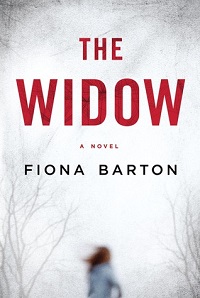
“The Widow” by Fiona Barton

the-widow

Contrary to what you would expect this book to be from its title – a tragedy or at least a drama – The Widow is actually a crime thriller. And a really good one at that – I couldn’t put it down until I had got to the end, to the “bottom of the mystery,” as they would say in our much-beloved Five Find-Outers mystery series by Enid Blyton that we grew up with in India.

Set in England, The Widow is a debut novel by Fiona Barton, who, I wasn’t surprised to learn, is a journalist, given the fluency and quality of the writing. The “widow” in the story is Jean, whose husband has just died in an accident. But there’s an entire back story to their marriage that gradually unfolds in the course of the book. Her husband, Glen, turns out to be a pedophile who may have abducted a two year girl, Bella, from her house. It takes a lot of digging and investigation to hone in on Glen as the probable suspect. The detective in charge of the case is convinced that he is the man. But there is no conclusive proof, and even though Glen is charged and brought to trial, there is not enough evidence to convict him. In the meantime, Jean is obsessed with kids but for a different reason — Glen is infertile so she cannot have kids of her own. Did Glen kidnap Bella? And if so, was Jean complicit in the kidnapping? Did she want Bella to be her child? And was Glen’s death really accidental or did Jean actually cause it? We don’t really get to know the answers to these questions until the end of the book.

The book’s structure adds to the drama. The story unfold over a span of four years, starting from the time of Bella’s kidnapping to a few weeks after Glen’s death. Not only does it keep alternating between different times instead of being chronological – a fairly common literary device adopted in novels these days – it is also narrated from the points of view of a few key people: Jean, the widow; Bob, the detective who becomes very emotionally invested in the case; Dawn, Bella’s mother, who is single and has a few skeletons in the closet of her own; and finally, Kate, a reporter who is the only one able to get through to Jean, past the media circus plaguing her life for four years since Bella disappeared.

Most crime thrillers have almost an obligatory surprise twist towards the end — they lead you down a certain path almost intentionally and then knock you off the sails with a big reveal. And in the most successful books of this genre like Gone Girl, their sheer brilliance make you forget and forgive the fact that they practically cheated into believing something that wasn’t true. The Widow is not like that. There are no surprise plot twists thrown in like a curve ball; yet, it still has a very satisfying conclusion in which you are assured that justice has been done. It’s far from being the next Gone Girl or The Girl on the Train, but I found it a very well written, engrossing, and page turning thriller.

The Widow
Author: Fiona Barton
Publisher: Penguin
Publication Date: February 2016

Contributor: Lachmi Khemlani runs a technology publication in the San Francisco Bay Area.

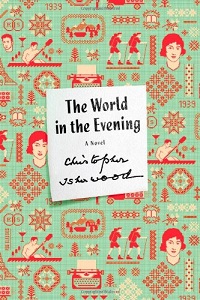
“The World in the Evening” by Christopher Isherwood

the-world-in-the-evening

I have always loved to read fiction, but I have been going through a drought lately when it comes to finding something to read that holds my attention and makes me care about the characters, that makes me lose myself in a book as I always did since I was a kid. Over the holidays, I tried reading several critically acclaimed books that had recently been published including the Booker-prize winning The Underground Railroad by Colson Whitehead, Swing Time by Zadie Smith, and Here I Am by Jonathan Safran Foer; but I found that I couldn’t care enough about the plot and the characters to stick with them beyond the first chapter. Then, on a trip to New York City, I visited its famous Strand bookstore where, in the course of browsing through the thousands of books it carries, I came across Christopher Isherwood’s The World in the Evening. I have been a fan of  Isherwood’s writing ever since I read his A Meeting by the River several years ago, which I still rate as one of the best books I have ever read. Isherwood was a contemporary of Aldous Huxley and Gerald Heard, and is best known for his The Berlin Stories book, which was adapted into the hit movie, Cabaret, starring Liza Minnelli, as well as for his book, A Single Man, which was also made into a movie starring Colin Firth. Thus, when I came across The World in the Evening, I picked it up immediately, hoping it would bring back some of the enjoyment of fiction that I have always had until now.

I found this true for The World in the Evening, for the most part. Set around the time of the Second World War, the book is centered around the experiences of a young man, Stephen, in his early thirties, including his first marriage when he was in his twenties to a woman who was twelve years older than him, his brief affair with a young man while he was still married to his first wife, and his second marriage (after his first wife dies) to a young, carefree, rather hedonistic woman, which ends disastrously after he finds out that she is having an affair and walks out on her. Most of the book is in the form of reminiscences he has when he is holed up in bed for several weeks after being hit by a truck when visiting his childhood home in rural Pennsylvania, where he comes after walking out on his second wife. He has extended conversations with the people looking after him, which include his adopted aunt who has been like a mother to him (his own died when he was very young); a war refugee from Germany his aunt has taken in, who is uncertain about the fate of her husband as a war captor; and his doctor, who is homosexual and lives with a man whom the conservative community they belong to is determined to view as just a “roommate.” In the course of his conversations with these people, his perusal of his first wife’s letters – she was a famous author – a collection of which he might publish, and the memories triggered by them, we come to know the details of his life, the ups and downs he has gone through, his own feelings about them, and what has motivated him to do what he has done.

What struck me most about this book was how self-introspective it was —Stephen lays bare all his bad behavior, his petty jealousies, his irrational rages, and his many contradictory feelings for us to see. Ultimately, he comes to perceive everything bad that has happened to him as his own fault, caused by how he thinks and acts rather than by bad things happening to him. It is refreshing to come across a story in which the protagonist realizes that it is their own attitude and behavior that is primarily responsible for the trials and tribulations they are experiencing in life. It is also how eventually Stephen is able to resolve his problems, put his demons to rest, and find some measure of peace and acceptance in his life. It seems to be an important lesson for all of us.

Also, given that the book was written in the early 50s, I was amazed by how frank it was about sex and sexuality, both straight and gay. The main character was, for all practical purposes, heterosexual but still has a homosexual fling, showing that the divide between homosexuals and heterosexuals may not as rigid as is commonly believed. In the present day, we would call Stephen’s character bisexual, but at the time the book was written, there was no such concept, and Stephen is not at all conflicted about his fling with a man, despite being clearly attracted to, and married to, women. In fact, the only guilt he feels is in the fact that he is cheating on his wife. The fact that it is with a man is almost inconsequential to him.

The World in the Evening is a great example of the kind of book I like —where the focus is simply on telling the story without resorting to linguistic tricks or stylistic cadences. There are no examples of “beautiful writing” to showcase here. It was a little long-winded at times and did not come anywhere close to the brilliance of A Meeting by the River, but it was eminently readable, engaging and held my attention throughout.

The World in the Evening
Author: Christopher Isherwood
Publication Date: First published 1954 by Methuen Publishing Ltd; Reprint edition published in November 2013 by Farrar, Straus and Giroux (FSG Classics)

Contributor: Lachmi Khemlani runs a technology publication in the San Francisco Bay Area.

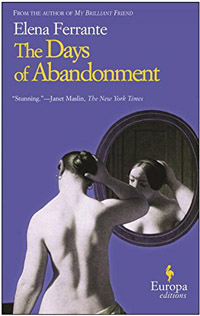
“The Days of Abandonment” by Elena Ferrante

the-days-of-abandonment

I wish I hadn’t read this book. It’s about how a woman goes to pieces slowly and painfully after being abandoned by her husband of fifteen years. The opening line sets the stage for what is to follow: One April afternoon, right after lunch, my husband announced that he wanted to leave me. He did it while we were cleaning the table, the children were quarrelling as usual in the next room….”

An all too familiar tale told in excruciating detail by a famous author who has preferred to remain incognito. Her Neapolitan novels are making waves, and that’s what prompted me to pick out this earlier work of hers (or is it ‘his’?). I must confess I’m sorely disappointed. The book begins with a whimper and ends with a whimper. I’m not without empathy for suffering women, but I prefer the strong ones who face life squarely. I can’t help thinking that J K Rowling is a single mother too and look at what she accomplished. I know it isn’t fair to compare, but it’s just that I hate sob stories, and this one really takes the cake.

The book is not without merit though. For women in similar situations, it might strike a familiar chord. A plethora of negative emotions, the sinking of the woman’s spirit into a deep, dark abyss of despair is vividly and convincingly portrayed. That’s why I wish I hadn’t read it.

The author is undoubtedly a master at portraying intense emotions. “After my marriage, I had quit and followed Marc through the world, wherever he was sent by his work as an engineer. New places, new life. And to keep under control the anxieties of change, I had, finally, taught myself to wait patiently until every emotion imploded and could come out in a tone of calm, my voice held back in my throat so that I would not make a spectacle of myself.”

Every sentence weighs heavy upon the heart. Sad, sad, sad – that’s all there is to it.

Overall assessment: Read only if you enjoy wallowing in pain.

The Days of Abandonment
Author: Elena Ferrante (translated from Italian by Ann Goldstein)
Publisher: Europa Editions
Publication Date: 2005 (first published in 2002 in Italy)

Contributor: Pushpa Kurup lives in Trivandrum, India and works in the IT sector.

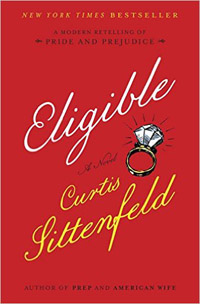
“Eligible: A Modern Retelling of Pride and Prejudice” by Curtis Sittenfeld

eligible

I absolutely loved Jane Austen’s Pride and Prejudice when I first read it as a teenager, and even now as an adult, having re-read it multiple times, I still rate it as the best—not “one of the best” but unequivocally “the best”—book I have read. This is why when I heard of the new book, Eligible, described as a contemporary take on the beloved Jane Austen classic, I was intrigued. The author, Curtis Sittenfeld, was a young, upcoming novelist who had already written a few books, was well respected, and generally considered as one of the promising literary stars of the new generation. While it is always difficult to appease die-hard fans of any book—I found the BBC mini-series of Pride and Prejudice a decent attempt but the recent Keira Knightley movie quite bad, even though it got good reviews—the promise of reliving my favorite Pride and Prejudice characters seemed too good to pass up on.

So I went ahead with reading Eligible. For the most part, I found it a fun and entertaining read. There is still the Bennet family with five unmarried sisters, who their mother, Mrs. Bennet, is desperately trying to find matches for. They live in Cincinnati, and while the three younger sisters still live at home, the older two, Jane and Elizabeth, live in New York where they have their own lives and careers. A sudden heart attack suffered by their father brings them back home for a visit, and this is how they get a chance to meet Mr. Bingley and Mr. Darcy, the eventual love interests of Jane and Elizabeth respectively. Both are doctors, so deemed as great “catches” by Mrs. Bennet, although Darcy soon falls out of favor by seeming to be snooty and obnoxious, as in the original. Bingley, on the other hand, is, in addition to being a doctor, a reality TV star, just coming off the sets of a Bachelor-type show called Eligible (which is where the name of the book comes from). Jane, meanwhile, is almost 40 and is trying to have a baby using artificial insemination through an anonymous sperm donor. Elizabeth, or Liz as she is called, is a fairly successful magazine writer who has been having an affair with a married man for many years and is not terribly happy with that relationship. Darcy, as in the original, is fabulously wealthy, exceptionally smart, and extremely handsome—he is a neurosurgeon, went to Stanford, has a Ph.D., and has a sprawling estate called “Pemberly” in Atherton, the priciest location in the already pricey Bay Area. In short, apart from his perceived arrogance and pride, he is perfection personified!

Rounding off the main characters from the original are Liz’s closest friend Charlotte, who gets paired off with Liz’s cousin Willie, a highly successful Silicon Valley entrepreneur, who was first interested in Liz and gets together with Charlotte only on the rebound; Lydia, the youngest Bennet sister, who elopes and gets married to a transgender man, Ham (short for Hamilton), who Mrs. Bennet does not accept at first but eventually comes around to thanks to some “neurological” talk from Darcy; Kitty, the second-youngest Bennet sister, who eventually joins a beauty school (thanks to Liz’s encouragement), and starts going out with a black man, which is another nail in the coffin for the biased Mrs. Bennet; Mary, the middle sister, who is as scholarly and uninteresting as in the original; Kathy de Bourgh, who is now a famous feminist celebrity that Liz interviews, rather than Darcy’s obnoxious aunt who want to stop him getting together with Liz; and finally, Bingley’s sister, Caroline Bingley, who continues to be the thorn on Liz’s side and wants Darcy for herself.

Admittedly, the plot line does sound ludicrous and die-hard fans of the book like me would likely cringe at this mutilation of their beloved characters. But surprisingly, Curtis Sittenfeld is able to pull it off for the most part, keeping in mind that Eligible is not meant to be a serious book but instead a fun and light-hearted take of the storyline of Pride and Prejudice set in current times. It is a fast-paced, easy read, with short chapters, some of which are no longer than a page or even a few paragraphs. The story moves on briskly, and some of the contemporary touches are quite witty, such as Kitty and Lydia being into CrossFit workouts and Paleo diets, the fumigation of the Bennet home because of an infestation of spiders, the over-shopping and hoarding tendency of Mrs. Bennet which requires Liz to eventually move all her stuff into a portable storage truck in order to sell the house, Jane’s artificial insemination through an anonymous sperm donor which actually results in her getting pregnant and having a baby, and the introduction of not just gay but also transgender characters into the storyline.

At the same time, some parts of the story just don’t work. For example, the whole reality TV aspect of the book is hard to take seriously—and it’s not just that Bingley recently came off from acting in a Bachelor-like show, he also returns for a sequel, and his eventual wedding to Jane, with family and friends, is included in the TV show, broadcast live on television! Then there is Mr. Darcy. While he was a terrific “catch” in Pride and Prejudice with his large estate and income, it was not at all unbelievable—it was quite common in the Victorian days for wealthy families to have large estates and for the scions of those families to be highly sought after for marriage. However, in Eligible, not only is Darcy impossibly wealthy (an estate in Atherton), but he is also the smartest person in the noblest profession (Stanford educated neurosurgeon), he is single (he has no time for girlfriends as he is so busy doing surgery on people’s brains), and of course, he is extremely good-looking! It’s hard to take a book seriously in which the “hero” is so perfect—in every possible way. Then there is the manner in which Liz and Darcy first get together—they have “hate sex” initiated by Liz. Whatever happened to good old-fashioned romance? Are people now so driven by hormones that the first thing they do at even the slightest hint of interest or attraction is sleep together, and are our contemporary books and movies simply capturing that?

For those of us who love our classics, we need to be prepared for the influx of modern retellings like Eligible as they are getting more common. (While Pride and Prejudice is a favorite, popular classics that are being “retold” in current or upcoming books are Romeo and Juliet, Wuthering Heights, The Taming of the Shrew, and Hamlet.) It would help to have the original books handy so they can “wash off” the experiences of these retellings, if required.  I have to go back and re-read Pride and Prejudice to let it works its magic and charm on me again.

Eligible: A Modern Retelling of Pride and Prejudice
Author: Curtis Sittenfeld
Publisher: Random House
Publication Date: April 2016

Contributor: Lachmi Khemlani runs a technology publication in the San Francisco Bay Area.